
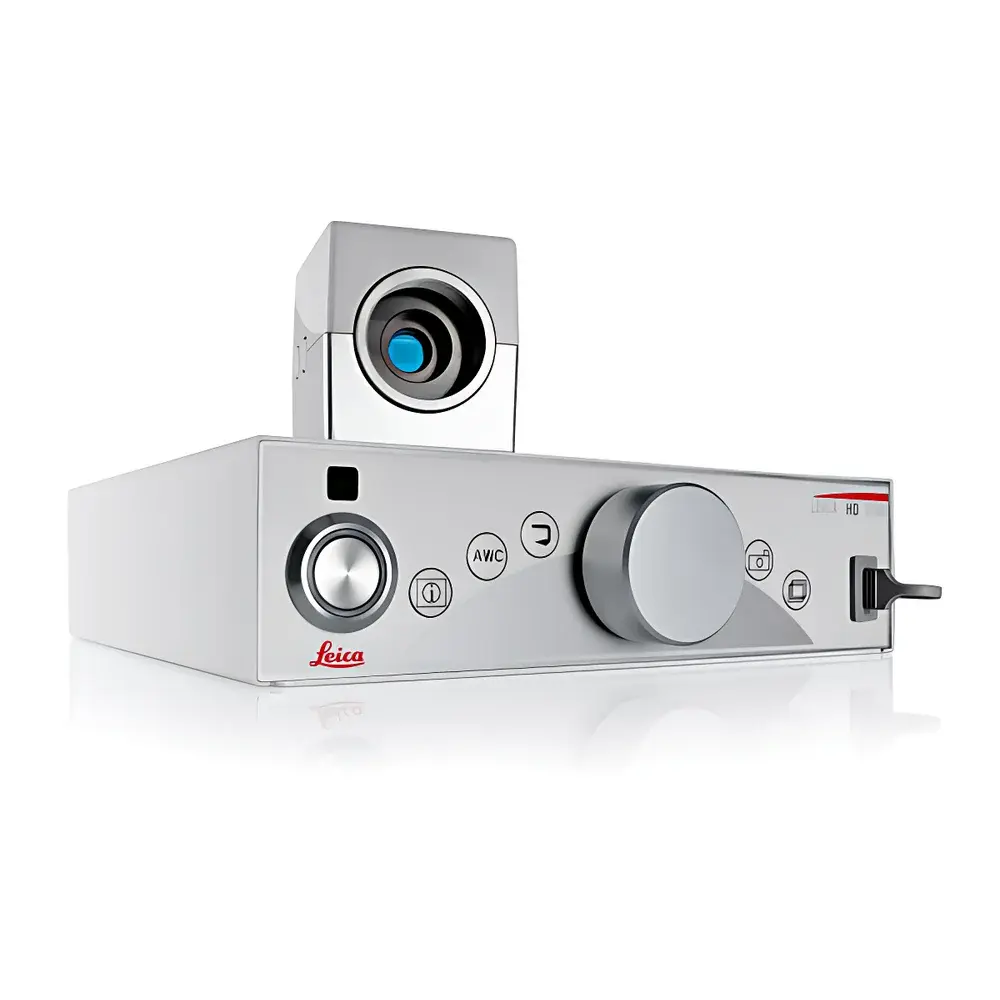
Leica HD C100 Medical Imaging Camera
| Brand | Leica |
|---|---|
| Origin | Germany |
| Model | HD C100 |
| Video Outputs | HDMI, 3G-SDI, HD-SDI, SD-SDI |
| Resolution Support | 1080p (1920×1080), 720p (1280×720), NTSC/PAL |
| Auto Exposure Control | Yes |
| Auto Iris & Shutter Compensation | Yes |
| Interface | Standard C-mount |
| Compliance | CE, IEC 60601-1, ISO 13485 |
Overview
The Leica HD C100 Medical Imaging Camera is a high-fidelity, clinical-grade digital imaging module engineered for integration into surgical microscopes, endoscopic towers, and intraoperative visualization systems. Designed and manufactured in Germany under stringent medical device quality standards, the HD C100 employs a progressive-scan CMOS sensor with global shutter architecture to deliver artifact-free, low-latency video capture essential for real-time surgical decision-making. Its optical interface conforms to industry-standard C-mount specifications, enabling seamless mechanical and optical coupling with Leica M-series and other OEM-compatible microscope bodies. Unlike consumer-grade imaging solutions, the HD C100 operates within the safety and performance framework defined by IEC 60601-1 (medical electrical equipment) and ISO 13485 (quality management for medical devices), ensuring electromagnetic compatibility, thermal stability, and long-term reliability in sterile, high-humidity OR environments.
Key Features
- Multi-format video output support: Simultaneous HDMI 1.4a and 3G-SDI (SMPTE 424M) outputs enable concurrent routing to primary surgical monitors and secondary recording or telestration systems without signal degradation.
- Dynamic exposure optimization: Integrated auto-iris and adaptive electronic shutter control respond within ≤120 ms to sudden changes in scene luminance—such as metallic instrument entry into the field of view—preventing overexposure while preserving shadow detail and tissue contrast.
- True 1080p60 native resolution capture: Sensor resolution of 1920 × 1080 pixels at full frame rate ensures pixel-level fidelity for neurosurgical microdissection, ophthalmic vitrectomy, and ENT procedures requiring sub-millimeter anatomical discrimination.
- Intuitive hardware-based UI: Dedicated tactile control buttons—located on the camera housing for glove-compatible operation—provide direct access to white balance, gamma, gain, and edge enhancement parameters without navigating nested software menus.
- Thermally stabilized housing: Aluminum alloy chassis with passive heat dissipation maintains internal temperature within ±1.5°C across 4–40°C ambient operating range, minimizing thermal drift in color calibration and sensor dark current.
Sample Compatibility & Compliance
The HD C100 is validated for use with Leica surgical microscopes (e.g., M530 OHX, PROve), rigid endoscopes (4 mm and 10 mm diameter), and laparoscopic light sources compliant with DIN EN 13273. It meets essential requirements for Class IIa medical devices under EU MDR 2017/745 and carries CE marking under Directive 2007/47/EC. Electromagnetic immunity complies with EN 60601-1-2:2015 (Level 3 for RF fields, Level 4 for ESD). All firmware revisions are traceable per ISO 13485:2016 clause 7.5.2, and device logs retain audit trails for exposure parameter changes—supporting GLP-compliant documentation in clinical trial settings.
Software & Data Management
While the HD C100 operates as a standalone video source with no embedded OS, it supports standardized UVC 1.5 and V4L2 protocols for plug-and-play integration with third-party surgical video management systems (e.g., Stryker Encore, Karl Storz Image1, ConMed Linx). Optional Leica Application Suite (LAS X) modules enable synchronized metadata tagging (timestamp, magnification, illumination intensity) via RS-232/RS-485 serial handshake. All configuration profiles—including custom LUTs for fluorescence overlay—are stored in non-volatile memory and survive power cycling. Firmware updates follow secure signed-package protocols compliant with FDA 21 CFR Part 11 Annex 11 requirements for electronic records integrity.
Applications
- Neurosurgery: Real-time cortical mapping during awake craniotomy with simultaneous HD feed to navigation workstations and intraoperative MRI displays.
- Ophthalmology: High-magnification vitreoretinal surgery where 1080p60 temporal resolution captures subtle membrane peeling dynamics without motion blur.
- ENT & Skull Base Surgery: Co-registration of endoscopic HD video with neuronavigation data using spatially calibrated C-mount alignment.
- Pathology & Education: Dual-output capability allows live streaming to teaching theaters (via SD-SDI) while archiving lossless 1080p60 sequences (via HDMI + external recorder) for case review and competency assessment.
FAQ
Is the HD C100 compatible with non-Leica microscope platforms?
Yes—provided the host system offers standard C-mount threading (1″–32 UNF) and supports 12 V DC power input with regulated current delivery ≥2.5 A.
Does the camera support RAW Bayer output for post-processing?
No—the HD C100 delivers processed YUV 4:2:2 video only; RAW output is not supported due to real-time processing constraints required for surgical latency compliance.
Can exposure parameters be locked during a procedure?
Yes—manual override mode disables auto-exposure algorithms and retains user-defined shutter speed, gain, and iris position until explicitly reset.
What is the maximum cable length for stable 3G-SDI transmission?
Up to 100 meters using Belden 1694A coaxial cable with proper termination and grounding per SMPTE RP 184.
Is firmware update capability available in the field?
Yes—updates are performed via USB-C connection using Leica-certified utility software; each release includes SHA-256 hash verification and rollback support.





