
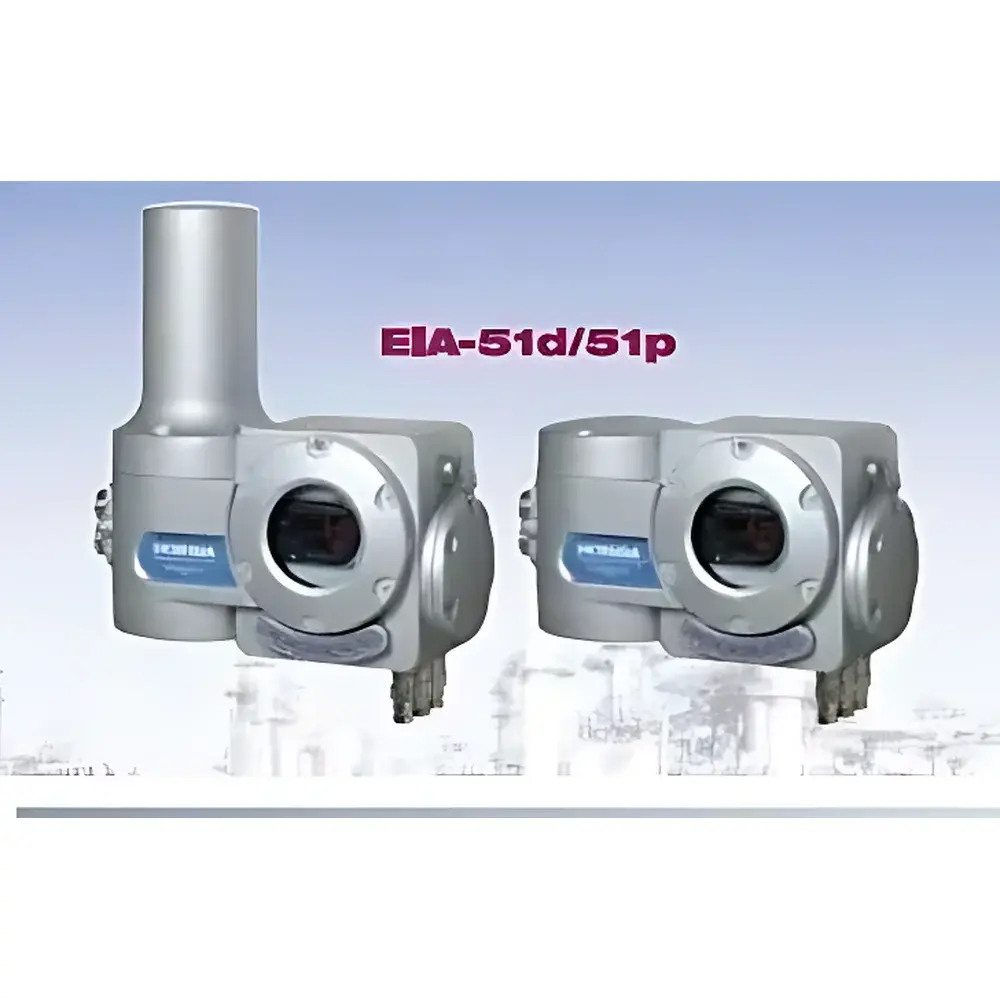
HORIBA EIA-51d / EIA-51p Explosion-Proof Infrared Gas Analyzer
| Brand | HORIBA |
|---|---|
| Origin | Japan |
| Model | EIA-51d / EIA-51p |
| Explosion Protection Type | Ex d IIB+H2 T4 (EIA-51d) / Ex p II T4X (EIA-51p) |
| Measurement Principle | Non-Dispersive Infrared (NDIR) with Interference Correction |
| Detectable Gases | CO, CO₂, CH₄ (configurable per application) |
| Range | 0–0.11 vol% to 0–100 vol% (gas-dependent) |
| Repeatability | ±0.5% F.S. (standard range) |
| Linearity | ±1.0% F.S. |
| Zero & Span Drift | ±2.0% F.S./week |
| Response Time (T90) | ≤20 s (standard), ≤40 s (optional extended range) |
| Sample Flow Rate | 500 mL/min |
| Sample Pressure | ≥1.98 kPa |
| Operating Ambient Temperature | –5 to 40 °C |
| Analog Output | Isolated 4–20 mA (DC), optional 0–10 V / 1–5 V |
| Communication Interface | RS-485 |
| Protocol | Modbus RTU |
| Baud Rates | 1200–19200 bps |
| Sample Contact Materials | SUS304, SUS316, FKM, CaF₂, Au |
| Calibration | Manual (standard), Auto (optional) |
Overview
The HORIBA EIA-51d and EIA-51p are certified explosion-proof infrared gas analyzers engineered for continuous, reliable measurement of combustible gases—including CO, CO₂, and CH₄—in hazardous areas classified under IEC 60079. Designed specifically for industrial process monitoring in petrochemical plants, refineries, chemical manufacturing facilities, and biogas upgrading units, these analyzers employ non-dispersive infrared (NDIR) spectroscopy with proprietary interference correction technology. Unlike conventional single-detector NDIR systems, the EIA-51 series integrates dual parallel detectors within a shared optical path: one dedicated to primary gas absorption measurement and the other to real-time compensation of spectral interference from co-existing gases (e.g., H₂O vapor, hydrocarbons), optical drift, and mechanical vibration. This architecture ensures stable baseline performance and minimizes calibration frequency—critical for unattended operation in Zone 1/Zone 2 environments where maintenance access is restricted or safety protocols limit intervention windows.
Key Features
- IEC-certified explosion protection: EIA-51d complies with Ex d IIB+H2 T4 (flameproof enclosure for Group IIB + hydrogen atmospheres); EIA-51p meets Ex p II T4X (pressurized enclosure for general industrial use).
- Interference-corrected NDIR optics: Simultaneous dual-channel detection mitigates cross-sensitivity from water vapor, background hydrocarbons, and optical aging—enabling high-fidelity quantification even in complex, variable-composition sample streams.
- Ruggedized sample interface: Wetted parts constructed from corrosion-resistant materials including SUS304/SUS316 stainless steel, fluorocarbon elastomer (FKM), calcium fluoride (CaF₂) windows, and gold-coated optical surfaces—ensuring long-term stability in aggressive flue or process gas matrices.
- Configurable analog output: Standard isolated 4–20 mA output with programmable alarm thresholds (–10% to +110% of span); optional voltage outputs (0–1 V, 0–5 V, 1–5 V, 0–10 V) support integration into legacy DCS and PLC architectures.
- Modbus RTU over RS-485: Enables remote configuration, real-time data polling, and diagnostic status reporting—facilitating compliance with asset management frameworks and predictive maintenance workflows.
- Low-maintenance design: Manual zero/span calibration standard; optional auto-calibration module supports scheduled reference gas injection without operator presence—reducing exposure risk during routine verification.
Sample Compatibility & Compliance
The EIA-51d/51p is validated for use with dry, dust-free sample gas containing ≤21% O₂ and free of condensable vapors or particulates. It operates at minimum inlet pressure of 1.98 kPa (absolute) and requires a stable sample flow of 500 mL/min. The analyzer is rated for ambient installation in indoor locations with temperature ranging from –5 °C to +40 °C (non-condensing, <90% RH), and must be mounted away from mechanical vibration sources exceeding 0.3 m/s² at 100 Hz. Conformance to IEC 60079-0 (general requirements), IEC 60079-1 (flameproof “d”), and IEC 60079-2 (pressurized “p”) ensures global acceptance in ATEX, UKEX, and NEC Class I Division 1/Zone 1 jurisdictions. While not intrinsically safe (Ex i), its certified protection methods provide equivalent operational safety for fixed-installation applications where zone classification permits flameproof or pressurized enclosures.
Software & Data Management
No embedded GUI or local software is provided; configuration and monitoring occur via external host systems using the open Modbus RTU protocol. All communication is serial (RS-485), supporting baud rates from 1200 to 19200 bps for compatibility with industrial field networks. Register mapping includes real-time concentration values, sensor health flags, calibration timestamps, and fault codes—enabling traceability required under GLP and GMP-aligned quality systems. Though not FDA 21 CFR Part 11 compliant out-of-the-box (lacking electronic signature and audit trail functionality), the device’s deterministic register structure allows integration with validated SCADA or MES platforms that implement full electronic record controls. Optional auto-calibration events are logged with time-stamped metadata, supporting ISO 17025-compliant uncertainty budgeting when paired with certified reference gases.
Applications
- Continuous emission monitoring (CEM) of CO and CO₂ in flare stacks and thermal oxidizers operating in hazardous zones.
- Biogas quality control in anaerobic digestion plants—measuring CH₄ concentration pre- and post-upgrading for grid injection compliance (e.g., EN 16723-1).
- Inert gas blanketing verification in solvent recovery units and reactor purge loops where oxygen depletion and hydrocarbon accumulation pose simultaneous explosion risks.
- Process safety interlock support in hydrogen production facilities (PEM electrolysis, steam methane reforming), leveraging the IIB+H2 certification for H₂-rich environments.
- Flue gas analysis in waste-to-energy boilers equipped with SNCR/SCR systems, where high moisture and particulate loading challenge conventional extractive analyzers.
FAQ
What explosion protection certifications does the EIA-51d hold?
The EIA-51d is certified Ex d IIB+H2 T4 per IEC 60079-1, permitting use in areas with explosive gas mixtures containing ethylene, propane, and hydrogen—up to a maximum surface temperature of 135 °C.
Can the EIA-51p operate in Zone 0 environments?
No—the EIA-51p is rated Ex p II T4X (pressurized enclosure), which applies to Zone 1/Zone 2 only. It is not suitable for continuous presence in Zone 0 (ignition-capable atmosphere under normal operation).
Is automatic calibration available as a factory-installed option?
Yes—auto-calibration is offered as an optional hardware module (gas valve manifold + solenoid drivers) with firmware support for timed reference gas injections; field retrofitting is not supported.
What sample conditioning is required upstream of the analyzer?
A dedicated sample probe, heated filter, and condensate trap are mandatory; HORIBA recommends pairing with a certified sample conditioning system meeting ISO 8573-1 Class 2 for particulate and Class 3 for moisture.
Does the analyzer support multi-gas measurement simultaneously?
Each EIA-51 unit is configured for a single target gas (CO, CO₂, or CH₄) at time of order; multi-component analysis requires separate analyzers or integration with a TIA-51 series (thermal conductivity variant) for O₂/H₂ in parallel configurations.







