
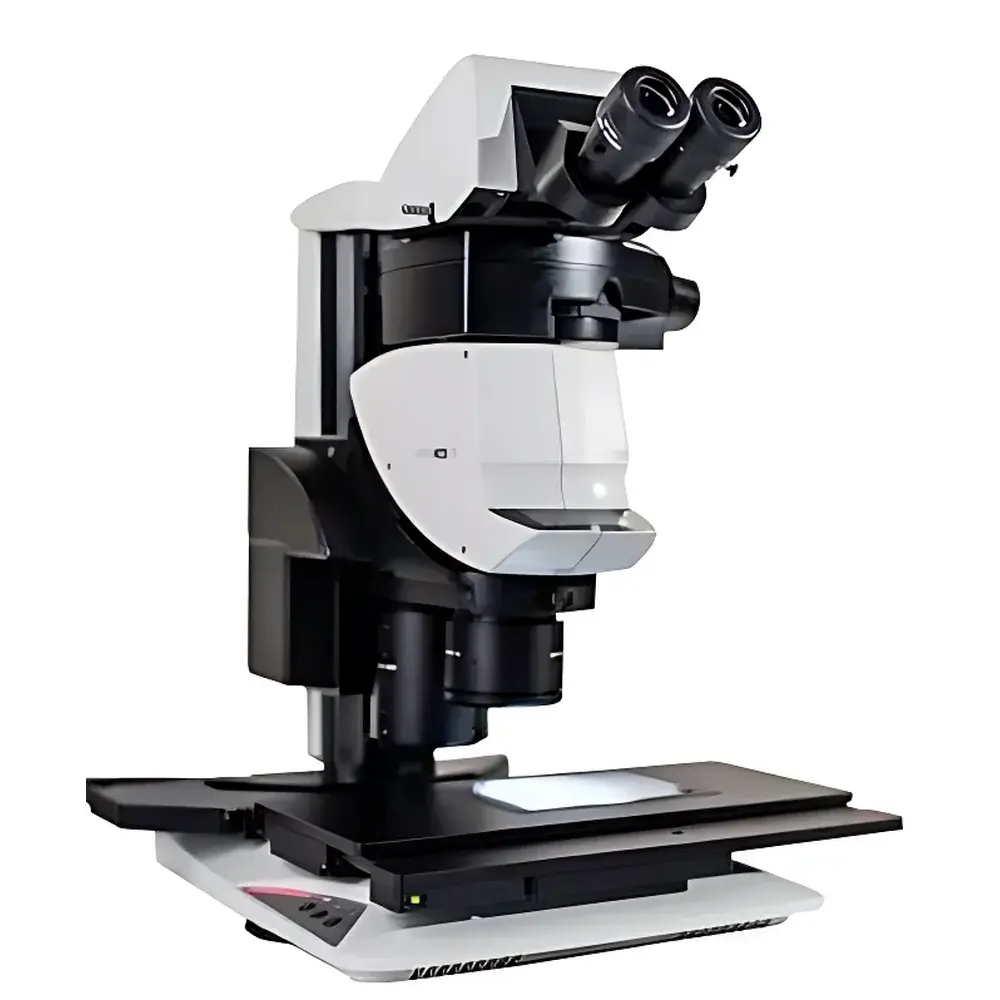
Leica LMT260 XY Scanning Stage for Stereo Microscopy
| Brand | Leica |
|---|---|
| Origin | Germany |
| Model | LMT260 XY |
| Positioning Repeatability | ≤0.25 µm (load < 0.5 kg), ≤1 µm (load ≤ 1.5 kg) |
| Resolution | 5 nm |
| Drive System | Dual Linear Motors |
| Position Feedback | Absolute Magnetic Encoder |
| Manual Override | Yes |
| Compatibility | Leica M-series and Z-series Stereo Microscopes, LAS X Software Suite |
Overview
The Leica LMT260 XY Scanning Stage is a high-precision, motorized translation platform engineered specifically for integration with Leica stereo microscopes—including the M-series (e.g., M205 A/F, M165 FC) and Z-series systems. It operates on the principle of closed-loop, absolute-position magnetic encoder feedback combined with dual independent linear motor actuation in orthogonal X and Y axes. This architecture eliminates reliance on homing routines or incremental referencing, enabling true absolute positioning from power-on—critical for time-lapse imaging, multi-well plate screening, and long-duration automated acquisition workflows. Designed for demanding optical metrology and life science applications, the stage delivers sub-micron positional fidelity under variable load conditions while maintaining mechanical stability and thermal drift compensation within typical laboratory environments (20–25 °C, <60% RH).
Key Features
- Dual linear motor drive system ensures rapid, silent, and backlash-free motion—achieving typical settling times of <30 ms per 100 µm step at full rated speed.
- Absolute magnetic encoder feedback provides real-time position verification without initialization; no reference mark or homing sequence required after power cycle or software restart.
- High-resolution positioning capability: 5 nm interpolation resolution over a standard travel range of 130 mm × 85 mm (custom ranges available upon request).
- Load-adaptive repeatability: ≤0.25 µm (RMS) for payloads up to 0.5 kg; ≤1.0 µm (RMS) at maximum rated load of 1.5 kg—validated per ISO 230-2 Annex B protocols.
- Integrated manual override via precision knurled knobs allows intuitive, tool-free repositioning without disengaging motors or interrupting software control.
- Optimized mechanical design minimizes parasitic tilt (<0.5 arcsec) and vertical deviation (<0.3 µm) across full travel—preserving focus plane integrity during tile-based acquisition.
Sample Compatibility & Compliance
The LMT260 is mechanically and electronically compatible with all Leica stereo microscope stands equipped with standardized stage mounting interfaces (e.g., M205 A/F base plates, Z16/Z20 adapter kits). It supports common sample carriers including glass slides, Petri dishes (up to 100 mm diameter), multi-well plates (6–96-well), and custom specimen holders with flat-bottomed, rigid bases. The stage conforms to IEC 61000-6-2 (immunity) and IEC 61000-6-4 (emission) electromagnetic compatibility standards. Its control electronics are CE-marked and compliant with RoHS 2011/65/EU. When operated under Leica LAS X software with audit trail enabled, the system supports GLP/GMP-aligned documentation requirements—including user access logs, parameter change history, and timestamped acquisition metadata—facilitating regulatory submissions under FDA 21 CFR Part 11 where electronic records are mandated.
Software & Data Management
Native integration is provided through Leica Application Suite (LAS) X v3.7+, supporting both “Multistep” and “TileScan” modules for automated multi-location imaging. The stage communicates via high-speed USB 2.0 or optional Ethernet interface using Leica’s proprietary LSC protocol, ensuring deterministic command latency (<2 ms). LAS X enables grid-based tiling with customizable overlap (0–20%), auto-focus synchronization per tile, and real-time stitching preview. Exported datasets retain embedded stage position metadata (X/Y/Z coordinates, timestamp, objective ID, illumination settings) in TIFF and OME-TIFF formats—ensuring FAIR data principles (Findable, Accessible, Interoperable, Reusable). Third-party control via Python (PyLeica SDK) or MATLAB is supported through documented COM/ActiveX APIs, enabling custom script-driven experimental automation.
Applications
- Time-lapse imaging of developmental biology specimens (e.g., zebrafish embryos, Drosophila larvae) across multiple spatial positions with synchronized focus tracking.
- High-throughput phenotypic screening in 96-well plates for neurobiology or toxicology assays requiring precise well-centering and repeatable field-of-view registration.
- Automated quality inspection of microfabricated components (e.g., MEMS devices, PCB solder joints) where micron-level coordinate reproducibility is essential for defect localization.
- Serial section alignment in correlative light-electron microscopy (CLEM) workflows, leveraging absolute stage coordinates to register optical images with subsequent EM acquisitions.
- Calibration validation of digital micrometer systems and interferometric measurement tools using traceable stage displacement as a reference standard.
FAQ
Does the LMT260 require periodic recalibration?
No. The absolute magnetic encoder system retains position information without battery backup and does not drift over time; calibration is factory-performed and remains valid throughout the product lifetime under normal operating conditions.
Can the stage be used with non-Leica microscopes?
Mechanical integration is possible with custom mounting adapters, but full software functionality (e.g., LAS X TileScan, autofocus sync) is only guaranteed with Leica stereo microscope systems and licensed LAS X installations.
What is the maximum recommended acceleration to preserve repeatability?
For optimal repeatability under 0.5 kg load, Leica specifies maximum acceleration of 0.5 g (4.9 m/s²); higher accelerations may be used for coarse positioning but reduce sub-100 nm stability margins.
Is vibration isolation required for nanometer-level resolution?
While the stage itself exhibits low intrinsic vibration susceptibility, achieving sustained 5 nm resolution requires passive or active vibration isolation appropriate for the host optical table—particularly when using objectives >1× magnification with depth-of-field <5 µm.
How is firmware updated?
Firmware updates are delivered via Leica Service Portal and installed through LAS X under administrator privileges; each update includes version-locked compatibility checks and automatic rollback capability.




