
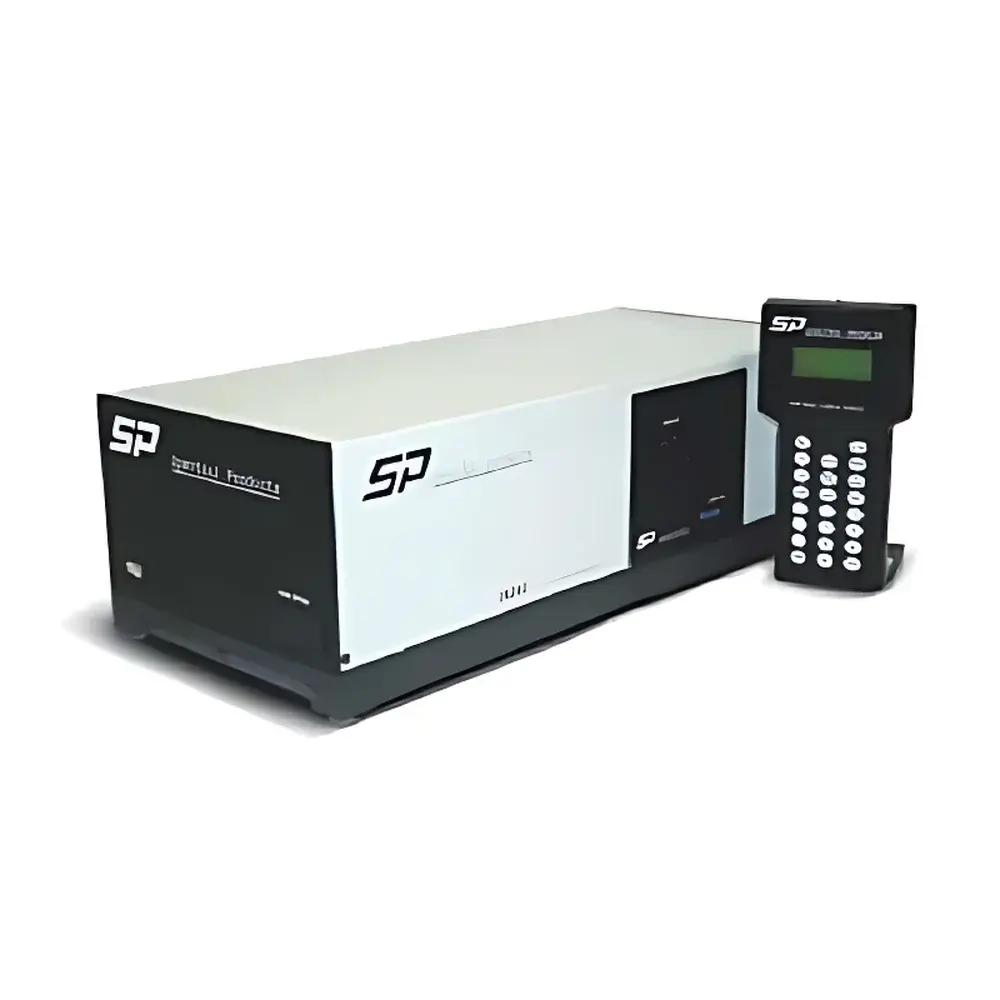
Spectral Products DK240 Mid-Infrared Spectrometer
| Brand | Spectral Products / SpectroSystem |
|---|---|
| Origin | USA |
| Manufacturer Type | Authorized Distributor |
| Import Status | Imported |
| Model | DK240 |
| Price Range | USD 4,200 – 14,100 |
| Spectral Range | 1.0–5.0 µm (configurable via detector & grating selection) |
| Detector Options | PbS (1.0–3.0 µm), PbSe (1.5–5.0 µm), InGaAs (0.9–2.5 µm) |
| Optical Resolution | 10–30 nm (slit- and grating-dependent) |
| f/# | 3.3–3.5 |
| Fiber Interface | SMA 905 or FC |
| Stray Light | < 0.1% (PbS/PbSe), < 0.01% (InGaAs) |
| Integration Time | 0.01 ms – 200 ms |
| Cooling | Thermoelectric (TEC) to –15°C (PbS/PbSe), –10°C (InGaAs) |
| A/D | 16-bit USB 2.0 interface |
| Software | SM32Pro & SM32Pro MX (Windows 32/64-bit, XP through Win10) |
| SDK | Included DLLs for C++, VB, LabVIEW |
Overview
The Spectral Products DK240 Mid-Infrared Spectrometer is a modular, research-grade dispersive spectrometer engineered for precise spectral acquisition in the mid-infrared (MIR) region—specifically from 1.0 µm to 5.0 µm—depending on detector configuration and optical grating selection. Unlike Fourier-transform infrared (FTIR) systems, the DK240 employs a Czerny-Turner optical architecture with fixed or exchangeable gratings and slit-defined entrance optics, delivering high optical throughput and wavelength stability under variable thermal and mechanical conditions. Its design prioritizes reproducibility in quantitative absorption, transmission, and reflectance measurements across industrial QA/QC labs, academic spectroscopy facilities, and process monitoring environments where real-time MIR fingerprinting of molecular vibrations (e.g., C–H, O–H, N–H, C=O stretching/bending modes) is required. The system operates as a standalone spectral engine or integrates into OEM platforms via its standardized USB 2.0 interface and comprehensive software development toolkit.
Key Features
- Modular detector compatibility: Interchangeable PbS (1.0–3.0 µm), PbSe (1.5–5.0 µm), and extended-range InGaAs (0.9–2.5 µm) arrays—each optimized for specific MIR sub-bands and signal-to-noise requirements.
- Thermoelectric cooling (TEC): Active temperature stabilization to –15°C (PbS/PbSe) or –10°C (InGaAs), reducing dark current drift and enabling stable long-integration acquisitions (>100 ms) without liquid nitrogen.
- Precision slit selection: Six standard slit widths (10, 25, 50, 100, 200, 400 µm) allow trade-offs between resolution and radiant throughput—critical for low-flux sources such as thermal emitters or attenuated fiber-coupled beams.
- Low-stray-light optical path: Optimized baffling and coating strategies achieve stray light suppression better than 0.1% for Pb-based detectors and <0.01% for InGaAs configurations—essential for accurate baseline correction in absorbance quantitation.
- Real-time triggering architecture: Supports free-run, external TTL edge-triggered acquisition, and synchronized multi-channel operation (up to eight spectrometers on one host), facilitating time-resolved kinetics or spatially resolved hyperspectral mapping.
- Scientific-grade data integrity: 16-bit digitization with RMS dark noise as low as 6 counts (InGaAs, 100 ms integration), enabling dynamic range >15,000:1 and robust detection of weak spectral features against broadband backgrounds.
Sample Compatibility & Compliance
The DK240 accommodates diverse sample geometries via direct free-space input (collimated beam) or fiber-coupled configurations using SMA 905 or FC connectors. It supports transmission cells (CaF₂, BaF₂, or ZnSe windows), reflection accessories (integrating spheres, specular reflectance stages), and gas-phase cuvettes compatible with standard IR pathlengths (1–10 cm). All optical components comply with ISO 17025 traceability guidelines for calibration reference materials, and spectral data generated with SM32Pro MX meets GLP/GMP documentation requirements—including audit-trail-enabled acquisition logs, user authentication, and metadata tagging per ASTM E1421 and USP . The instrument’s firmware and software architecture are designed to support 21 CFR Part 11 compliance when deployed with validated electronic signature workflows.
Software & Data Management
SM32Pro and SM32Pro MX serve as the primary acquisition and analysis environment, supporting Windows XP through Windows 10 (32- and 64-bit). Core capabilities include real-time spectral averaging, automatic dark/reference subtraction, multi-curve overlay, derivative spectroscopy, peak integration, and colorimetric analysis (CIE XYZ, L*a*b*). Both applications export ASCII, CSV, and binary formats compatible with MATLAB, Python (NumPy), and OriginLab. The included SDK provides documented C++ DLLs, Visual Basic type libraries, and LabVIEW VIs—enabling full control over integration time, trigger mode, pixel binning, and ROI selection within custom automation scripts. Data files embed EXIF-style metadata (wavelength calibration coefficients, slit width, grating ID, TEC setpoint, timestamp), ensuring traceability in regulated environments.
Applications
- Pharmaceutical solid-state characterization: Polymorph identification, hydrate/solvate analysis, and API-excipient interaction studies via MIR absorption band shifts (e.g., carbonyl region at 1650–1750 cm⁻¹).
- Petrochemical feedstock screening: Quantitative hydrocarbon group-type analysis (paraffins, naphthenes, aromatics) using C–H stretch and bend region deconvolution (2800–3000 cm⁻¹).
- Environmental gas sensing: Detection and concentration profiling of CO, CO₂, CH₄, NO, and NH₃ in stack emissions or ambient air using tunable diode laser-compatible spectral windows.
- Materials science: Thin-film thickness determination via interference fringe analysis in transmission mode; semiconductor dopant profiling using free-carrier absorption features.
- OEM integration: Embedded use in handheld analyzers, inline process monitors, and laboratory automation systems requiring compact, USB-powered MIR spectral engines with deterministic latency.
FAQ
What detector options are supported on the DK240 platform?
The DK240 accepts PbS (1.0–3.0 µm), PbSe (1.5–5.0 µm), and multiple InGaAs array variants (0.9–2.2 µm, 0.9–2.5 µm), each with distinct pixel counts, cooling specifications, and noise performance profiles.
Is calibration traceable to NIST standards?
Yes—factory calibration includes NIST-traceable tungsten-halogen and blackbody sources. Users may perform field recalibration using optional certified reference filters or gas cells (e.g., NIST SRM 2036 for water vapor lines).
Can the DK240 operate in vacuum or inert atmosphere environments?
The base spectrometer housing is not sealed for vacuum, but it may be mounted inside gloveboxes or purged enclosures using standard flange adapters; optical windows must be selected for MIR transmission (e.g., KBr, CsI).
Does the SDK support Linux or macOS development?
The official SDK targets Windows only; however, USB protocol documentation and raw binary packet structure are provided, enabling third-party Linux/macOS driver development via libusb.
What is the typical warm-up time to thermal equilibrium?
With active TEC engaged, the detector reaches stable operating temperature (< ±0.1°C fluctuation) within 8–12 minutes after power-on, verified by onboard thermistor telemetry in SM32Pro.






