
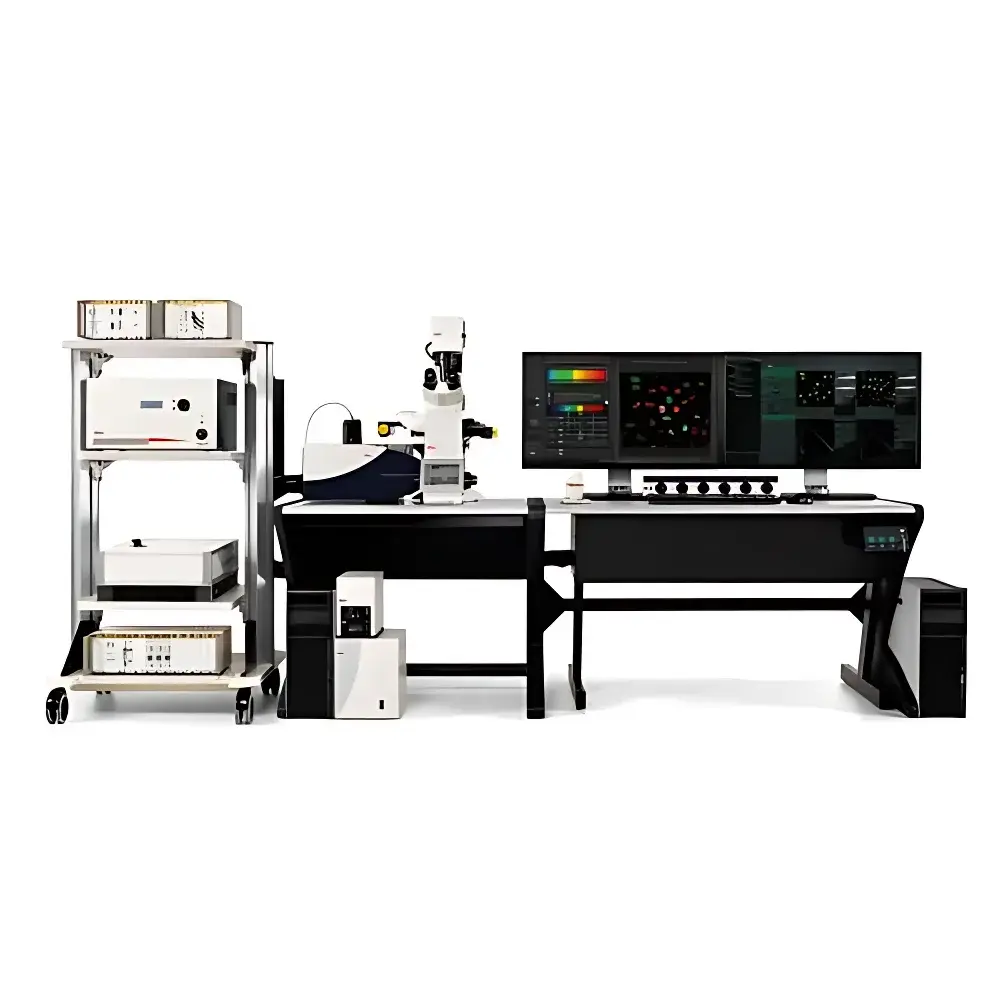
Leica TCS SP8 SMD Confocal Microscope
| Brand | Leica |
|---|---|
| Origin | Germany |
| Model | TCS SP8 SMD |
| Application Domain | Single-Molecule Detection (SMD), Fluorescence Correlation Spectroscopy (FCS), Fluorescence Cross-Correlation Spectroscopy (FCCS), Fluorescence Lifetime Imaging Microscopy (FLIM), Fluorescence Lifetime Correlation Spectroscopy (FLCS) |
| Integrated Hardware Platform | PicoQuant MD-series detection modules and timing electronics |
| Software Integration | PicoQuant SymPhoTime 64 (SMD-optimized edition) |
| Optical Architecture | Inverted confocal platform with tunable white-light laser (WLL), spectral detection (HyD detectors), and time-correlated single-photon counting (TCSPC) capability |
| Compliance | Designed for GLP/GMP-aligned workflows |
Overview
The Leica TCS SP8 SMD Confocal Microscope is a high-precision, inverted laser scanning platform engineered for quantitative single-molecule detection and advanced fluorescence fluctuation spectroscopy. Built upon Leica’s proven TCS SP8 optical architecture, this system integrates PicoQuant’s industry-standard MD-series time-resolved detection hardware and SymPhoTime 64 software—enabling rigorous, reproducible acquisition of photon arrival times, intensity trajectories, and spectral signatures at the single-molecule level. Its core measurement principle relies on time-correlated single-photon counting (TCSPC) coupled with spectral unmixing and spatial confocal gating, allowing simultaneous extraction of fluorescence lifetime, diffusion kinetics, molecular brightness, and stoichiometric interaction parameters from live or fixed biological specimens. The system is designed for laboratories requiring trace-level sensitivity, temporal resolution down to picosecond scales, and strict compliance with quantitative biophysical assay standards.
Key Features
- Full integration of Leica TCS SP8 optical engine with PicoQuant MD hardware: includes ultra-low-jitter avalanche photodiodes (APDs), high-throughput TCSPC electronics, and synchronized laser pulsing (40–80 MHz repetition rate).
- Spectral detection via Leica HyD hybrid detectors with continuous spectral dispersion (350–900 nm range), enabling filter-free FLIM and multi-parameter spectral-lifetime deconvolution.
- Tunable white-light laser (WLL) excitation with precise wavelength selection (470–670 nm), supporting multi-color excitation and minimization of spectral crosstalk in multicomponent assays.
- Unified control interface: all hardware modules—including lasers, scanners, detectors, and timing electronics—are orchestrated through a single instance of SymPhoTime 64, eliminating inter-software synchronization errors.
- Application-specific wizards for FCS, FCCS, FLIM, and FLCS ensure standardized experimental setup, automated calibration routines, and built-in quality metrics (e.g., count rate stability, autocorrelation decay shape, χ² residuals).
- Real-time statistical feedback during acquisition: live display of correlation curves, FLIM histograms, molecular brightness distributions, and photon count rates enables immediate assessment of sample integrity and instrument performance.
Sample Compatibility & Compliance
The TCS SP8 SMD supports standard glass-bottom culture dishes, coverslips (No. 1.5), and microfluidic chambers compatible with live-cell imaging and surface-immobilized single-molecule assays. It accommodates aqueous and buffered environments, temperature-controlled stages (20–40 °C), and CO₂-stabilized incubation enclosures. From a regulatory standpoint, the system meets foundational requirements for quantitative fluorescence microscopy in regulated environments: its TCSPC timing accuracy ( 0.999 over 4 orders of magnitude), and software audit-trail capabilities (when deployed with validated SymPhoTime 64 configurations) align with ASTM E2852-21 (standard guide for fluorescence correlation spectroscopy), ISO/IEC 17025:2017 (for measurement uncertainty reporting), and FDA 21 CFR Part 11 (electronic records and signatures) when integrated into documented laboratory procedures.
Software & Data Management
SymPhoTime 64 serves as the central analytical environment, providing native support for raw .ptu file handling—the universal binary format for TCSPC data across PicoQuant and Leica platforms. Each acquired dataset retains full photon-timestamp metadata, including excitation channel, detector ID, macro-time, micro-time, and spectral bin assignment. The software implements model-based fitting engines for diffusion coefficient estimation (FCS), binding stoichiometry (FCCS), lifetime distribution analysis (multi-exponential FLIM), and cross-correlation lifetime decomposition (FLCS). All processing steps are scriptable via Python API, and raw data export complies with HDF5 and MIBI-compatible formats for third-party interoperability. Audit trails log user actions, parameter modifications, and analysis version history—essential for GLP-compliant reporting and method validation.
Applications
- Quantitative protein–protein interaction mapping in live cells using FCCS and FLCS under physiological conditions.
- Membrane receptor diffusion dynamics and oligomerization states via two-focus FCS and brightness analysis.
- Conformational heterogeneity in nucleic acid complexes assessed by multi-parameter FLIM-FRET and lifetime-resolved anisotropy.
- Validation of novel fluorophore photophysics—including blinking behavior, triplet-state kinetics, and environmental sensitivity—using single-molecule burst analysis.
- High-content screening of drug-induced changes in intracellular crowding or viscosity via calibrated FCS diffusion measurements.
- Development and benchmarking of computational models for molecular transport, binding equilibria, and energy transfer pathways.
FAQ
Can the TCS SP8 SMD be upgraded from a standard TCS SP8 configuration?
Yes—existing TCS SP8 systems equipped with HyD detectors and TCSPC-capable scan heads can be retrofitted with PicoQuant MD modules and SymPhoTime 64 licensing to achieve full SMD functionality.
Is FLIM data acquisition compatible with standard Leica LAS X workflows?
No—FLIM and SMD experiments require SymPhoTime 64 for TCSPC acquisition and analysis; LAS X operates independently for conventional intensity-based imaging only.
What is the minimum detectable concentration for FCS measurements?
Under optimal labeling and optical conditions, detection limits reach ~10 pM for freely diffusing fluorescent proteins in aqueous buffer, dependent on quantum yield, excitation efficiency, and background suppression.
Does the system support pulsed interleaved excitation (PIE) for multi-color FCCS?
Yes—PIE mode is natively supported via synchronized WLL pulsing and detector gating, enabling precise cross-channel correlation without spectral bleed-through artifacts.
How is data integrity maintained during long-duration SMD time series?
Hardware-level timestamp synchronization, real-time count-rate monitoring, and automatic drift correction via reference bead tracking ensure consistent photon statistics across multi-hour acquisitions.





