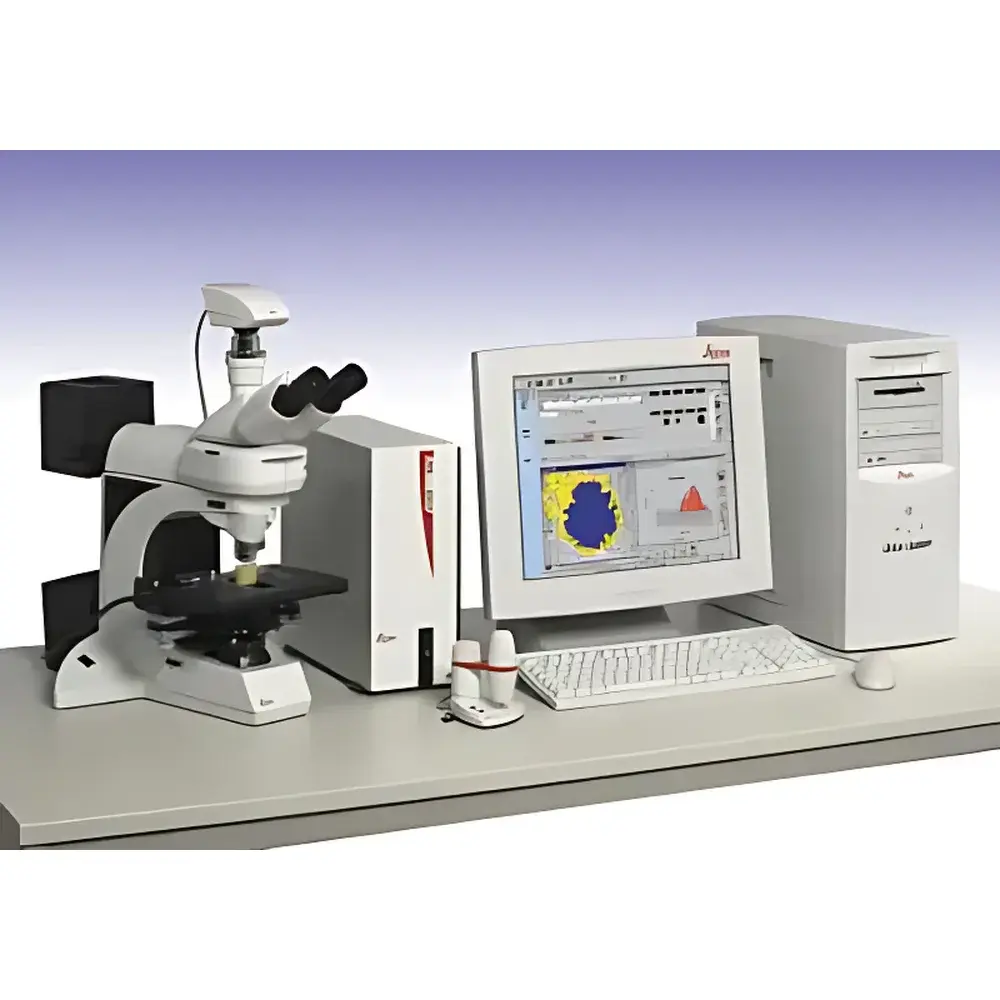
Leica QMW & Qmetal Metallographic Analysis Software Suite
| Brand | Leica |
|---|---|
| Origin | Germany |
| Model | QMW, Qmetal |
| Compliance | ASTM E112, ASTM E1245, ISO 643, ISO 9042, DIN 50601, JIS G 0551 |
| Deployment | Windows-based standalone workstation software |
| Integration | Fully compatible with Leica DM series metallurgical microscopes and motorized stages |
| Licensing | Per-seat perpetual license with optional annual maintenance |
| Data Management | Audit-trail enabled, GLP-compliant reporting, FDA 21 CFR Part 11 ready (with optional electronic signature module) |
Overview
Leica QMW and Qmetal are purpose-built metallographic image analysis software platforms engineered for quantitative microstructural characterization in metallurgical, materials science, and quality assurance laboratories. Built upon Leica Microsystems’ three-decade legacy in optical imaging and materials metrology, the suite implements standardized measurement algorithms grounded in ASTM, ISO, DIN, and JIS methodologies—including grain size determination (ASTM E112), inclusion rating (ASTM E1245), phase fraction analysis, coating thickness quantification, and hardness correlation mapping. The system operates on a calibrated digital imaging pipeline: it acquires monochrome or color images via Leica’s high-sensitivity CCD/CMOS cameras, applies optical distortion correction and illumination normalization, then executes pixel-intensity-based segmentation, morphological filtering, and feature extraction—all traceable to NIST-traceable reference standards. Designed as a turnkey solution, QMW integrates tightly with Leica’s motorized DM series metallurgical microscopes, automated XY scanning stages, and Z-axis focus drives—enabling fully repeatable, operator-independent acquisition of multi-field montage images and extended-depth-of-field composites for rough or topographically complex specimens.
Key Features
- Fully guided workflow wizards for ASTM/ISO-compliant analyses—including grain size (E112), non-metallic inclusions (E1245), decarburization depth, and ferrite/pearlite ratio—reducing training time and inter-operator variability.
- Multi-level user access control: administrator-defined roles (e.g., Supervisor, Analyst, Viewer) with password-protected parameter locking, method validation flags, and change-log recording.
- Automated montage stitching of up to 500+ fields of view (FOVs) with sub-pixel alignment accuracy; supports large-area coverage (e.g., full cross-sections of rolled steel plates or castings).
- Extended Depth of Field (EDF) synthesis using Leica IM1000-compatible algorithms—critical for accurate measurement on etched, polished, or coated surfaces with inherent topography.
- Integrated calibration management: stage calibration, pixel-to-micron scaling verification, and objective lens metadata auto-recognition across Leica’s Plan Apochromat and HCX objectives.
- Batch processing engine for unattended analysis of queued image sets, with real-time progress monitoring and error logging.
Sample Compatibility & Compliance
QMW and Qmetal support standard metallurgical sample formats—polished/etched metallographic mounts (1″–2″ diameter), thin sections, fracture surfaces, thermal spray coatings, and sintered powder compacts. Image acquisition is optimized for reflected-light contrast modes including brightfield, darkfield, polarized light, and differential interference contrast (DIC). All quantitative outputs comply with ISO/IEC 17025 requirements for testing laboratories: measurement uncertainty estimation is embedded per analysis type, raw image archives are preserved with EXIF metadata (timestamp, objective ID, magnification, exposure settings), and report templates adhere to ASTM E2018 structural guidelines. The software architecture satisfies GLP documentation integrity requirements and can be configured for FDA 21 CFR Part 11 compliance when deployed with validated electronic signatures and audit trail modules.
Software & Data Management
Deployed on Windows 10/11 Professional x64 systems, QMW utilizes a relational SQLite database backend for secure storage of images, measurement results, calibration records, and user activity logs. Each analysis session generates a timestamped, immutable dataset bundle—including original TIFF/RAW files, processed binary masks, statistical summaries (mean, std dev, min/max, confidence intervals), and annotated PDF reports with embedded calibration certificates. Export options include CSV (for SPC integration), XML (for LIMS ingestion), and OLE embedding into Microsoft Office applications. The software supports DICOM-SR export for enterprise imaging archives and interfaces natively with Leica’s LAS X platform for cross-platform microscopy data federation. Optional Leica Service Cloud connectivity enables remote diagnostics, firmware updates, and method library synchronization across distributed lab networks.
Applications
- Steel & alloy production: ASTM E112 grain size certification, inclusion rating per ASTM E45/E1245, banding analysis, and decarburization layer quantification in hot-rolled coil QA.
- Automotive component validation: porosity analysis in die-cast aluminum housings, coating thickness uniformity in galvanized steels, and fatigue crack morphology classification.
- Power generation: creep damage assessment in turbine blade superalloys, oxidation scale thickness mapping on boiler tubes (per ISO 9042), and weld HAZ microstructure grading.
- Academic research: phase transformation kinetics modeling via time-series image stacks, quantitative texture analysis from EBSD-correlated datasets, and intermetallic compound distribution statistics.
- Failure analysis labs: fractographic feature quantification (dimple density, cleavage area %), corrosion pit depth profiling, and heat-affected zone boundary delineation.
FAQ
Does QMW support third-party microscopes?
No—QMW is engineered exclusively for seamless hardware integration with Leica DM series metallurgical microscopes and Leica-branded motorized stages, focus drives, and illumination controllers. Non-Leica hardware may be used for image import only (static TIFF/JPEG), but automated acquisition, EDF synthesis, and stage navigation require native Leica hardware drivers.
Can QMW results be exported to statistical process control (SPC) systems?
Yes—CSV exports include full statistical descriptors (n, mean, SD, CV%, Cpk, Ppk) aligned with AIAG SPC standards; direct OPC UA connectivity is available via optional Leica Industrial Gateway module.
Is method validation documentation provided?
Leica supplies IQ/OQ documentation templates, ASTM/ISO traceability matrices, and a comprehensive Validation Support Package (VSP) containing test protocols, acceptance criteria, and blank run datasets for GxP-regulated environments.
What is the minimum recommended hardware configuration?
Intel Core i7-8700K or AMD Ryzen 7 3700X, 32 GB RAM, NVIDIA Quadro P2000 or RTX A2000 GPU, 1 TB SSD, Windows 10 Pro 22H2 (64-bit); dual-monitor setup strongly recommended for simultaneous image preview and measurement dashboard.
How is software licensing enforced?
Per-seat licensing is managed via hardware-bound USB dongle or network-based FlexNet license server; floating licenses support concurrent user pooling across departmental workstations with centralized usage analytics.