
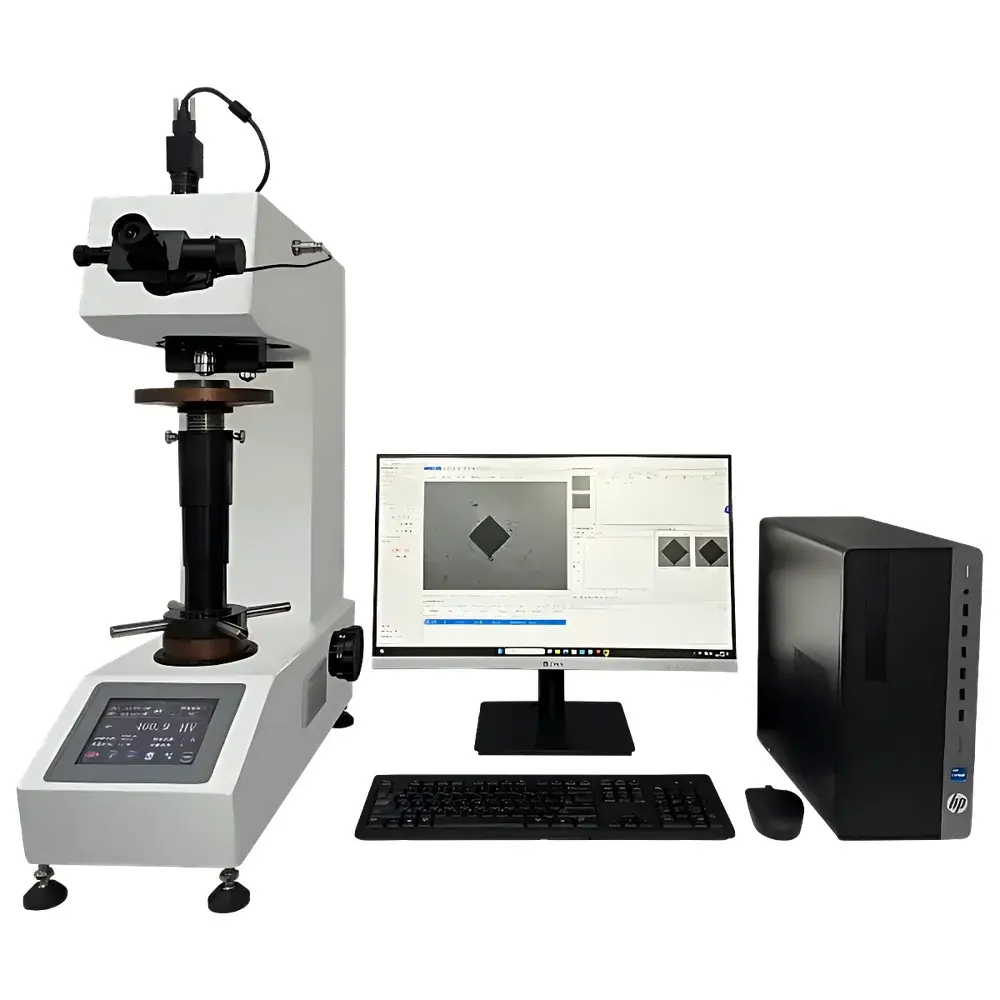
YANRUN HMAS-D5M/D10M/D30M/D50M Fully Automated Vickers Hardness Testing System
| Brand | YANRUN |
|---|---|
| Origin | Shanghai, China |
| Manufacturer Type | Manufacturer |
| Product Category | Domestic |
| Model | HMAS-D5M / HMAS-D10M / HMAS-D30M / HMAS-D50M |
| Instrument Type | Vickers Hardness Tester |
| Hardness Measurement Range | 8–3000 HV |
| Test Force Options | 0.2–50 kgf (6 force ranges per model) |
| Compliance | GB/T 4340, ISO 6507 |
| Minimum Detectable Indentation Resolution | 0.06 µm (with 20× objective) |
| Maximum Specimen Height | 235 mm |
| Distance from Indenter Center to Chamber Wall | 130 mm |
| Power Supply | AC 220 V / 50 Hz |
| Dimensions (L×W×H) | 570 × 220 × 680 mm |
| Net Weight | 54.0 kg |
| Gross Weight | 72.0 kg |
Overview
The YANRUN HMAS-D5M/D10M/D30M/D50M is a fully automated Vickers hardness testing system engineered for precision metrology in metallurgical laboratories, quality control departments, and R&D facilities. It operates on the fundamental principle of Vickers micro- and macro-hardness measurement: a diamond pyramid indenter (136° apex angle) is applied to the specimen surface under a precisely controlled test force; after a defined dwell time, the diagonals of the resulting square impression are measured optically, and hardness is calculated using the standard formula HV = 0.1891·F/d², where F is the applied load (kgf) and d is the mean diagonal length (mm). This system supports both microhardness (down to 0.2 kgf) and macrohardness (up to 50 kgf) applications across a broad hardness range (8–3000 HV), making it suitable for soft metals, hardened steels, carbides, ceramics, thin coatings, and case-hardened layers.
Key Features
- Fully automated turret actuation: software-driven, silent switching between indenter and objective lenses with zero mechanical backlash or positional drift.
- Closed-loop indentation cycle: automatic loading, dwell (0–60 s in 1-s increments), and unloading — achieving repeatability ≤ 0.1% per ASTM E384 and ISO 6507-1 requirements.
- Modular, drag-and-droppable UI: customizable workspaces with one-click access to frequently used functions including batch mode, CPK analysis, and multi-indent clustering.
- Advanced image processing engine: 13 real-time background enhancement algorithms ensure optimal contrast and edge definition across diverse material surfaces — from polished stainless steel to as-cast aluminum alloys.
- Sub-micron positioning accuracy: motorized stage with grid-based navigation and path planning for systematic cross-sectional hardness profiling (e.g., carburized or nitrided case depth evaluation).
- Dual measurement capability: simultaneous readout via integrated digital eyepiece (10×, with digital display) and high-resolution PC-based image analysis software.
- Traceable reporting: each indentation generates a QR-coded “micro-report” containing full metadata — load, dwell time, diagonal measurements, calculated HV value, operator ID, timestamp, and calibration certificate reference.
Sample Compatibility & Compliance
The HMAS series accommodates specimens up to 235 mm in height and 130 mm from indenter center to chamber wall — enabling testing of large forgings, turbine blades, and heat-treated components without sectioning. Its modular force architecture supports six discrete test loads per model (e.g., HMAS-D50M: 1, 5, 10, 20, 30, 50 kgf), satisfying both ISO 6507-1 macrohardness requirements and GB/T 4340.1 microhardness standards. All systems undergo factory verification against NIST-traceable hardness reference blocks and include full documentation for GLP/GMP audit readiness. Optional 21 CFR Part 11-compliant software modules provide electronic signatures, audit trails, and user role-based access control for regulated environments.
Software & Data Management
The embedded Windows-based analysis platform supports six operational modes: manual point-and-measure, semi-automatic single-point, fully automatic grid mapping, line-scan profiling, multi-layer depth analysis, and statistical batch reporting. Raw indentation images, coordinate data, and hardness values are stored in an encrypted SQLite database with configurable export options (CSV, PDF, XLSX, XML). CPK, PPK, histogram, and trend charts are generated in real time. Data integrity is ensured through timestamped versioning, checksum validation, and optional network backup to NAS or cloud storage. Software updates are delivered via secure HTTPS channel with SHA-256 signature verification.
Applications
- Case depth determination in carburized, nitrided, or induction-hardened components.
- Quality assurance of tool steels, bearing alloys, and aerospace-grade titanium.
- Thin-film and coating hardness evaluation (e.g., TiN, DLC, Al₂O₃) using low-force microhardness protocols.
- Failure analysis labs requiring repeatable, traceable hardness gradients across weld zones and heat-affected regions.
- Academic materials science research involving phase-specific hardness mapping via EBSD-correlated indentation arrays.
- Supplier qualification programs requiring ISO/IEC 17025-compliant hardness data packages.
FAQ
What standards does the HMAS system comply with?
It conforms to ISO 6507-1 (Vickers hardness testing — Part 1: Test method), GB/T 4340.1 (Chinese national standard equivalent), and ASTM E384 (for microhardness). Calibration certificates reference NIST SRM 1900 series blocks.
Can the system perform depth profiling automatically?
Yes — the integrated stage navigation and path-planning module enables fully automated line-scan and grid-based indentation sequences with user-defined step intervals and dwell times.
Is remote operation supported?
The system supports LAN-based remote desktop access and HTTP API integration for lab information management systems (LIMS) and MES platforms.
What is the minimum resolvable indentation diagonal?
With the 20× objective lens, the system achieves 0.06 µm resolution; with the 10× objective, resolution is 0.12 µm — both meeting ISO 6507-2 optical measurement uncertainty requirements.
Does the software support multi-user environments with audit trails?
Yes — optional GxP-ready software includes 21 CFR Part 11 compliance features: electronic signatures, immutable audit logs, and role-based permission tiers (operator, supervisor, administrator).



