
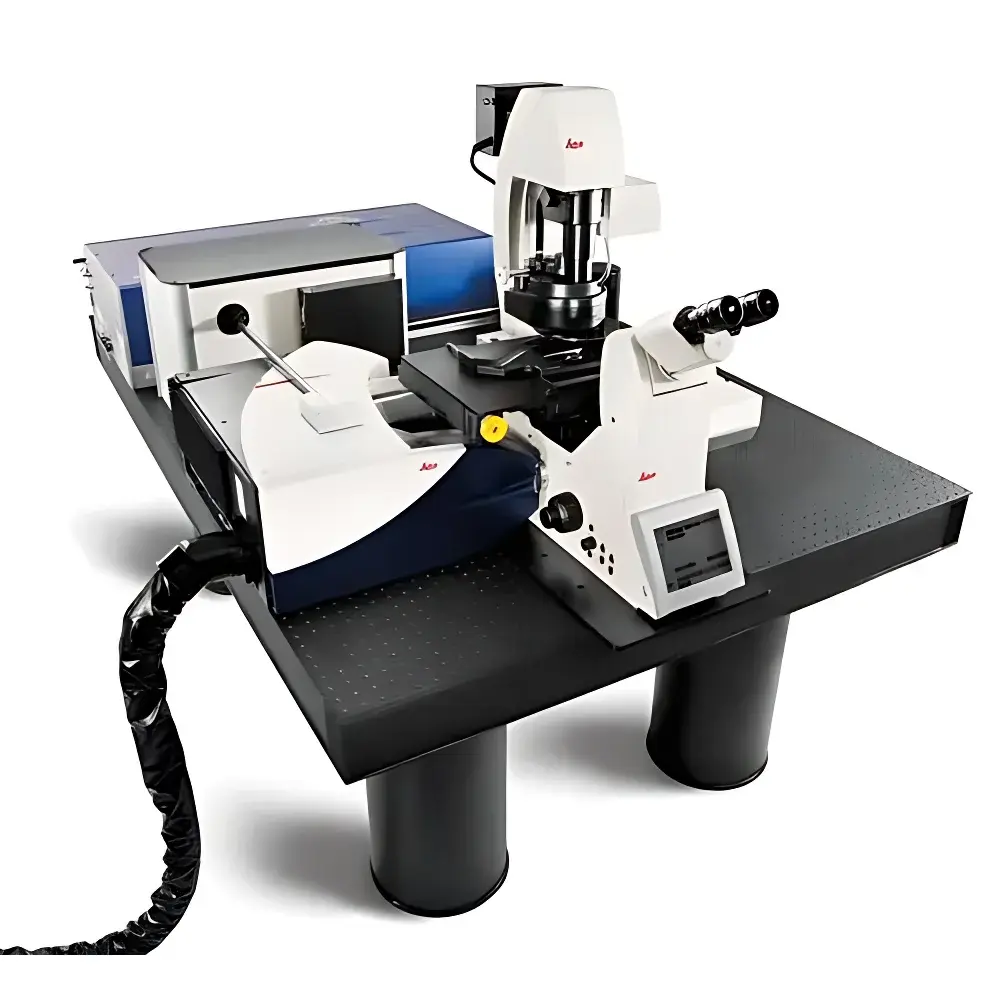
Leica TCS SP8 CARS Coherent Anti-Stokes Raman Scattering Confocal Microscope
| Brand | Leica |
|---|---|
| Origin | Germany |
| Model | TCS SP8 CARS |
| Laser Modalities | Visible, UV, IR, SHG, CARS |
| Imaging Modes | Single-photon fluorescence, multiphoton fluorescence, CARS, SHG, spectral unmixing |
| Scan Systems | Dual scanning architecture (standard resonant + high-speed resonant/galvo) |
| Software Platform | LAS X (successor to LAS AF), FDA 21 CFR Part 11 compliant modules available |
| Compliance | ISO 13485–certified manufacturing, CE-marked, GLP/GMP-ready audit trail support |
Overview
The Leica TCS SP8 CARS is a research-grade, fully integrated confocal laser scanning microscope engineered for label-free, chemically specific imaging of biological specimens at subcellular resolution. Unlike conventional fluorescence microscopy, which relies on exogenous fluorophores, the TCS SP8 CARS leverages coherent anti-Stokes Raman scattering (CARS) — a nonlinear optical process that probes intrinsic vibrational modes of chemical bonds (e.g., CH₂, CH₃, OH) without perturbing sample integrity. This enables quantitative, non-invasive visualization of lipid droplets, myelin sheaths, collagen fibrils, and other endogenous biomolecular structures in live cells, thick tissues, and even intact small animal models. The system combines a tunable dual-laser source (pump and Stokes beams) with a high-sensitivity spectral detection unit and a dual-scanning optical architecture, allowing simultaneous or sequential acquisition across multiple contrast mechanisms — including CARS, second-harmonic generation (SHG), one- and two-photon fluorescence, and UV-excited autofluorescence.
Key Features
- Label-free molecular contrast via CARS: Direct visualization of C–H bond vibrations with submicron spatial resolution and video-rate acquisition capability.
- Dual scanning architecture: Interchangeable or concurrent operation of standard galvanometric and high-speed resonant scan heads — optimized for both morphological surveys and dynamic processes (e.g., vesicle trafficking, calcium waves).
- Multi-modal excitation platform: Integrated UV (355 nm), visible (405–633 nm), and near-infrared (up to 1300 nm) lasers enable multimodal imaging — CARS/SHG/TPF/UV-FI — within a single instrument.
- Spectral detection flexibility: Hybrid detectors (GaAsP PMTs + spectral unmixing) support linear unmixing of overlapping CARS signals and autofluorescence, enhancing specificity in heterogeneous samples.
- FDA 21 CFR Part 11–ready software environment: LAS X software includes electronic signature support, user access levels, audit trail logging, and secure data export — meeting GLP/GMP documentation requirements for regulated laboratories.
- Ergonomic and modular design: Motorized stage, adaptive optics compatibility, and intuitive workflow-driven interface reduce operator dependency and accelerate method transfer across users.
Sample Compatibility & Compliance
The TCS SP8 CARS accommodates a broad range of native and minimally processed specimens: live adherent and suspension cells (in chambered coverslips or microfluidic devices), organotypic brain slices (up to 300 µm), fixed paraffin-embedded or cryosections, and cleared whole-mount tissues (e.g., CLARITY, iDISCO). Its non-destructive, non-phototoxic imaging modality complies with ISO/IEC 17025 guidelines for measurement uncertainty in life science instrumentation and supports adherence to ASTM E2915-22 (Standard Practice for Assessing Spectral Imaging System Performance). All optical components meet RoHS and WEEE directives; the system is CE-marked for in vitro diagnostic use where applicable.
Software & Data Management
LAS X serves as the unified control and analysis platform, offering real-time CARS signal optimization via automated laser alignment routines, spectral tuning wizards, and pulse delay calibration tools. Raw data are stored in open-format .lif files (compatible with ImageJ/Fiji, Huygens, Imaris), with metadata embedded per MIAME/MINSEQE standards. Batch processing pipelines support automated background subtraction, CARS phase correction, and ratiometric lipid/protein mapping. For regulated environments, optional LAS X Audit Trail and Electronic Signature modules provide full traceability — satisfying FDA 21 CFR Part 11, EU Annex 11, and ISO 13485 documentation requirements.
Applications
- Live-cell lipid metabolism studies: Quantitative tracking of lipid droplet dynamics during adipogenesis or lipolysis without fixation or staining.
- Neuroscience: Myelin integrity assessment in demyelinating disease models (e.g., EAE mice) using intrinsic CH₂ vibration contrast.
- Dermatology & connective tissue research: Simultaneous CARS (collagen/lipid) and SHG (fibrillar collagen) imaging of skin biopsies and engineered dermal equivalents.
- Developmental biology: Label-free 3D reconstruction of embryonic organogenesis in zebrafish and mouse embryos using CARS-guided optical sectioning.
- Pharmaceutical toxicology: In situ monitoring of drug-induced steatosis in primary hepatocyte spheroids via CARS-based lipid quantification.
FAQ
What makes CARS imaging fundamentally different from conventional fluorescence microscopy?
CARS does not require exogenous dyes or genetic labeling; it detects intrinsic Raman-active molecular vibrations, preserving native biochemistry and eliminating photobleaching or cytotoxicity concerns.
Can the TCS SP8 CARS perform true simultaneous multi-modal imaging?
Yes — through time-shared or parallel beam path routing, the system acquires CARS, SHG, and fluorescence signals concurrently with synchronized detector gating and spectral separation.
Is the system compatible with super-resolution techniques?
While CARS itself is diffraction-limited, the TCS SP8 platform supports STED and GSDIM modules via shared optical train and LAS X integration — enabling correlative nanoscale structural and chemical analysis.
How is laser safety managed during CARS operation?
All lasers comply with IEC 60825-1 Class 4 safety standards; interlocked enclosures, real-time power monitoring, and automatic beam shutters ensure compliance with institutional laser safety officer (LSO) protocols.
Does Leica offer application-specific validation packages for regulated labs?
Yes — IQ/OQ/PQ documentation kits, including wavelength accuracy verification, spatial resolution testing (using NIST-traceable USAF 1951 targets), and CARS signal linearity calibration, are available upon request.





