
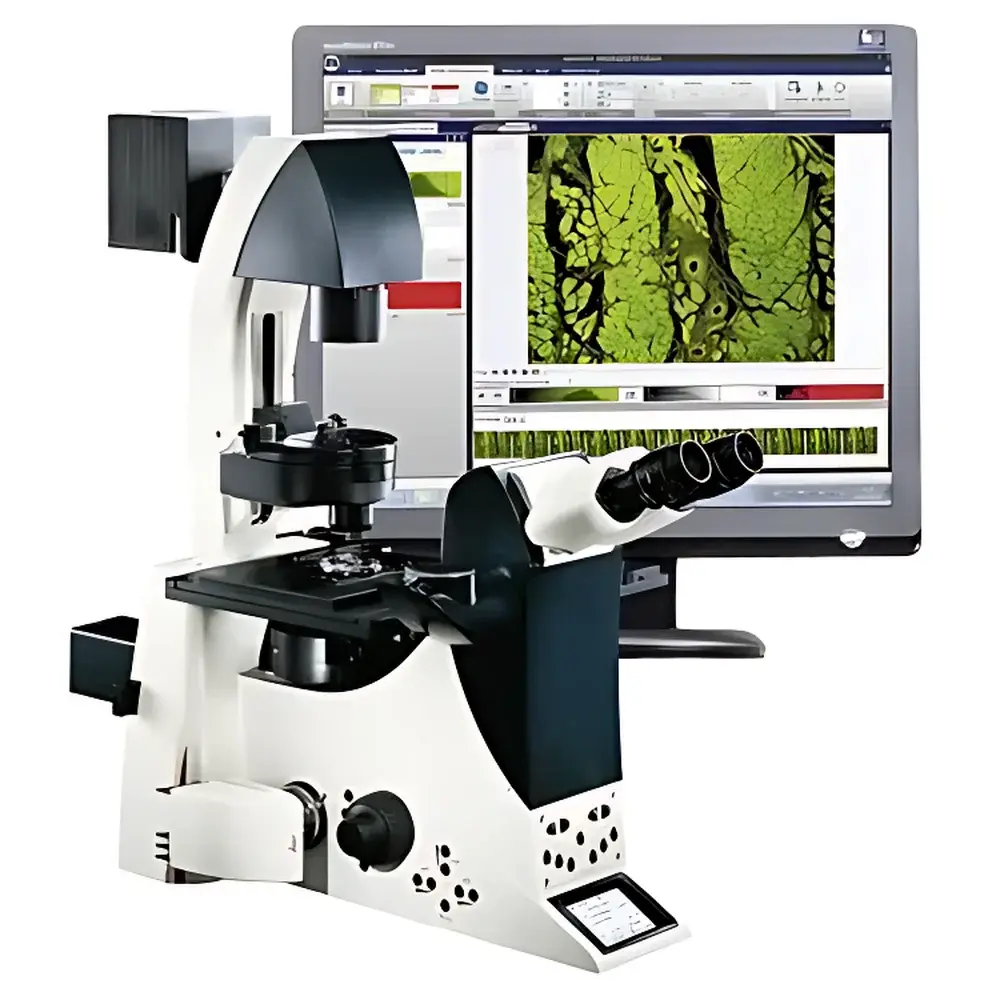
Leica MM AF NX Biological Microscopy Image Acquisition and Analysis Software
| Brand | Leica |
|---|---|
| Origin | Germany |
| Model | Leica MM AF NX |
| Software Architecture | Workflow-Centric, IronPython-Scriptable |
| Compliance Framework | Designed for GLP/GMP-aligned laboratory environments |
| Data Management | Experiment-Centric Hierarchical Storage |
| User Interface | Tab-Based Ribbon UI with Hardware Integration Layer |
| Concurrent Operation | Real-Time Image Acquisition + Parallel Analysis Tasks |
| Extensibility | Native IronPython API for Custom Automation Scripts |
| Import/Export Formats | TIFF, LSM, JPEG2000, OME-TIFF, CSV, XML (OME-XML metadata compliant) |
| Microscope Control Protocol | Leica Application Suite X (LAS X) Native Integration |
| Multi-Dimensional Support | Up to 5D (x, y, z, λ, t) dataset handling |
Overview
Leica MM AF NX is a next-generation biological microscopy image acquisition and analysis software platform engineered for precision life science research in both fixed and live-cell imaging applications. Built upon the robust computational foundation of MetaMorph® NX — a widely adopted standard in quantitative fluorescence microscopy — Leica MM AF NX integrates microscope hardware control, multi-dimensional image acquisition, and modular analytical processing into a unified, workflow-driven environment. Its core architecture implements a deterministic, event-synchronized imaging pipeline that ensures temporal fidelity during time-lapse experiments and spatial consistency across z-stacks or spectral acquisitions. Designed explicitly for Leica inverted and upright research-grade microscopes (including DMi8, DM6 B, and THUNDER systems), the software operates as a native extension of the Leica Application Suite X (LAS X) ecosystem, enabling bidirectional communication with motorized stages, filter wheels, shutters, environmental chambers, and high-speed sCMOS/EMCCD cameras. This tight hardware-software coupling minimizes latency in closed-loop acquisition protocols and supports compliance-critical experimental reproducibility.
Key Features
- Tab-Based Ribbon Interface: A logically organized, context-sensitive ribbon UI replaces traditional nested menus — providing immediate access to acquisition presets, measurement tools, annotation layers, and export modules without modal dialog interruption.
- Real-Time Concurrent Processing: Enables simultaneous image acquisition and on-the-fly analysis — including background subtraction, intensity profiling, particle detection, and region-of-interest (ROI) statistics — without interrupting ongoing time-series capture.
- Experiment-Centric Data Architecture: All raw images, metadata (acquisition parameters, stage coordinates, objective ID, exposure settings), and derived measurements are stored in a hierarchical, timestamped project structure — facilitating audit-ready traceability per ISO/IEC 17025 and FDA 21 CFR Part 11 requirements when paired with validated system configurations.
- IronPython Scripting Engine: Provides full programmatic access to the acquisition engine, image buffer, measurement pipeline, and metadata database — allowing users to automate complex multi-channel, multi-position, or conditional-triggered workflows without external middleware.
- 5D Dataset Navigation & Visualization: Supports interactive rendering of x-y-z-λ-t hypercubes with synchronized scrolling, spectral unmixing previews, and dynamic intensity scaling — optimized for confocal, widefield, and structured illumination microscopy modalities.
Sample Compatibility & Compliance
Leica MM AF NX natively supports imaging data from adherent and suspension cell cultures, tissue sections, organoids, and transparent model organisms (e.g., zebrafish embryos, C. elegans). It maintains compatibility with standard fluorescent probes (GFP, RFP, Alexa Fluor dyes), immunolabeling protocols, and FRET-based biosensors. The software’s metadata schema conforms to the Open Microscopy Environment (OME) model and exports OME-TIFF files with embedded acquisition parameters — ensuring interoperability with Fiji/ImageJ, QuPath, and commercial digital pathology platforms. For regulated environments, deployment within validated IT infrastructures enables alignment with GLP documentation standards and supports electronic signature workflows under 21 CFR Part 11 when integrated with enterprise authentication systems.
Software & Data Management
Data integrity is enforced through immutable project logs that record every user action, parameter change, and script execution with timestamps and operator IDs. Image datasets are stored in a self-contained folder hierarchy containing binary image data, JSON-formatted metadata, and human-readable experiment notes. Batch export functions support automated generation of publication-ready figures (multi-panel TIFF/PNG), statistical summary tables (CSV), and annotated measurement reports (PDF). Version-controlled script libraries can be shared across instrument nodes via network-mounted repositories — enabling standardized protocol deployment across core imaging facilities.
Applications
Leica MM AF NX serves as the central analytical hub for quantitative cell biology studies including mitotic progression tracking, subcellular organelle dynamics, calcium flux quantification, co-localization analysis (Pearson’s/Manders’ coefficients), wound-healing assays, and high-content screening (HCS) validation. Its deterministic acquisition logic makes it particularly suited for longitudinal studies requiring strict inter-experiment comparability — such as drug response profiling in primary patient-derived cells or CRISPR-edited isogenic lines. Academic labs, biopharma R&D groups, and contract research organizations leverage its extensibility to embed proprietary algorithms for phenotype classification or machine learning–assisted segmentation pre-processing.
FAQ
Is Leica MM AF NX compatible with non-Leica microscope hardware?
No — it is exclusively designed for native integration with Leica research microscopes via LAS X firmware and requires Leica-certified camera and stage controllers.
Does the software support GPU-accelerated image processing?
Yes — select modules including deconvolution, noise reduction, and real-time rendering utilize CUDA-enabled NVIDIA GPUs when available.
Can historical MetaMorph scripts be migrated to Leica MM AF NX?
Limited backward compatibility exists for basic macro commands; however, full migration requires refactoring into IronPython using the documented Leica SDK.
What level of cybersecurity compliance does the software support?
The software itself does not include built-in encryption or role-based access control — these must be implemented at the OS or domain level per institutional IT policy.
Is technical support provided directly by Leica Microsystems?
Yes — licensed users receive direct engineering-level support through Leica’s global Field Application Scientist network and certified service centers.





