
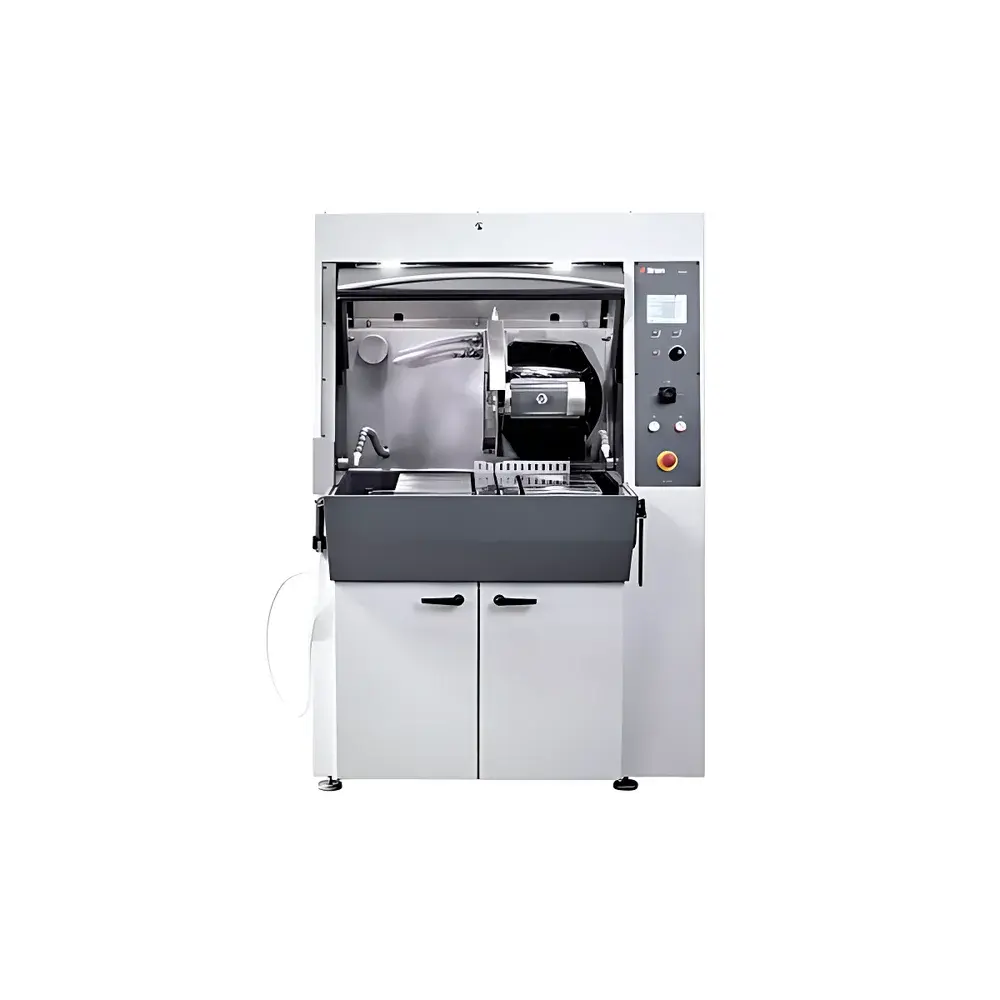
Struers Axitom Large-Format Metallographic Cutting System
| Brand | Struers |
|---|---|
| Origin | Denmark |
| Model | Axitom |
| Instrument Type | Metallographic Cutting Machine |
| Maximum Wheel Diameter | 350 mm |
| Motor Power (S1) | 5.5–6.5 kW |
| Motor Power (S3) | 7.9–9.2 kW |
| Peak Power | 11–13 kW |
| Rotational Speed (rated load) | 1950 rpm |
| Max Workpiece Dimensions (H×W×D) | 200 × 650 × 440 mm |
| Extended Chamber Clearance (H×D) | 120 × 170 mm |
| Positioning Range | 0–300 mm |
| Max Sample Height Under Wheel | 200 mm |
| Positioning Speed | 50 mm/s |
| Feed Rate Range | 0.05–5 mm/s |
| Cutting Force Range | 50–700 N |
| Table Size (W×D) | 591 × 492 mm |
| T-Slot Width | 12 mm |
| Overall Dimensions (H×W×D) | 1745 × 1155 × 1305 mm |
| Weight | 758 kg |
Overview
The Struers Axitom is a large-format, fully automated metallographic cutting system engineered for high-throughput, precision sample preparation in industrial quality control laboratories, R&D facilities, and accredited metallurgical testing centers. Built upon Struers’ decades of expertise in materials preparation, the Axitom employs a robust motor-driven abrasive cutting principle—optimized for controlled material removal under variable force, speed, and feed profiles—to ensure minimal thermal distortion, consistent kerf width, and reproducible cross-sectional integrity across diverse metallic, ceramic, and composite specimens. Its design prioritizes operational safety, process repeatability, and compliance with ISO 14971 (risk management), ISO/IEC 17025 (testing laboratory competence), and EU Machinery Directive 2006/42/EC. The system integrates seamlessly into GLP- and GMP-aligned workflows through configurable audit trails, user-access controls, and parameter-locking capabilities.
Key Features
- 350 mm abrasive wheel compatibility: Optimized for high-efficiency cutting of large-section samples—including castings, forgings, weldments, and additively manufactured components—without compromising edge fidelity or microstructural preservation.
- Dual automatic cutting tables: Independent X-Y-Z positioning enables sequential or parallel processing of two specimens, reducing cycle time and operator intervention while maintaining traceable setup conditions per sample.
- ExciCut intelligent cutting mode: Dynamically adjusts feed rate and cutting force based on real-time load feedback to suppress heat generation during hard-alloy or carbide-rich material sectioning—critical for preserving phase stability and avoiding tempering artifacts.
- AxioCut extended chamber configuration: Optional expansion module accommodates oversized workpieces up to 650 mm wide and 440 mm deep, supporting full-section analysis of structural components and large-diameter tubing.
- MultiCut automated serial sectioning: Enables unattended production of multiple parallel sections at pre-defined intervals—essential for gradient analysis, coating thickness profiling, and statistical sampling in failure investigations.
- OptiFeed adaptive feed control: Algorithms modulate feed velocity in 0.05 mm/s increments to match material hardness and wheel wear state, minimizing wheel consumption and extending service life without manual recalibration.
- AxioWash integrated cleaning cycle: Patented internal rinse-and-drain sequence removes slurry residue from the cutting chamber, wheel guard, and coolant recirculation path—reducing maintenance downtime and preventing cross-contamination between dissimilar alloys.
Sample Compatibility & Compliance
The Axitom accommodates a broad spectrum of conductive and non-conductive engineering materials, including ferrous and non-ferrous metals (e.g., stainless steels, aluminum alloys, titanium grades), sintered carbides, graphite composites, and thermoset matrix systems. Its programmable force and feed parameters meet ASTM E3-22 (Standard Guide for Preparation of Metallographic Specimens) and ISO 13074 (Metallographic Examination of Sintered Metal Materials). All safety interlocks, emergency stop circuits, and splash guards conform to EN 60204-1 and IEC 61508 SIL2 requirements. Optional documentation packages support FDA 21 CFR Part 11 compliance for electronic records and signatures in regulated pharmaceutical or medical device manufacturing environments.
Software & Data Management
Controlled via Struers’ proprietary AxioOS interface, the Axitom supports full method-based operation with password-protected user roles (Operator, Technician, Administrator). Each cutting protocol stores complete metadata—including wheel ID, coolant type, feed profile, force curve, and timestamped execution logs—for traceability and root-cause analysis. Exportable CSV reports integrate directly into LIMS platforms or statistical process control (SPC) software. Firmware updates are delivered via encrypted USB key or secure network push, ensuring version-controlled validation in regulated settings.
Applications
- High-volume sectioning of turbine blades, rail axles, and pressure vessel welds for macro/micro examination per ASME BPVC Section V.
- Preparation of representative coupons from additive-manufactured parts for porosity, lack-of-fusion, and grain structure assessment per ASTM F3049.
- Serial sectioning of multi-layer coatings (e.g., thermal barrier systems) for interface integrity and delamination evaluation.
- Failure analysis labs requiring rapid, artifact-free sectioning of fractured components for SEM-EDS and EBSD correlation.
- Foundry QA departments performing routine tensile bar and impact specimen preparation per ISO 6892-1 and ISO 148-1.
FAQ
What cooling options are supported?
The Axitom is configured for flood-coolant delivery using water-soluble or oil-based formulations; optional mist-cooling kits are available for dry-cutting applications requiring minimal fluid exposure.
Can the system be integrated into an automated sample prep line?
Yes—via Ethernet/IP or Modbus TCP interfaces, the Axitom supports handshake protocols with robotic loaders and downstream grinding/polishing stations.
Is remote diagnostics available?
Struers’ AxioLink cloud service enables secure remote monitoring, predictive maintenance alerts, and firmware update scheduling—subject to customer-configured firewall policies.
What wheel mounting standards does it accept?
The spindle complies with ISO 5211 flange mounting (32 mm bore) and supports standard 350 × 2.5 × 32 mm abrasive wheels with ISO 9001-certified bonding matrices.
How is method validation performed?
Built-in calibration routines verify positioning accuracy (±0.02 mm), feed rate consistency (±1.5%), and force transducer linearity (±0.5% FS) per ISO/IEC 17025 Annex A.3 guidelines.
Related Products



