
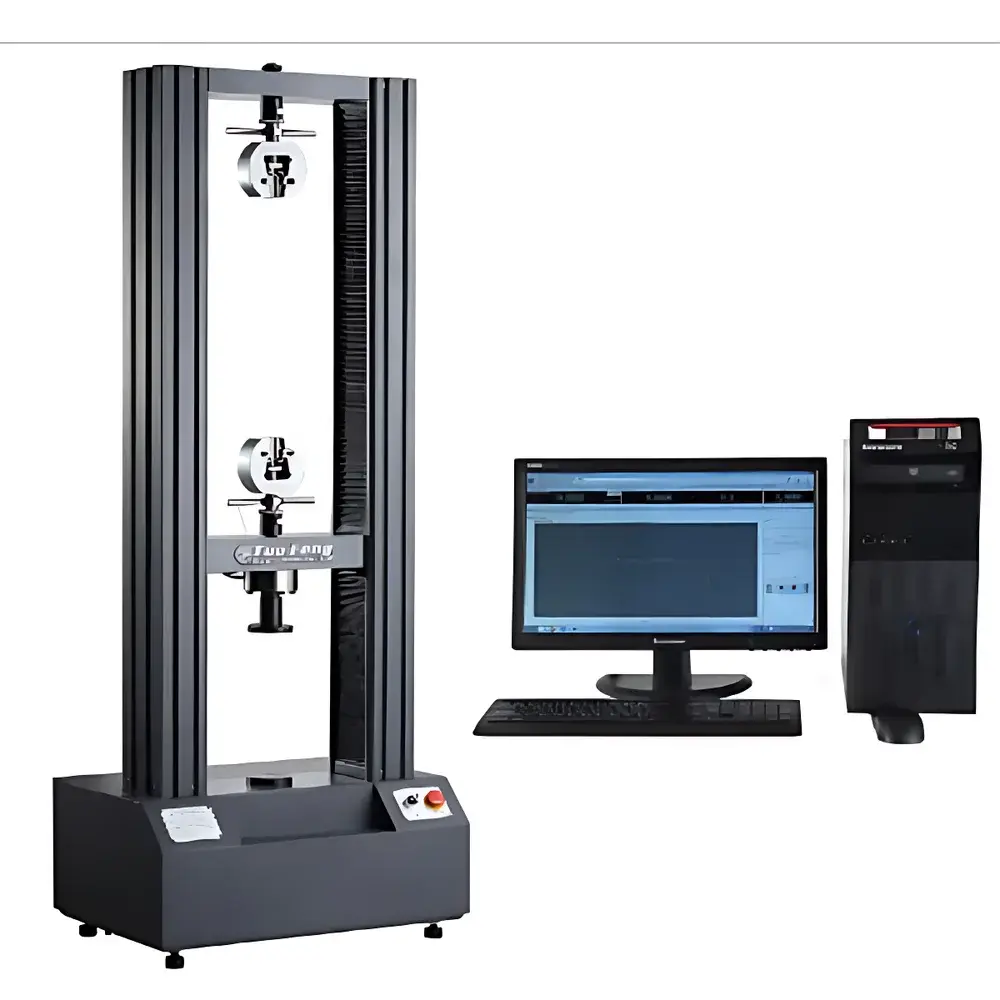

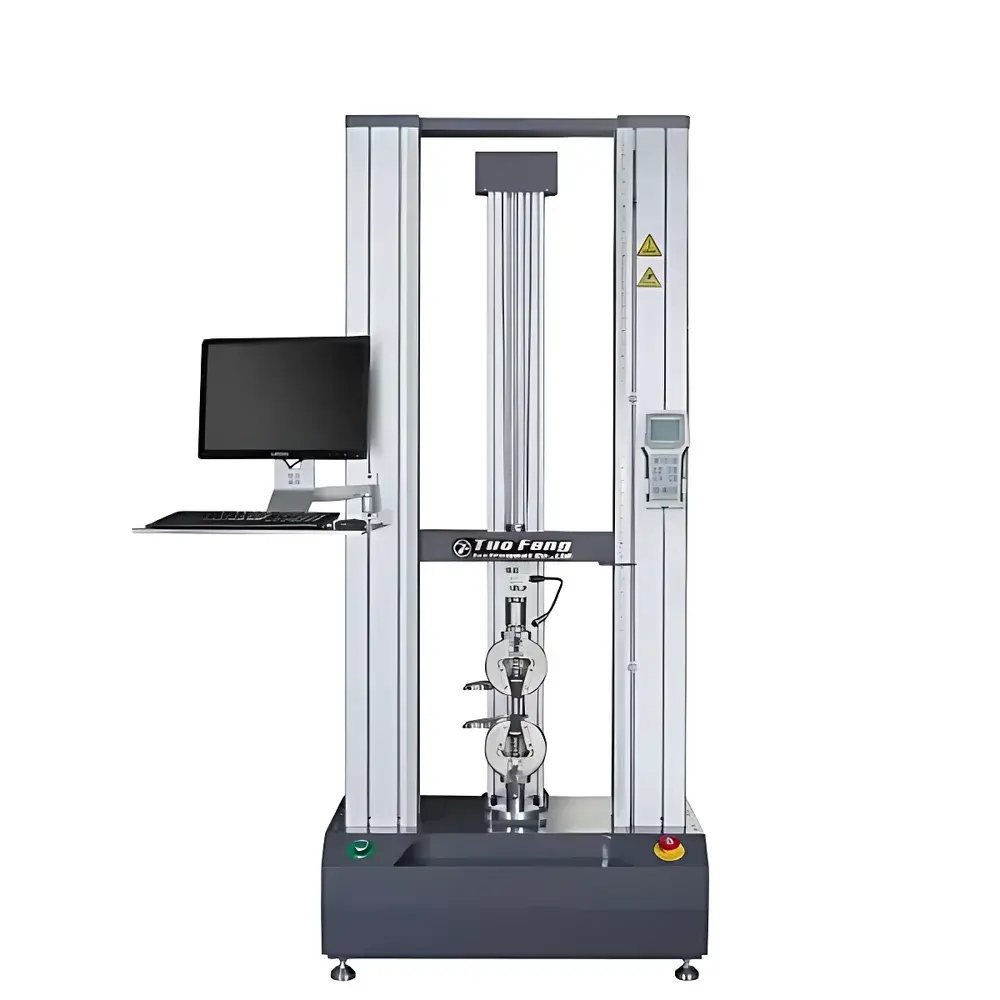
Tuofeng TFW-208 Microcomputer-Controlled Electronic Universal Testing Machine
| Brand | Tuofeng |
|---|---|
| Origin | Shanghai, China |
| Manufacturer Type | Direct Manufacturer |
| Instrument Type | Electronic Universal Testing Machine |
| Model | TFW-208 |
| Max Test Load | 20 kN |
| Accuracy Class | 0.5 |
| Effective Force Range | 0.2–100% of full scale |
| Force Measurement Accuracy | ±0.005% of reading |
| Force Resolution | 1/500,000 full-scale code (no range switching, constant resolution) |
| Drive System | Imported servo motor with worm gear reducer |
| Lead Screw | High-precision preloaded ball screw |
| Effective Test Width | 600 mm (customizable) |
| Stroke | 800 mm (extendable) |
| Speed Range | 0.001–500 mm/min (infinitely variable) |
| Displacement Measurement | Optical encoder |
| Displacement Accuracy | ±0.005% of reading |
| Strain Measurement | Optional extensometer or large-deformation sensor |
| Safety Protection | Electronic limit switches, emergency stop, overload protection (10% over capacity) |
| Motor Power | 1.0 kW |
| Dimensions (W×D×H) | 1000 × 700 × 2000 mm |
| Weight | ~450 kg |
Overview
The Tuofeng TFW-208 Microcomputer-Controlled Electronic Universal Testing Machine is an ISO/IEC 17025-aligned static mechanical testing system engineered for high-reproducibility tensile, compression, flexural, shear, tear, peel, and puncture testing of metallic, polymeric, composite, and elastomeric materials—including silicone rubber compounds. Based on closed-loop servo-controlled load application and high-fidelity displacement feedback, the system complies with fundamental principles of ASTM E4, ISO 7500-1, and GB/T 16491-2008 for force calibration and structural integrity verification. Its rigid dual-column frame, preloaded ball-screw actuation, and real-time digital signal processing architecture ensure minimal compliance error (<0.05% of stroke), enabling accurate determination of modulus, yield point, ultimate strength, elongation at break, and stress relaxation behavior under controlled strain rates.
Key Features
- 0.5-class accuracy per ISO 7500-1 and JJG 475-2008, verified traceably to national metrological standards
- Constant-resolution force measurement at 1 part in 500,000 full-scale—no auto-ranging artifacts across the 0.2–100% test range
- Infinitely variable crosshead speed from 0.001 to 500 mm/min, programmable with ramp-hold-step profiles for creep, relaxation, and cyclic loading
- Dual-speed motorized crosshead positioning (fast jog + precision fine-adjust) with programmable return-to-start functionality
- Integrated electronic safety interlocks: hardware-based overload cutoff (10% over full scale), dual-channel limit switch redundancy, and emergency stop circuit compliant with IEC 60204-1
- Modular extensometry support: compatible with clip-on axial extensometers (ASTM E83 Class B-1) and non-contact video extensometers for low-modulus or soft silicone specimens
Sample Compatibility & Compliance
The TFW-208 accommodates standardized and custom geometries—from ASTM D412 dumbbell specimens for silicone elastomers to ISO 37 crescent-shaped cuts, GB/T 528 ring specimens, and ASTM D638 Type I bars. Fixture adaptability includes pneumatic wedge grips (for high-friction elastomers), hydraulic self-tightening clamps, and specialized peel fixtures meeting ASTM D903 and ISO 8510-2. All test protocols are fully traceable to international material standards: ASTM D412/D638/D790/D1445/D3574, ISO 37/527/178/6892, GB/T 528/1040/9341, and JIS K6251. The system meets GLP documentation requirements through audit-ready test logs, user-access-level permissions, and electronic signature support aligned with FDA 21 CFR Part 11 Annex 11 expectations.
Software & Data Management
The Windows-based TuofengTest software provides ISO 17025-compliant data acquisition and reporting. It supports six real-time display modes (load–time, load–displacement, stress–strain, etc.), multi-curve overlay for comparative analysis, and automated parameter extraction—including tensile strength, Young’s modulus, yield offset (0.2%), elongation at break, and secant modulus. Units are freely convertible between SI, imperial, and legacy systems (e.g., MPa ↔ psi, mm ↔ in). Raw data exports to CSV, Excel, or XML; reports comply with ISO/IEC 17025 clause 7.8.2 for result validity. Software architecture enables modular expansion—custom test methods (e.g., ISO 7619-1 Shore A hardness correlation) or third-party instrument integration (e.g., environmental chamber synchronization) can be implemented via API hooks. Lifetime software updates and remote calibration assistance are included.
Applications
This system serves as a primary mechanical characterization platform in R&D and QC laboratories across sectors where silicone performance dictates functional reliability: medical device component validation (catheters, seals, gaskets per ISO 10993-12), automotive NVH elastomer qualification (engine mounts, bushings), aerospace sealant adhesion testing (ASTM D1002), and consumer electronics encapsulant tensile fatigue assessment. It is routinely deployed for accelerated aging studies (per ASTM D573), compression set evaluation (ISO 815), and dynamic mechanical property mapping via stepped-rate protocols. Universities utilize it for polymer physics education, particularly in viscoelastic modeling (Maxwell/WLF fitting) and fracture mechanics initiation analysis.
FAQ
Does the TFW-208 support ASTM D412 testing for silicone rubber?
Yes—equipped with appropriate grips and extensometer configuration, it fully satisfies all dimensional, speed, and data acquisition requirements of ASTM D412-22 for tensile properties of vulcanized rubber and thermoplastic elastomers.
Can the system perform compression testing per ISO 604?
Yes—the 20 kN capacity, 600 mm test width, and flat platens enable rigid compression testing of rigid plastics and filled silicones up to 100 mm in height.
Is test data export compatible with LIMS environments?
Yes—CSV, XML, and database ODBC drivers are natively supported; metadata fields include operator ID, calibration certificate ID, environmental conditions, and instrument firmware version.
What is the minimum resolvable displacement increment?
The optical encoder delivers sub-micron positional resolution (≤0.1 µm) within its specified accuracy envelope of ±0.005% of reading.
How is traceability maintained for force calibration?
Each unit ships with a NIST-traceable calibration certificate (valid 12 months); onboard self-calibration routines verify zero and span drift prior to each test sequence.
Related Products



