
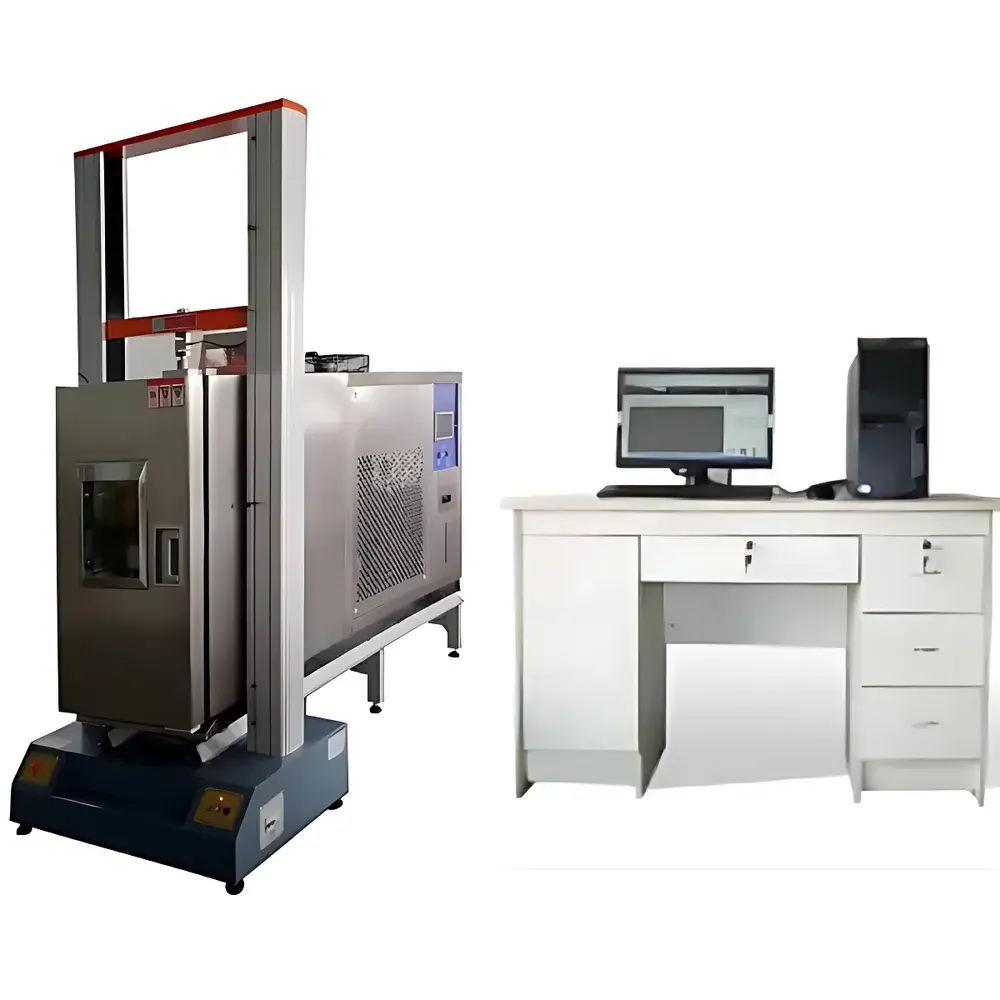
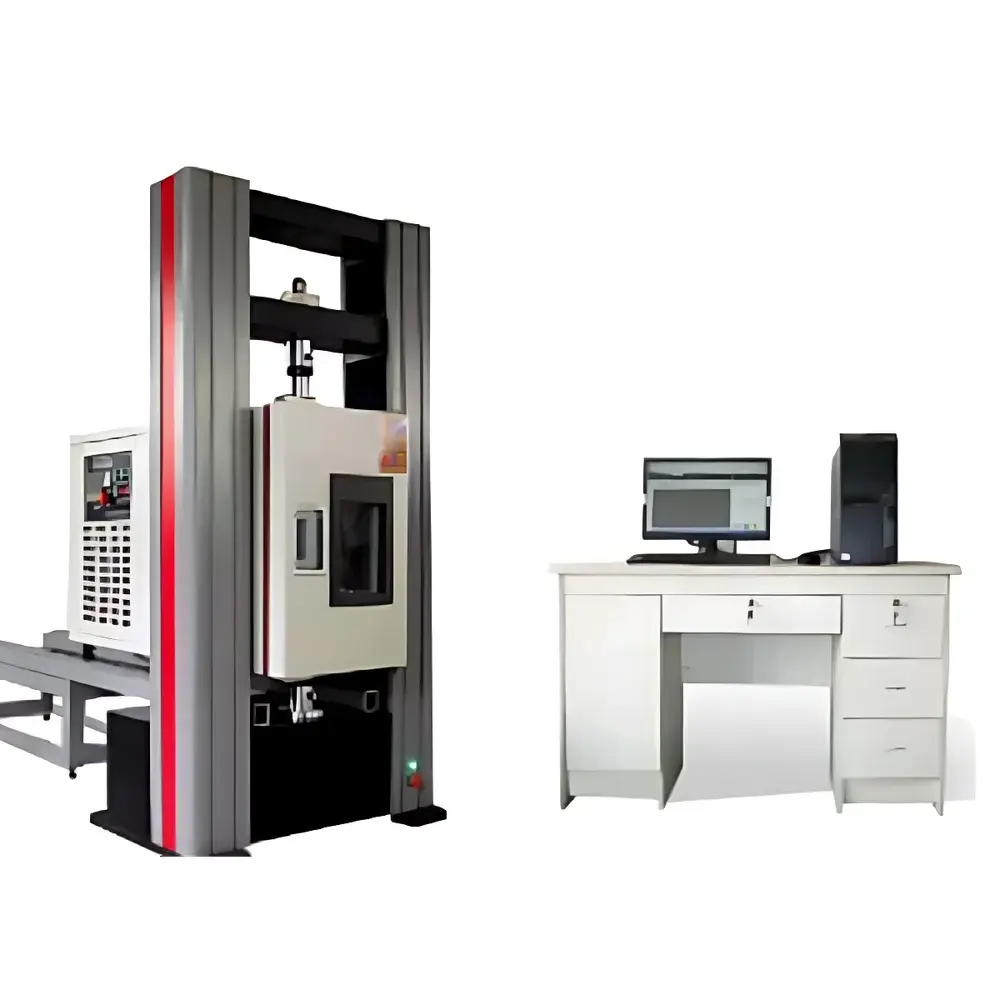
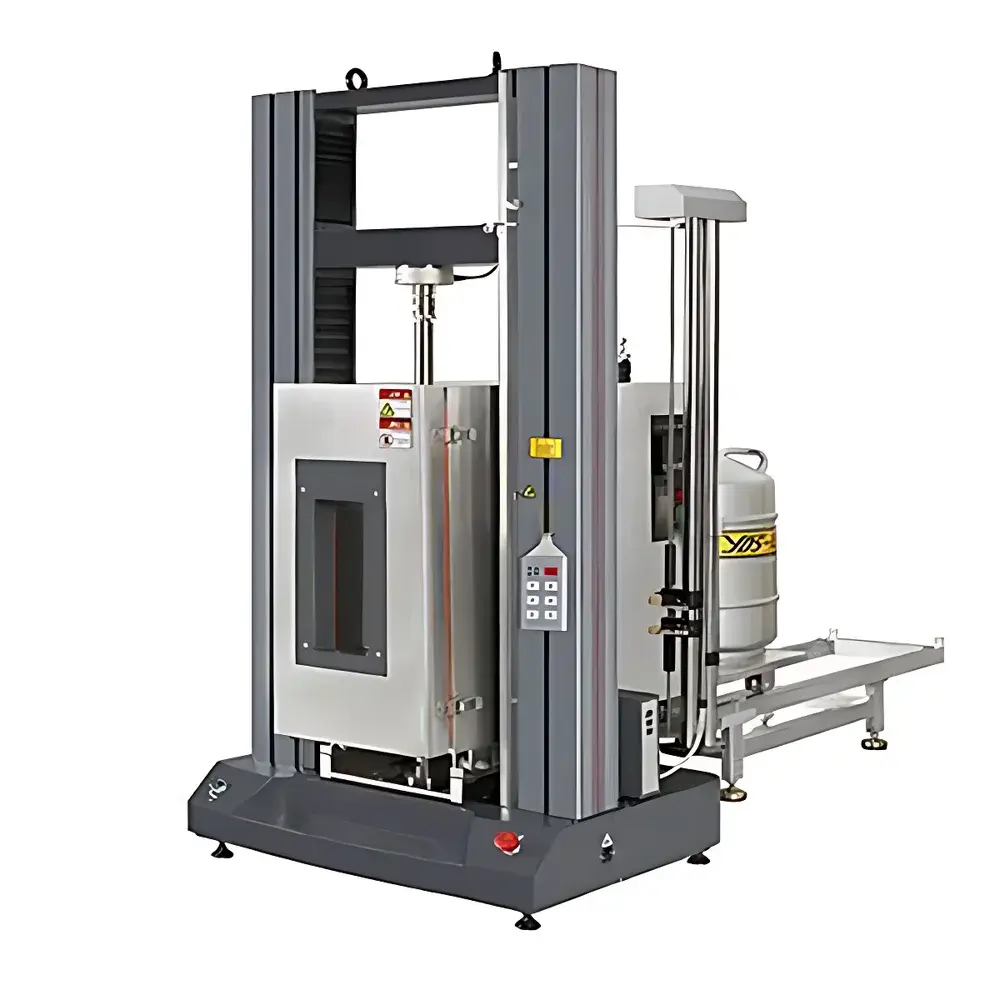
Tuofeng TFW-287 High-Temperature Electronic Universal Testing Machine
| Brand | Tuofeng |
|---|---|
| Origin | Shanghai, China |
| Manufacturer Type | Direct Manufacturer |
| Model | TFW-287 |
| Instrument Type | Electromechanical Universal Testing Machine |
| Load Capacity Range | 0.01 N to 300 kN |
| Load Accuracy | ±0.5% |
| Compliance | GB, ISO 6892-1, ASTM E8/E21, JIS Z2241, DIN 50125 |
| Temperature Chamber Range | –40 °C to +100 °C |
| Temperature Control Accuracy | ±2 °C (longitudinal 100 mm) |
| Deformation Resolution | Up to 1/300,000 FS |
| Force Resolution | 1/500,000 FS, full-range, no switching |
| Displacement Error | ±0.5% of reading |
| Column Internal Width | 840 mm |
| Crosshead Travel (standard) | 1000 mm |
| Host Dimensions | 1250 × 560 × 2400 mm |
| Weight | ~380 kg |
| Power Supply | AC 220 V / 50 Hz ±10%, 750 W |
Overview
The Tuofeng TFW-287 High-Temperature Electronic Universal Testing Machine is an electromechanical force-testing platform engineered for precision mechanical characterization of metallic and non-metallic materials across a wide thermal spectrum—from –40 °C to +100 °C. Integrating a programmable environmental chamber with a rigid dual-column frame and high-fidelity load cell architecture, the system enables controlled uniaxial tensile, compressive, flexural, peel, tear, and shear testing under thermally regulated conditions. Its measurement principle relies on closed-loop servo-controlled crosshead displacement combined with real-time force transduction via a temperature-compensated, 0.5-class load cell per ISO 7500-1 and ASTM E4. The machine operates in full compliance with international standard test protocols—including ISO 6892-1 (tensile testing of metallic materials), ASTM E8/E21 (tension tests of metallic materials at elevated temperatures), ASTM D638/D790 (plastics), and JIS Z2241—making it suitable for accredited laboratory environments requiring traceable, reproducible mechanical data.
Key Features
- High-stability dual-column steel frame with 840 mm internal clearance and 1000 mm nominal crosshead travel—optimized for specimen alignment and thermal chamber integration.
- 0.5-class force measurement system with ±0.5% accuracy over 0.4–100% full scale (FS); resolution up to 1 part in 500,000 FS, maintained continuously without range switching.
- Integrated high-performance environmental chamber: stainless-steel 304 exterior, 316 mirror-finish interior; silicone-alumina fiber insulation; NiCr heating element (1.5 kW); centrifugal blower for uniform airflow; Pt100 platinum resistance sensors for closed-loop temperature feedback.
- Programmable temperature control with ramp rates up to 100 °C in <30 minutes; thermal equilibrium achieved within 5 minutes across the specified range; longitudinal temperature uniformity ±2 °C over 100 mm.
- Modular load capacity configuration: supports selectable maximum forces from 5 kN to 300 kN via calibrated load cells, each independently verified per ISO 376.
- Robust safety subsystems: integrated earth-leakage protection, overcurrent circuit breakers, mechanical limit switches, and emergency stop interface compliant with IEC 60204-1.
Sample Compatibility & Compliance
The TFW-287 accommodates standardized test specimens (e.g., ASTM E8 dog-bone, ISO 6892-1 Type 2, JIS Z2241 flat coupons) as well as custom geometries up to 360 mm (W) × 300 mm (D) × 500 mm (H) within the chamber. It supports both ambient and conditioned testing per GLP/GMP-aligned workflows. All force, displacement, and temperature data are timestamped and stored with audit-trail capability—enabling compliance with FDA 21 CFR Part 11 when paired with validated software configurations. Calibration certificates follow ISO/IEC 17025 requirements and are traceable to NIM (National Institute of Metrology, China) or equivalent national metrology institutes.
Software & Data Management
The system runs on a Windows-based proprietary test control and analysis suite supporting multi-channel synchronous acquisition (force, displacement, extensometer, chamber temperature). Software modules include automatic parameter derivation (UTS, yield strength, modulus, elongation at break, secant modulus), curve overlay, statistical batch reporting, and customizable report templates exportable to PDF, Excel, and XML. Raw data files are saved in binary+ASCII hybrid format with embedded metadata (operator ID, calibration IDs, environmental logs). Optional add-ons support ASTM E2309-compliant uncertainty propagation, ISO 14286-compliant fracture toughness pre-cracking control, and third-party API integration (LabVIEW, Python SDK) for automated QA/QC pipelines.
Applications
This instrument serves critical R&D and quality assurance functions across sectors where thermal-mechanical coupling governs material behavior: aerospace alloy qualification at service temperatures; polymer thermoforming validation; elastomer hysteresis analysis under cyclic thermal loads; ceramic sintering strength profiling; adhesive bond durability assessment in automotive thermal cycling; and biomedical polymer degradation kinetics under accelerated aging. Universities and national labs utilize it for fundamental creep-rupture studies, while certification bodies deploy it for ISO 17025-accredited mechanical property verification against EN 10002-1 or ASME BPVC Section II.
FAQ
What temperature ranges can the environmental chamber achieve, and how quickly?
The chamber operates from –40 °C to +100 °C. Heating to +100 °C takes less than 30 minutes; thermal equilibrium is achieved within 5 minutes across the working zone.
Is the system compatible with extensometers for strain measurement?
Yes—it supports contact and non-contact extensometers (e.g., video-based DIC or clip-on LVDT types) via analog/digital I/O interfaces with synchronized sampling up to 1 kHz.
Can test data be exported in formats compatible with LIMS or ERP systems?
Yes—raw data and summary reports are exportable to CSV, XML, and PDF. An optional RESTful API module enables direct integration with enterprise data infrastructure.
Does the system meet regulatory requirements for pharmaceutical or medical device testing?
When configured with 21 CFR Part 11-compliant software settings (electronic signatures, audit trails, role-based access), it satisfies GMP/GLP documentation requirements for mechanical validation of packaging, implants, and delivery systems.
What maintenance intervals are recommended for long-term accuracy retention?
Annual recalibration of load cell and temperature sensors is recommended; chamber door gaskets and insulation integrity should be inspected quarterly; drive screw lubrication every 2,000 hours of operation.
Related Products



