
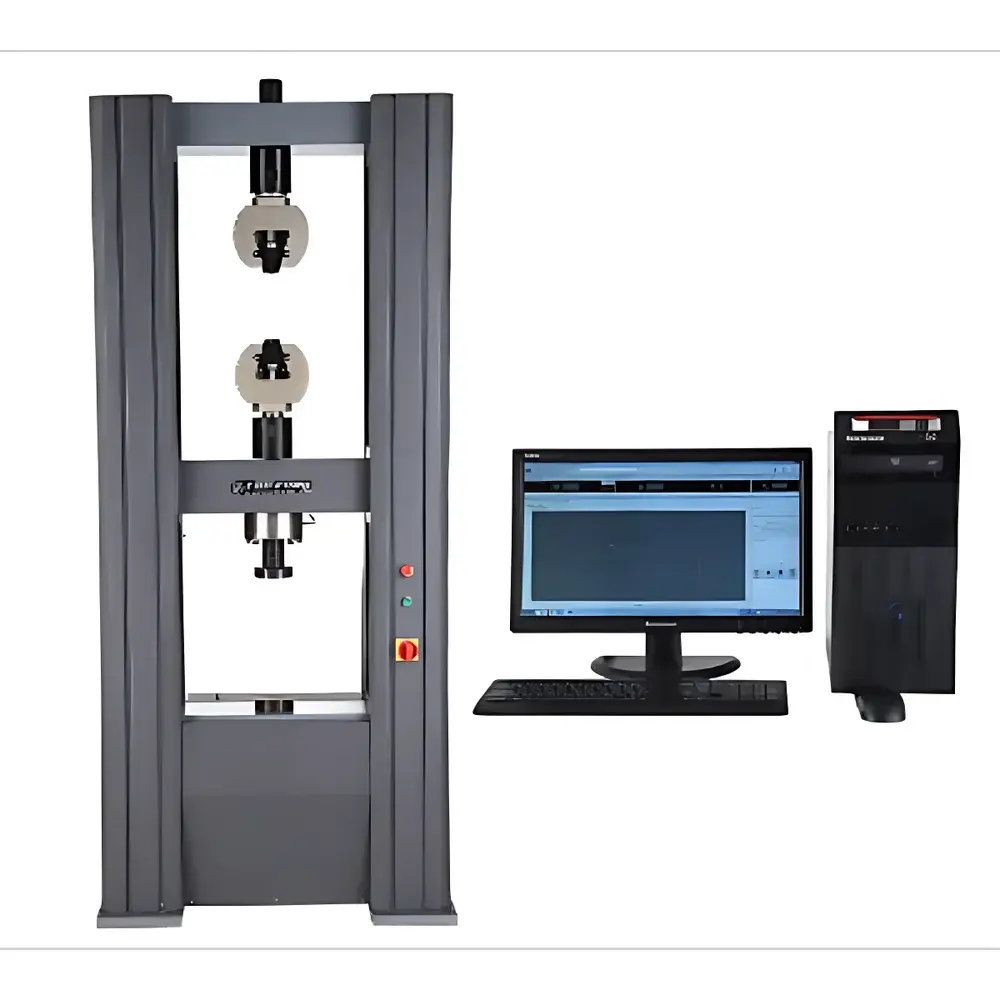
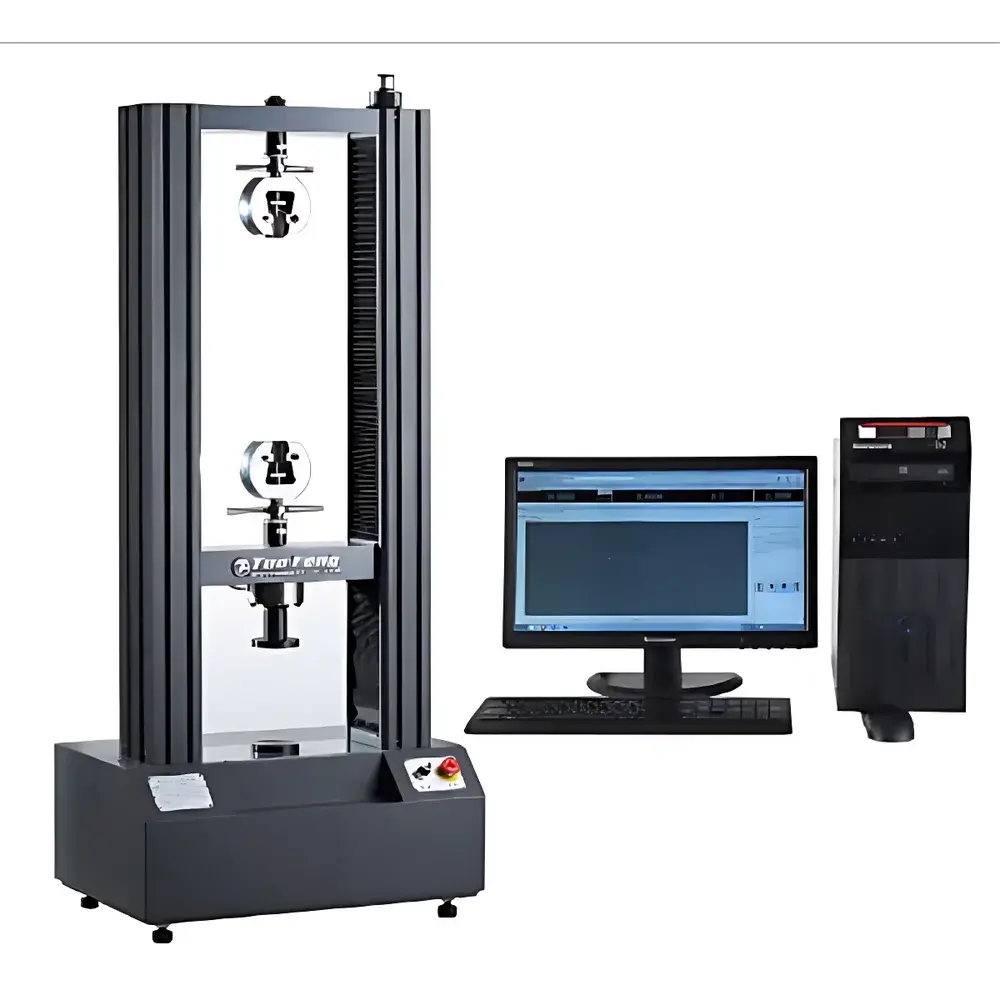
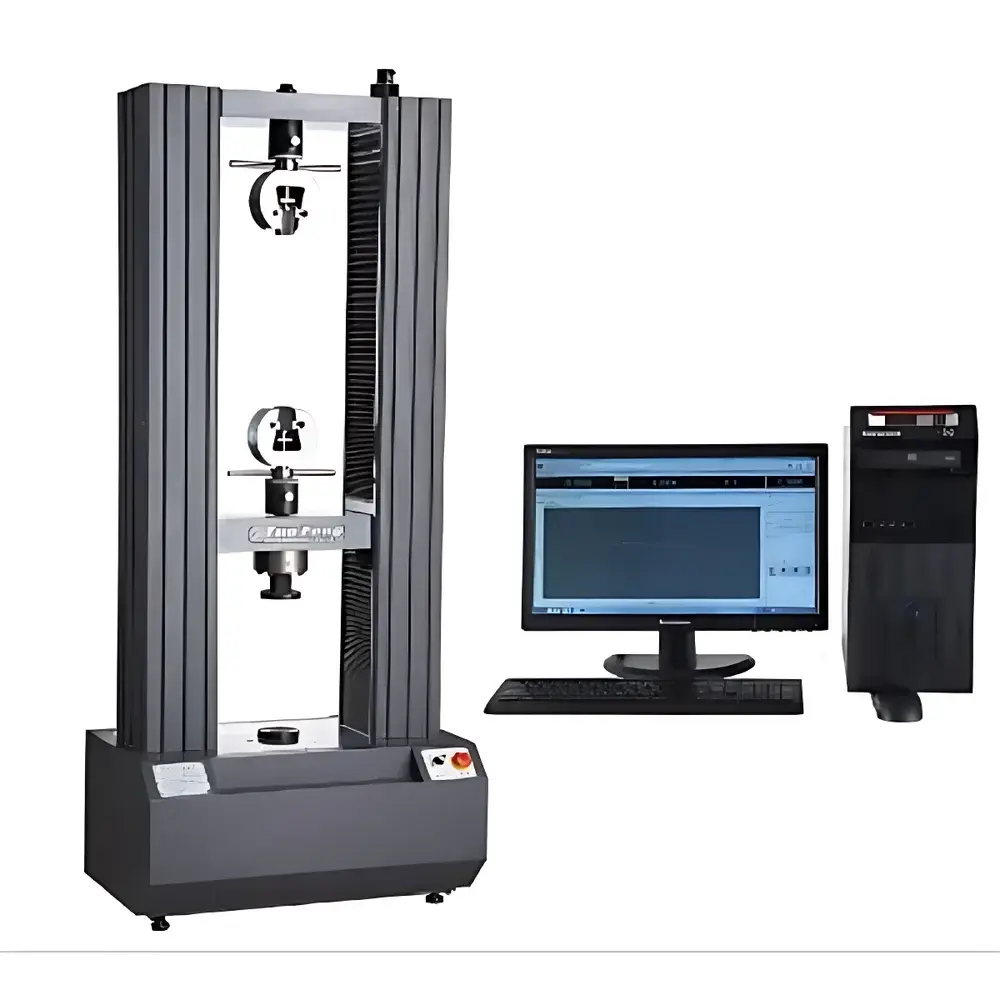
Tuofeng TFW-229 Microcomputer-Controlled Electronic Universal Testing Machine
| Brand | Tuofeng |
|---|---|
| Model | TFW-229 |
| Type | Electromechanical Universal Testing Machine |
| Max Test Load | 200 kN |
| Accuracy Class | 0.5 |
| Effective Force Range | 0.2–100% of Full Scale |
| Force Measurement Accuracy | ±0.005% of reading |
| Resolution | 1 part in ±500,000 full-scale codes (single-range, constant resolution) |
| Drive System | Imported servo motor with precision worm-gear reducer |
| Lead Screw | High-accuracy preloaded ball screw |
| Effective Test Width | 600 mm (customizable) |
| Stroke | 800 mm (height-adjustable) |
| Speed Range | 0.001–500 mm/min (infinitely variable) |
| Displacement Measurement | Optical encoder, accuracy ±0.005% of reading |
| Strain Measurement | Optional extensometer or large-deformation sensor, accuracy ±0.005% of reading |
| Safety Protection | Electronic limit switches, emergency stop, overload protection (10% above rated load) |
| Crosshead Control | Dual-speed motorized up/down (fast/slow), jog mode, automatic return post-test |
| Fixture Customization | Application-specific grips and fixtures available |
| Power Supply | 220 V AC, 3.0 kW |
| Dimensions (W×D×H) | 1100 × 900 × 2600 mm |
| Weight | ~1500 kg |
| Compliance | GB/T 16491–2008, JJG 475–2008, ASTM E4, ASTM E8, ISO 6892-1, ISO 7500-1, DIN 51221, JIS Z2241, BS EN ISO 6892-1 |
Overview
The Tuofeng TFW-229 is a high-precision, microcomputer-controlled electromechanical universal testing machine engineered for static mechanical property evaluation of metallic, polymeric, composite, and ceramic materials under uniaxial loading conditions. Based on the fundamental principles of force transduction via strain-gauge load cells and displacement tracking via optical encoders, the system delivers traceable, repeatable, and metrologically robust measurements across tension, compression, bending, shear, tear, peel, and puncture test modes. Its rigid dual-column frame, preloaded ball-screw actuation, and closed-loop servo control architecture ensure minimal deflection, high stiffness, and exceptional load fidelity — critical for accurate modulus determination and yield point detection per ISO 527-1 and ASTM D638 standards.
Key Features
- 0.5-class accuracy certified per GB/T 16491–2008 and ISO 7500-1:1999, supporting regulatory-grade material qualification.
- Single-range force measurement system with ±500,000-count resolution and no internal range switching — eliminates step errors and ensures consistent sensitivity from 0.2% to 100% of full scale (200 kN).
- Imported high-torque servo motor coupled with a low-backlash worm-gear reducer enables precise speed control from 0.001 to 500 mm/min, meeting both quasi-static (e.g., ASTM D695) and high-rate (e.g., ISO 178) test requirements.
- Motorized crosshead with independent fast/slow modes, jog functionality, and programmable auto-return ensures operator safety and workflow efficiency during batch testing.
- Integrated multi-level protection: electronic end-limit switches, hardware emergency stop circuit, and automatic overload cutoff at 110% of rated capacity.
- Modular fixture interface compatible with standardized wedge-action grips, compression platens, bend supports, peel fixtures, and custom-designed tooling per ASTM D1876, ISO 8510-2, and ASTM D6252.
Sample Compatibility & Compliance
The TFW-229 accommodates specimens ranging from thin films (≥0.05 mm thick) to structural steel coupons (up to 60 mm thick), with customizable test width (standard 600 mm) and extended stroke (800 mm). It supports standard specimen geometries defined in ASTM E8/E8M (tension), ASTM D695 (compression), ASTM D790 (flexure), and ISO 527-2 (plastics). The system complies with national and international metrological verification protocols including JJG 475–2008 (China), ISO/IEC 17025:2017 (for accredited labs), and GLP-relevant audit trails when paired with validated software configurations. All mechanical components meet RoHS Directive 2011/65/EU environmental compliance.
Software & Data Management
The embedded Windows-based testing software provides full compliance-ready operation: user-defined test methods (load-controlled, displacement-controlled, or time-controlled), real-time plotting of multiple curves (force–time, stress–strain, displacement–time), and automated calculation of key parameters — tensile strength, yield strength (0.2% offset), elongation at break, Young’s modulus, compressive strength, flexural modulus, tear strength, peel adhesion, and puncture resistance. Units are freely convertible (N/kN/lbf, MPa/psi, mm/in, %), and language support includes English, Simplified Chinese, and Traditional Chinese. Data export conforms to CSV, XLSX, and PDF formats; reports include metadata (operator ID, timestamp, calibration certificate ID, environmental conditions). Software architecture supports FDA 21 CFR Part 11-compliant electronic signatures and audit trail logging when deployed in regulated environments.
Applications
This system serves as a core mechanical characterization platform across industries requiring rigorous material validation: aerospace (alloy sheet tensile testing per AMS 2304), automotive (composite bumper impact simulation prep), construction (rebar yield verification per GB/T 1499.2), medical device packaging (peel strength per ASTM F88), rubber and elastomer R&D (tensile set per ISO 8067), and additive manufacturing (post-build tensile anisotropy assessment). Universities utilize it for undergraduate mechanics labs and graduate-level fracture mechanics studies, while QC/QA departments deploy it for incoming raw material inspection and final product release testing under ISO 9001:2015 and IATF 16949 frameworks.
FAQ
Does the TFW-229 support ASTM and ISO-compliant test method automation?
Yes — preconfigured test templates align with ASTM E8, ASTM D638, ISO 6892-1, ISO 527-1, and other major standards; users may also define custom ramp-hold sequences and pass/fail criteria.
Can the system be integrated into a centralized LIMS or MES environment?
Yes — via TCP/IP or RS232 communication protocols; optional OPC UA server module enables secure bidirectional data exchange with enterprise systems.
Is third-party calibration certification included with delivery?
Each unit ships with a factory calibration certificate traceable to NIM (National Institute of Metrology, China); optional UKAS-accredited calibration is available upon request.
What is the warranty coverage and service response time?
Standard 24-month parts-and-labor warranty; technical support is available globally via remote diagnostics, and on-site service is scheduled within 72 business hours for priority contracts.
Are extensometers required for modulus measurement?
For accurate elastic modulus and yield point determination per ISO 527-2 or ASTM D638, a contact or non-contact extensometer is recommended and fully supported by the software’s dual-channel strain input interface.



