
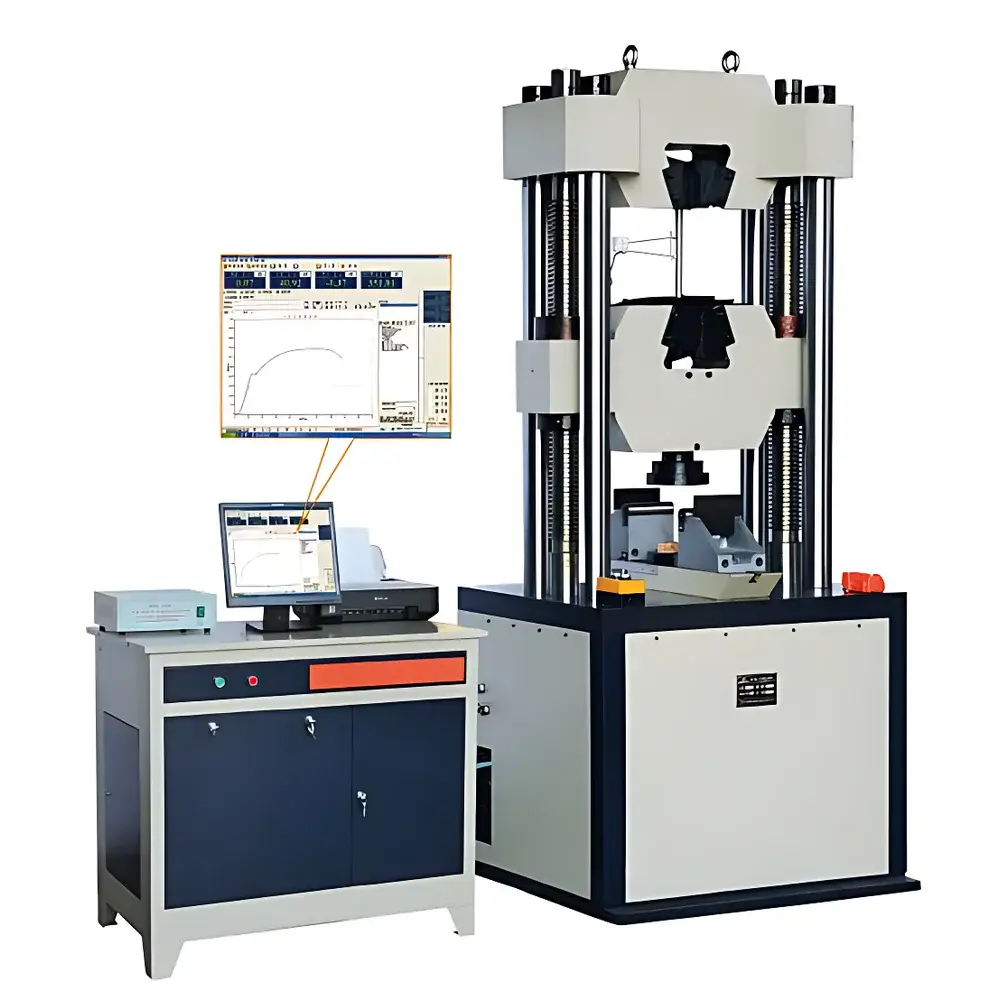
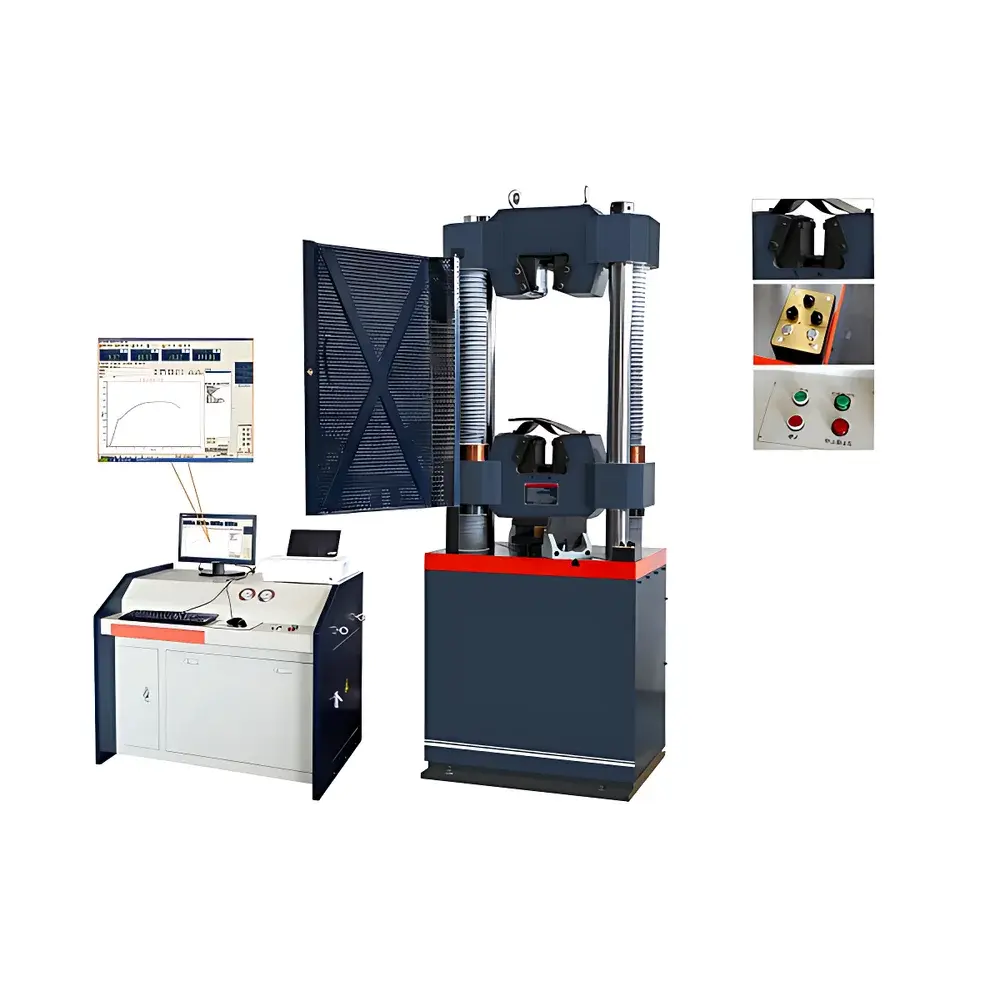
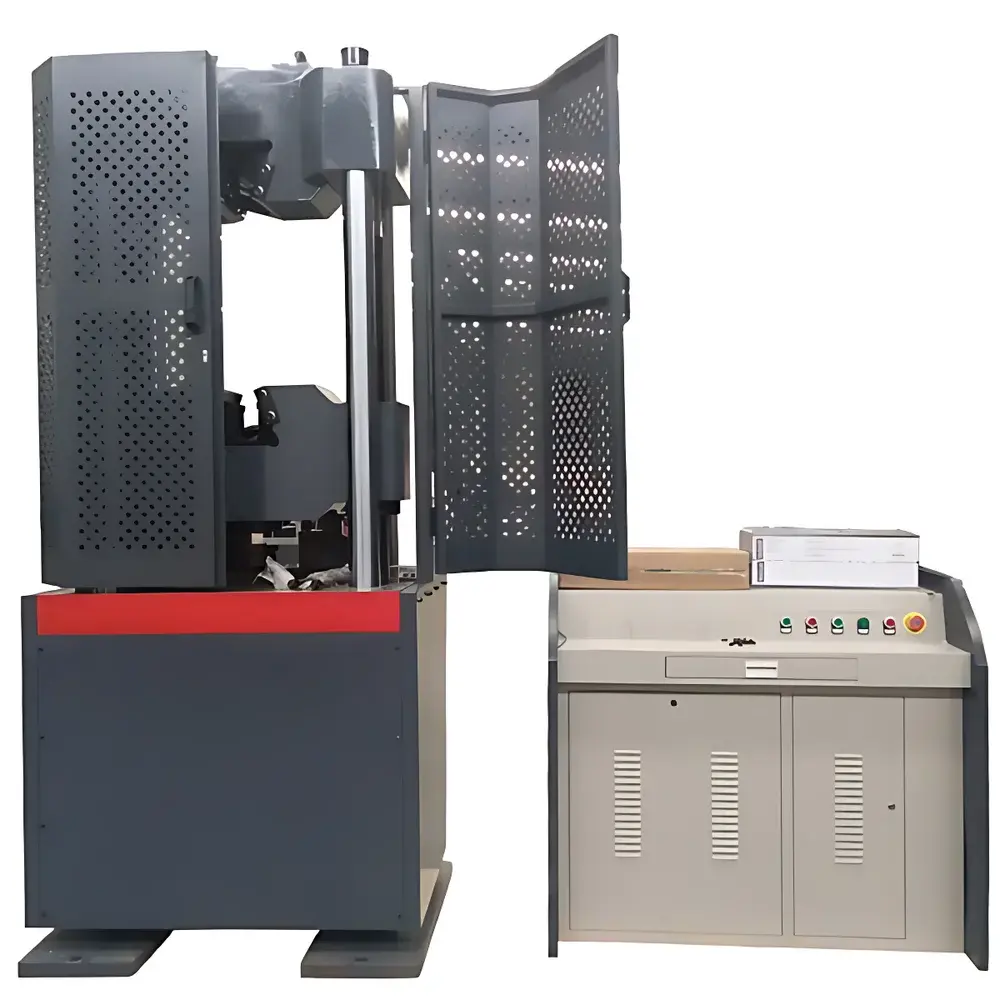
Tuofeng WAW-100B Electro-Hydraulic Servo Universal Testing Machine
| Brand | Tuofeng |
|---|---|
| Origin | Shanghai, China |
| Manufacturer Type | Direct Manufacturer |
| Model | WAW-100B |
| Max. Test Load | 100 kN |
| Force Measurement Range | 2–100% FS |
| Force Accuracy | ≤ ±1% of reading |
| Force Resolution | 0.01 kN |
| Displacement Resolution | 0.01 mm |
| Deformation Resolution | 0.01 mm |
| Max. Tensile Space | 550 mm |
| Max. Compression Space | 450 mm |
| Piston Stroke | 150 mm |
| Round Specimen Grip Range | Φ6–Φ26 mm |
| Flat Specimen Thickness Capacity | 0–15 mm |
| Flat Specimen Max. Width | 70 mm |
| Compression Platen Diameter | φ160 mm |
| Bending Span (Max.) | 450 mm |
| Bending Support Width | 120 mm |
| Bending Support Diameter | Φ30 mm |
| Max. Piston Speed | 50 mm/min |
| Clamping Method | Manual |
| Host Dimensions (W×D×H) | 720×580×1950 mm |
| Control Cabinet Dimensions (W×D×H) | 1000×700×1400 mm |
| Compliance | GB/T 228.1–2021 (revised from GB 228–2002), ISO 6892-1, ASTM E8/E21 |
Overview
The Tuofeng WAW-100B Electro-Hydraulic Servo Universal Testing Machine is a precision-engineered mechanical testing system designed for static mechanical property evaluation of metallic and non-metallic materials under tension, compression, bending, and shear loading conditions. Built upon a robust oil-cylinder-underneath structural architecture, the machine delivers high-force stability and long-term repeatability in laboratory and industrial quality control environments. Its hydraulic actuation system—comprising a high-pressure servo-controlled pump, precision digital electro-hydraulic servo valve, differential pressure regulation module, and high-fidelity load cell—is synchronized with a real-time closed-loop control algorithm to ensure strict adherence to rate-controlled test protocols (e.g., constant crosshead speed, constant load rate, or constant strain rate). The system conforms to internationally recognized mechanical testing standards including GB/T 228.1–2021 (equivalent to ISO 6892-1), ASTM E8/E21 for metallic materials, and supports method development aligned with ISO 7500-1 (calibration of force-proving instruments) and ISO 5893 (tensile and compression testing machines).
Key Features
- Oil-cylinder-underneath frame design optimizes vertical stiffness and minimizes column deflection during high-load compression tests.
- Dual-zone workspace: upper zone dedicated to tensile testing; lower zone (between lower crosshead and base table) configured for compression and three-point/four-point bending.
- Motor-driven, chain-and-screw transmission system enables precise adjustment of test space—supporting specimen lengths up to 550 mm in tension and 450 mm in compression.
- Digital electro-hydraulic servo control architecture ensures dynamic response fidelity, enabling programmable load/position/displacement profiles with sub-millisecond command latency.
- Integrated high-resolution displacement measurement via optical encoder (0.01 mm resolution) and optional extensometer (YYU-25/50) for true strain acquisition compliant with ISO 9513 Class 1 accuracy requirements.
- Two-tier user permission management (administrator and operator levels) enforces role-based access control for method editing, calibration, and report generation—supporting audit-ready workflows.
- Overload protection (≥103% FS) and mechanical stroke limit switches automatically halt pump operation to prevent hardware damage or unsafe operational states.
Sample Compatibility & Compliance
The WAW-100B accommodates a broad spectrum of standardized specimens per international material testing conventions. Round specimens ranging from Φ6 mm to Φ26 mm are secured using manually tightened wedge-action grips; flat specimens up to 15 mm thick and 70 mm wide are clamped with parallel-faced jaws. Compression testing utilizes a φ160 mm hardened steel platen, while bending fixtures feature adjustable support rolls (Φ30 mm, 120 mm width) with span settings up to 450 mm. All mechanical interfaces comply with ISO 2041 (testing machine terminology) and GB/T 16825.1 (verification of uniaxial testing machines). The system’s force measurement subsystem is traceably calibrated per ISO 7500-1 Class 1, and its software architecture supports electronic record integrity in alignment with GLP and GMP documentation practices.
Software & Data Management
The embedded Windows-based control software provides a unified interface for test configuration, real-time monitoring, post-test analysis, and reporting. Core functionalities include customizable test step sequencing, open-ended standard editing (ASTM, ISO, GB), and Excel-compatible report templates allowing field-level formatting without scripting. Real-time multi-curve visualization includes force–displacement, stress–strain, force–time, and deformation–time plots—all time-synchronized and exportable as CSV or image files. Raw data files are stored in structured binary format with embedded metadata (operator ID, timestamp, environmental conditions, calibration status). Audit trail functionality logs all critical actions—including parameter modifications, calibration events, and report exports—satisfying basic requirements for FDA 21 CFR Part 11 compliance when deployed with appropriate IT governance controls.
Applications
This system serves as a foundational platform for mechanical characterization across multiple sectors: metallurgical R&D labs evaluating yield strength, ultimate tensile strength, and elongation at break in alloy development; civil engineering QA/QC departments verifying reinforcement bar compliance per GB/T 1499.2; aerospace suppliers conducting batch qualification of titanium and aluminum extrusions; academic institutions performing fracture mechanics and creep pre-testing; and polymer compounders assessing flexural modulus of thermoplastics and composites. Its versatility extends to teaching laboratories where students perform standardized tensile demonstrations under instructor-defined protocols.
FAQ
What standards does the WAW-100B support out-of-the-box?
It natively implements GB/T 228.1–2021, with configurable templates for ASTM E8, ISO 6892-1, and EN 10002-1. Custom standards can be imported via XML-based profile definitions.
Is the system compatible with third-party extensometers?
Yes—the analog input channel accepts industry-standard LVDT and strain-gauge-based extensometers with ±10 V output and supports automatic zeroing and gauge length registration.
Can test data be exported to LIMS or ERP systems?
Raw test data (CSV) and summary reports (PDF/XLSX) are fully exportable; API integration is available via optional OPC UA server module for enterprise system interoperability.
What maintenance intervals are recommended for the hydraulic system?
Hydraulic oil replacement every 2,000 operating hours or biannually (whichever occurs first); filter elements replaced every 1,000 hours; annual verification of servo valve hysteresis and load cell linearity per ISO 7500-1 Annex C.
Does the system meet electromagnetic compatibility (EMC) requirements for CE marking?
The control cabinet complies with IEC 61326-1 (industrial EMC) and IEC 61000-6-2/-4; full CE-marked configuration requires integration with certified power distribution and grounding infrastructure.



