

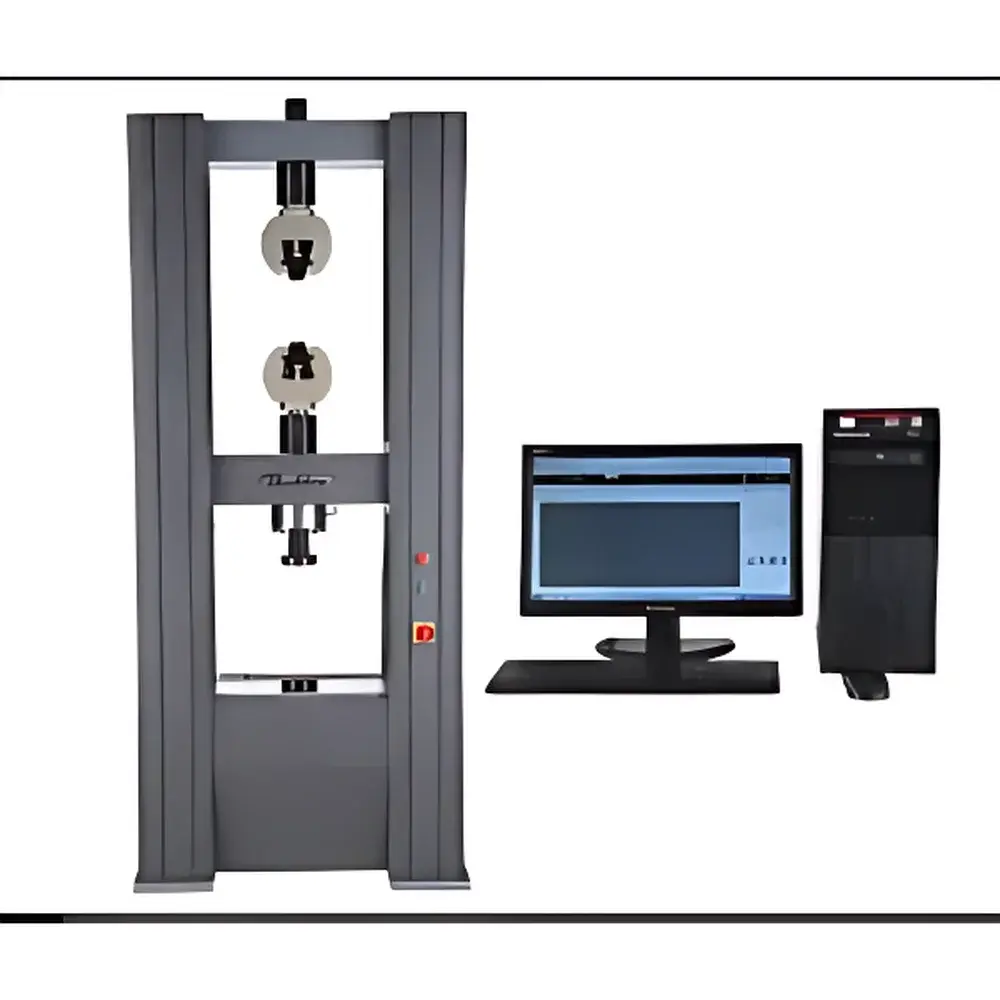
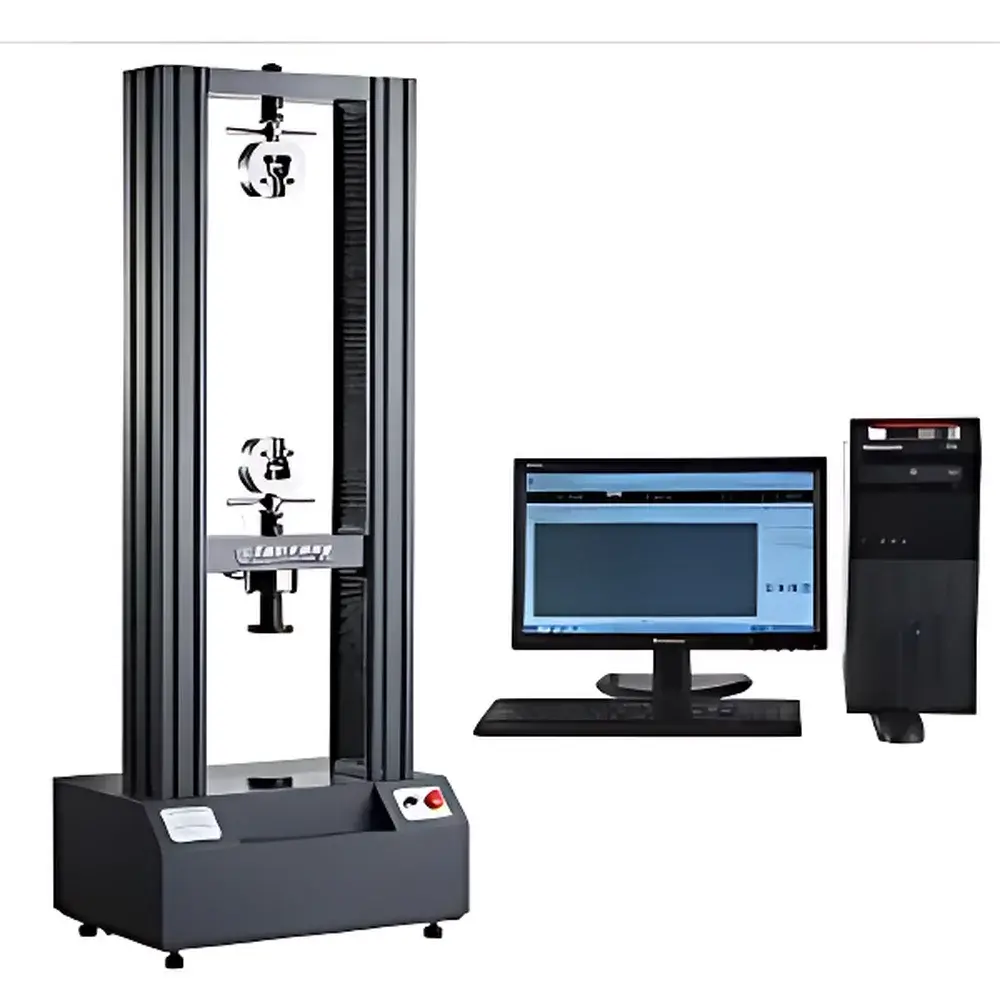
Tuofeng TFW-19 PC-Controlled Electromechanical Universal Testing Machine
| Brand | Tuofeng |
|---|---|
| Origin | Shanghai, China |
| Manufacturer Type | Direct Manufacturer |
| Product Category | Domestic |
| Model | TFW-19 |
| Instrument Type | Electromechanical Universal Testing Machine |
| Accuracy Class | 0.5 |
| Max Test Load | 100 kN |
| Effective Force Range | 0.2–100% of Full Scale |
| Force Measurement Accuracy | ±0.005% of Reading |
| Load Cell Resolution | 1 part in ±500,000 full-scale codes (no range switching, constant resolution) |
| Drive System | Imported Servo Motor with Worm Gear Reducer |
| Lead Screw | High-Precision Ball Screw |
| Effective Test Width | 600 mm (customizable) |
| Stroke | 800 mm (extendable) |
| Speed Range | 0.001–500 mm/min (infinitely variable) |
| Displacement Measurement | Optical Encoder |
| Displacement Accuracy | ±0.005% of Reading |
| Strain Measurement | Optional Extensometer or Large-Deformation Sensor |
| Strain Accuracy | ±0.005% of Reading |
| Safety Protection | Electronic Limit Switches, Emergency Stop Button, Overload Protection (10% above capacity) |
| Crosshead Adjustment | Dual-Speed Motorized (Fast/Slow), Point-to-Point Control |
| Return Function | Automatic or Manual High-Speed Return to Initial Position |
| Fixture Customization | Application-Specific Clamps Available |
| Dimensions (W×D×H) | 1000 × 700 × 2000 mm |
| Power Supply | 220 V, 1.5 kW |
| Weight | ~800 kg |
| Compliance | GB/T 16491–2008, JJG 475–2008, ASTM E4, ASTM E8, ASTM D638, ISO 6892-1, ISO 178, DIN 53455, JIS Z2241, BS EN 10002-1 |
Overview
The Tuofeng TFW-19 PC-Controlled Electromechanical Universal Testing Machine is a dual-column, microprocessor-driven mechanical testing system engineered for high-precision static mechanical characterization of metallic, polymeric, composite, and ceramic materials. Based on the fundamental principle of controlled displacement actuation via servo-motor-driven ball screw transmission, the system applies calibrated axial loads while simultaneously measuring force, displacement, and—when equipped with optional extensometry—true strain. Its modular architecture supports standardized tensile, compression, flexure, shear, tear, peel, and burst testing protocols across R&D laboratories, QC departments, and third-party certification bodies. Designed to meet international metrological traceability requirements, the TFW-19 delivers Class 0.5 accuracy per GB/T 16491–2008 and JJG 475–2008, with force resolution maintained at 1 part in ±500,000 full-scale throughout the entire measurement range—eliminating range-switching artifacts common in legacy systems.
Key Features
- Dual-column rigid frame with reinforced welded steel construction ensures minimal deflection (<0.05 mm under 100 kN load), supporting repeatable alignment for ASTM E4-compliant calibration.
- Imported servo motor coupled with precision worm gear reducer enables smooth, low-noise operation across the full speed spectrum (0.001–500 mm/min), critical for creep and relaxation studies.
- High-accuracy ball screw assembly (C5 grade, preloaded) guarantees axial positioning repeatability within ±0.005 mm over 800 mm stroke.
- Real-time dual-channel acquisition: synchronized force (via temperature-compensated S-beam load cell) and displacement (via quadrature optical encoder) sampling at ≥1 kHz.
- Integrated safety triad: programmable electronic limit switches, hardware-based emergency stop circuit, and automatic overload cutoff at 110% of rated capacity.
- Motorized crosshead with independent fast/slow modes and point-to-point jog control simplifies specimen setup and post-test recovery.
- Modular fixture interface (M6/M8 threaded mounting pattern) accommodates ASTM-standard wedge grips, pneumatic clamps, compression platens, and custom tooling.
Sample Compatibility & Compliance
The TFW-19 accommodates specimens ranging from thin polymer films (≥0.05 mm thickness) to structural steel coupons (up to 60 mm diameter). Standard configurations support flat tensile strips (per ASTM D638 Type I–V), round bars (ASTM E8), rectangular beams (ISO 178), and laminated composites (ASTM D3039). With optional extensometers (clip-on or non-contact video-based), it meets ISO 527-2 and ASTM E83 requirements for strain-controlled testing. The system complies with national and international standards including GB/T 228.1–2021, ASTM E4 (verification of force-measuring instruments), ASTM E8/E8M (tension testing of metallic materials), ISO 6892-1 (metallic tensile testing at ambient temperature), and ISO 178 (flexural properties of plastics). Calibration certificates are traceable to NIM (National Institute of Metrology, China) and compatible with ISO/IEC 17025–accredited laboratory workflows.
Software & Data Management
The Windows-based TFW-TestSuite v4.2 software provides full GLP/GMP-aligned data integrity: audit-trail-enabled user login, electronic signatures, and 21 CFR Part 11–compliant configuration locking. It supports seven test modes—constant rate of extension (CRE), constant rate of loading (CRL), constant stress, constant strain, hold-to-load, hold-to-strain, and cyclic ramp-hold—each fully programmable with up to 20 step sequences. Real-time plotting includes dual-Y-axis stress–strain, load–displacement, and time-series overlays. All raw data (force, displacement, strain, time) are stored in open CSV/HDF5 formats; calculated parameters—including tensile strength, yield point (0.2% offset), Young’s modulus, elongation at break, compressive yield strength, and secant modulus—are auto-generated per input geometry (cross-section area, gauge length). Batch analysis tools enable statistical comparison across up to 99 specimens, with export-ready reports (PDF/Excel) containing embedded curves, metadata, and compliance statements.
Applications
The TFW-19 serves as a core platform in materials qualification workflows across regulated and industrial sectors. In aerospace, it validates aluminum-lithium alloy sheet formability per AMS 4077 and carbon-fiber prepreg interlaminar shear strength (ILSS) per ASTM D2344. In medical device manufacturing, it verifies tensile integrity of nitinol stent wires (ISO 15626) and suture breaking strength (ISO 10555-1). Automotive Tier-1 suppliers use it for rubber bushing compression set (ASTM D395) and thermoplastic elastomer tear resistance (ASTM D624). Within academic research, its high-resolution load/displacement fidelity supports constitutive modeling of shape-memory polymers and viscoelastic damping characterization. Regulatory submissions to FDA, CE Notified Bodies, or CNAS-accredited labs routinely reference TFW-19-derived datasets due to its documented metrological traceability and software validation documentation package.
FAQ
Does the TFW-19 support ASTM E23 for impact-modified polymer Charpy testing?
No—the TFW-19 is a quasi-static electromechanical tester; impact testing requires pendulum or drop-weight systems per ASTM E23.
Can the system be integrated into a factory MES or LIMS environment?
Yes—via OPC UA or TCP/IP API, enabling bidirectional data exchange with Siemens Opcenter, LabVantage, or Thermo Fisher SampleManager.
Is third-party calibration certification available?
Yes—NIST-traceable calibration kits and accredited field service are offered annually, with full uncertainty budgets per ISO/IEC 17025.
What is the warranty coverage and software update policy?
Standard 24-month parts-and-labor warranty; software upgrades (including new standard method modules) are provided free of charge for life.
Are video extensometers supported for non-contact strain measurement?
Yes—optional DIC-based video extensometry (5 MP resolution, 120 fps) is available for ASTM E83 Class B compliance and surface deformation mapping.
Related Products



