
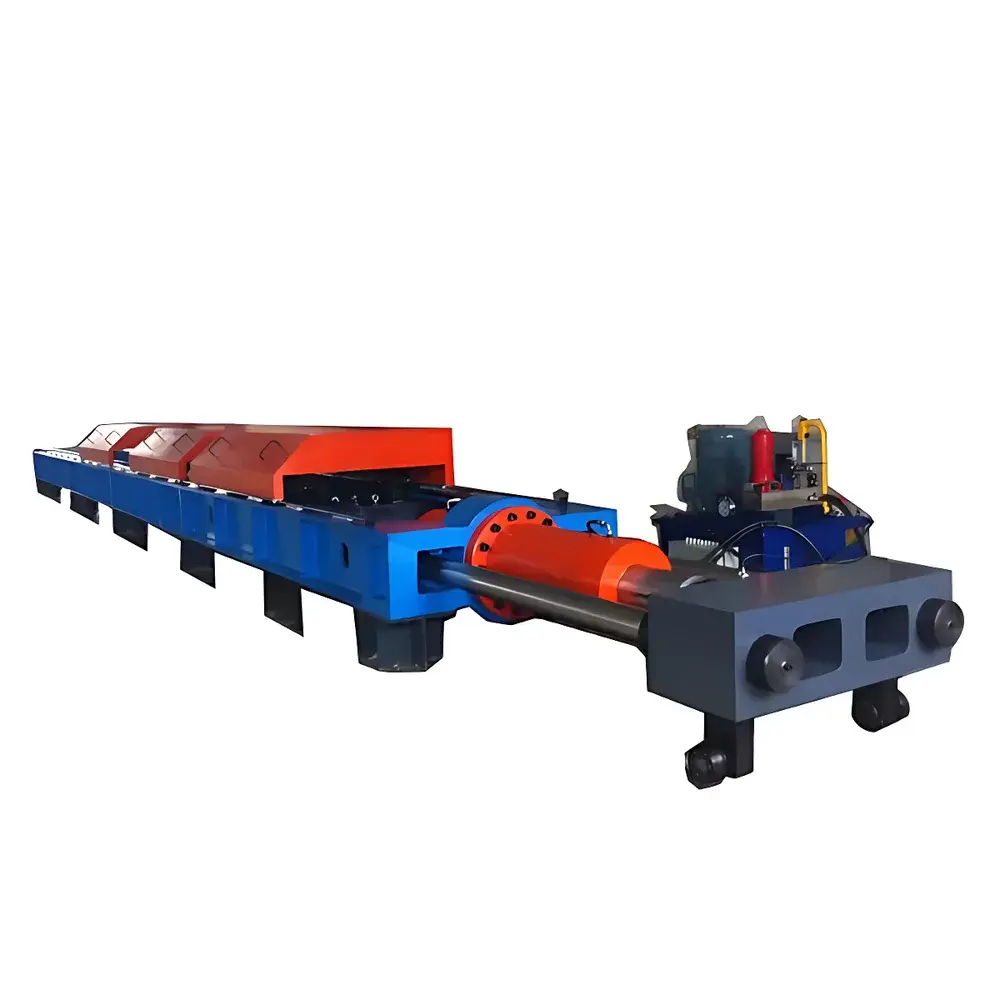
Topfeng TFW-218 Horizontal Tensile Testing Machine
| Brand | Topfeng |
|---|---|
| Origin | Shanghai, China |
| Manufacturer Type | Direct Manufacturer |
| Product Category | Domestic |
| Model | TFW-218 |
| Instrument Type | Electromechanical Tensile Testing Machine |
| Maximum Test Load | 5000 kN |
| Load Measurement Range | 0.2–100% of Full Scale |
| Load Accuracy | ±0.5% FS |
| Test Stroke | 25 m |
| Displacement Resolution | 0.0001 mm |
Overview
The Topfeng TFW-218 Horizontal Tensile Testing Machine is an industrial-grade electromechanical testing system engineered for high-capacity static tensile evaluation of structural and safety-critical components. Designed around a rigid welded frame architecture with a single-rod, double-acting servo hydraulic actuator, the machine delivers controlled, repeatable axial loading up to 5000 kN—making it suitable for qualification testing of heavy-duty mechanical assemblies such as marine anchor chains, aircraft cable systems, lifting slings, wire ropes, high-strength bolts, shackles, and turnbuckles. The system operates on closed-loop servo control principles, integrating real-time load feedback from high-precision compression-tension load cells and displacement monitoring via optical rotary encoders. Its horizontal configuration accommodates extended test specimens (up to 25 m total stroke) while maintaining alignment integrity and minimizing bending moments during loading—critical for ASTM E8/E8M, ISO 6892-1, and EN 10002-1 compliant tensile characterization.
Key Features
- Rigid horizontal frame structure with reinforced base and guided crosshead movement for optimal load train alignment and minimal parasitic bending
- Single-rod, double-acting servo-controlled hydraulic actuator delivering smooth, programmable force application across full 0–200 mm/min speed range
- High-stability load measurement using calibrated S-type or canister-type load cells with ±0.5% full-scale accuracy per ISO 376 Class 0.5
- Displacement sensing via high-resolution optical encoder (0.0001 mm resolution), synchronized with load acquisition at ≥1 kHz sampling rate
- Modular fixture interface supporting custom-designed grips—including wedge-action rope clamps, threaded bolt adapters, and swivel-link anchoring systems—for secure specimen engagement without slippage or premature failure
- Hydraulically driven movable crosshead with pin-lock positioning mechanism enabling rapid, repeatable adjustment of test length between 2 m and 25 m
- Dedicated digital servo amplifier enabling simultaneous force, displacement, and strain control loops—fully compliant with ASTM E4 and ISO 5893 requirements for closed-loop testing
Sample Compatibility & Compliance
The TFW-218 accommodates specimens ranging from Ø6 mm steel cables to Ø80 mm mooring chains and fully assembled rigging hardware up to 25 meters in effective gauge length. Specimen mounting is facilitated by interchangeable grip sets engineered for specific material geometries and surface conditions—e.g., knurled jaw inserts for high-friction wire rope retention or low-profile collars for threaded fasteners. All mechanical interfaces conform to ISO 26203-2 (tensile testing of metallic materials—method for determination of mechanical properties at elevated temperatures) dimensional tolerances. The system supports standardized test protocols including ASTM A391/A391M (chain), ASTM A931 (wire rope), ISO 17081 (shackles), and EN 13411-2 (terminations). Structural design complies with CE Machinery Directive 2006/42/EC and incorporates dual-channel emergency stop circuits, light curtain interlocks, and full perimeter safety guarding per ISO 13857.
Software & Data Management
Control and data acquisition are managed through Topfeng’s proprietary TensileLab™ v4.2 software platform, a Windows-based application certified for GLP/GMP environments. The software provides real-time visualization of force–displacement, stress–strain, and force–time curves with user-definable scaling and overlay functions. Automated calculation modules compute yield strength (Rp0.2), ultimate tensile strength (Rm), elongation at break (A), reduction of area (Z), and modulus of elasticity (E) per ISO 6892-1 Annex A. Raw data export is supported in CSV, XML, and universal .tdms formats; audit trails include operator ID, timestamp, calibration certificate references, and parameter change logs—all compliant with FDA 21 CFR Part 11 requirements for electronic records and signatures. Optional integration with LIMS platforms is available via OPC UA protocol.
Applications
- Qualification and periodic certification testing of marine mooring systems (anchor chains, synthetic fiber ropes, chain stoppers)
- Mechanical verification of aerospace-grade fasteners, clevis pins, and swaged terminations under static overload conditions
- Developmental testing of high-performance composite tendons and prestressed concrete reinforcement cables
- Failure mode analysis of lifting gear components (hooks, links, eye bolts) per ASME B30.26 standards
- Validation of welding integrity and heat-affected zone (HAZ) performance in heavy-section steel joints
- Third-party conformity assessment for CE marking, DNV-GL type approval, and LR certification programs
FAQ
What is the maximum allowable specimen length for full-stroke testing?
The effective test space ranges from 2 m to 25 m, excluding the 1000 mm piston stroke. Total system envelope must be verified during site planning to ensure adequate clearance for specimen extension and safety containment.
Does the system support strain-controlled testing modes?
Yes—when paired with optional extensometers (e.g., clip-on or non-contact video-based), the controller enables true strain-rate-controlled tests per ISO 6892-2, with programmable ramp rates down to 0.00025 s⁻¹.
Is calibration traceability provided with delivery?
Each unit ships with a UKAS-accredited calibration certificate covering load cell, displacement transducer, and control loop linearity—valid for 12 months under standard operating conditions.
Can the machine perform proof load and load-hold tests?
Yes—the software includes predefined test templates for ISO 8722 proof load verification, ASTM F2101 hold-duration protocols, and cyclic preload sequences with dwell periods up to 72 hours.
What maintenance intervals are recommended for hydraulic subsystems?
Hydraulic oil analysis and filter replacement are advised every 2000 operational hours or annually, whichever occurs first; servo valve recalibration is recommended every 5 years or after 10,000 test cycles.



