
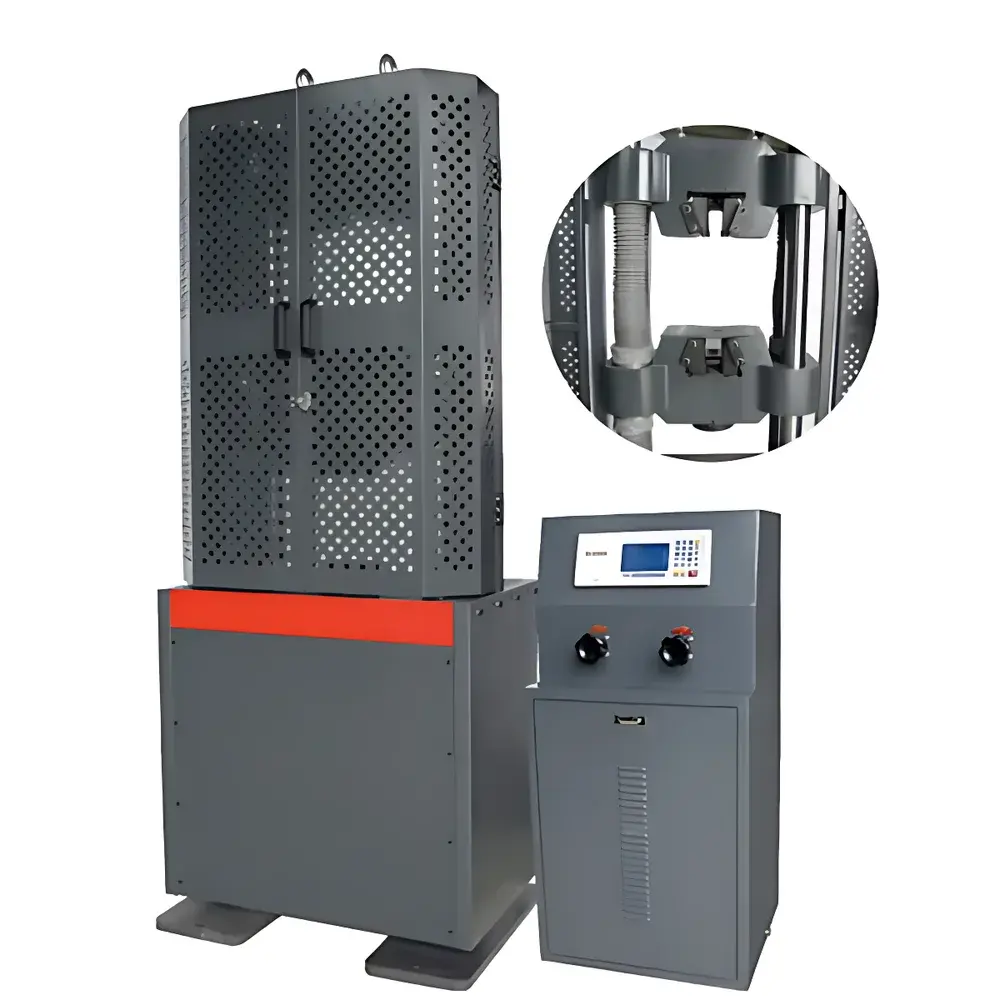
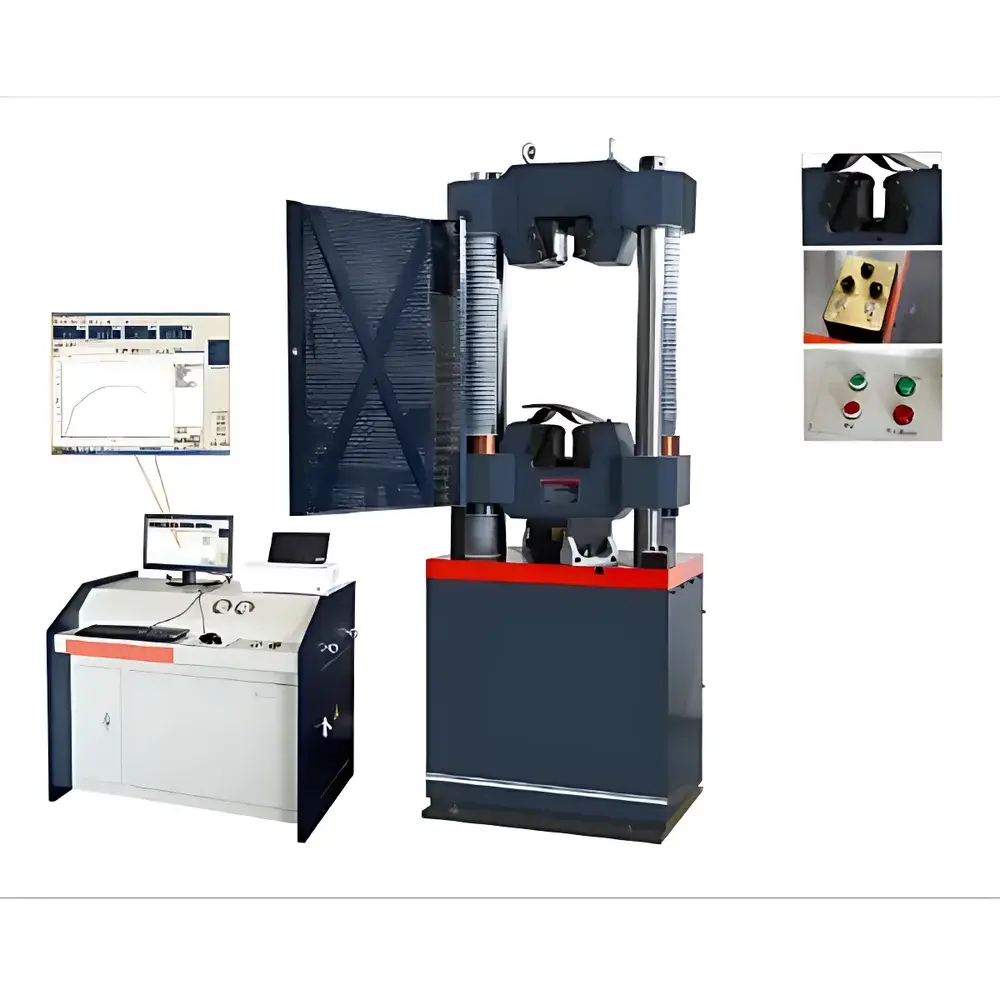
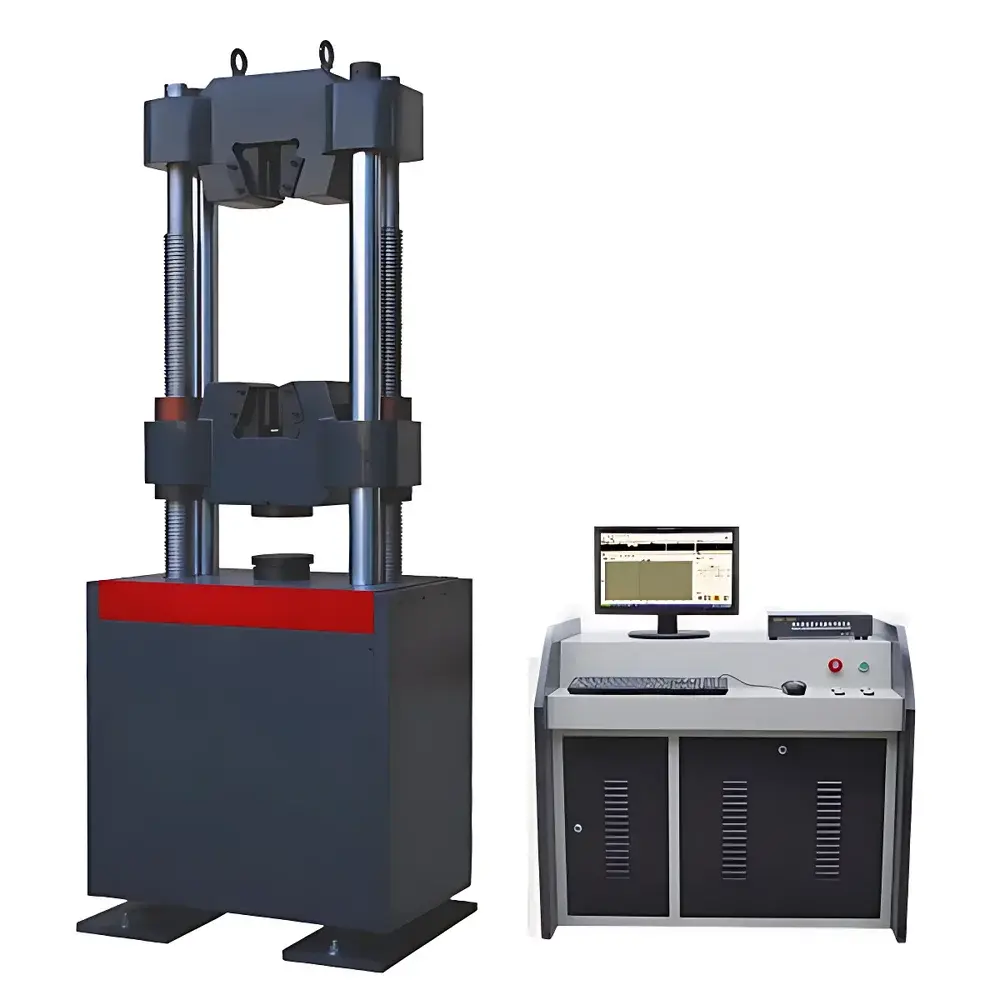
Tuofeng TFW-216 Electro-Hydraulic Servo Universal Testing Machine
| Brand | Tuofeng |
|---|---|
| Origin | Shanghai, China |
| Manufacturer Type | Direct Manufacturer |
| Equipment Type | Electro-Hydraulic Servo Universal Testing Machine |
| Model | TFW-216 |
| Max Load Capacity | 1000 kN |
| Force Measurement Range | 1–100% of full scale |
| Force Resolution | 0.01 kN |
| Force Accuracy | ±1% of indicated value |
| Displacement Measurement | Optical encoder |
| Displacement Accuracy | ±1% of indicated value |
| Displacement Resolution | 0.01 mm |
| Tensile Space | 650 mm |
| Compression Space | 650 mm |
| Round Specimen Grip Range | Ø13–40 mm |
| Flat Specimen Thickness Range | 0–15 mm |
| Clamping Method | Automatic hydraulic clamping |
| Piston Stroke | 250 mm |
| Maximum Piston Speed | 70 mm/min |
| Bend Support Roller Spacing | 40–600 mm |
| Bend Support Roller Width | 140 mm |
| Max Allowable Deflection | 100 mm |
| Shear Specimen Diameter | Ø10 mm |
| Compression Platen Dimensions | 204 × 204 mm |
| Host Dimensions (W×D×H) | 890 × 660 × 2200 mm |
| Control Cabinet Dimensions (W×D×H) | 500 × 400 × 1200 mm |
| Power Supply | 3-phase, 2.2 kW |
| Net Weight | 3400 kg |
Overview
The Tuofeng TFW-216 Electro-Hydraulic Servo Universal Testing Machine is a high-capacity, precision-engineered system designed for static mechanical property evaluation of metallic and non-metallic materials under tension, compression, bending, shear, and cyclic loading conditions. Built on a robust four-column, two-screw, bottom-mounted hydraulic actuator architecture, the machine delivers stable load application and high structural rigidity—critical for maintaining force linearity and minimizing frame deflection during high-load testing. Its electro-hydraulic servo control architecture integrates a high-response servo valve, precision pressure transducers, optical displacement encoders, and a fully digital multi-channel closed-loop controller. This enables simultaneous and independent control of test parameters—including stress rate, strain rate, and crosshead displacement—fully compliant with ISO 6892-1, ASTM E8/E21, GB/T 228.1–2021, and EN 10002-1 standards. The system’s oil-immersed actuation ensures smooth, low-noise operation and exceptional thermal stability over extended test durations.
Key Features
- Four-column, dual-screw frame with bottom-mounted hydraulic cylinder—optimized for high axial stiffness and minimal parasitic bending moments
- Full digital multi-channel closed-loop control system supporting stress, strain, and displacement control modes with seamless, impact-free mode switching
- Automatic hydraulic wedge-type grips with programmable clamping pressure—ensuring uniform contact stress and eliminating slippage for round (Ø13–40 mm) and flat (0–15 mm thick) specimens
- High-fidelity optical encoder-based displacement measurement with 0.01 mm resolution and ±1% accuracy across full stroke (250 mm)
- Dual-range high-precision load cell calibrated to 1000 kN maximum capacity, delivering 0.01 kN resolution and traceable accuracy within ±1% of reading per ISO 7500-1 Class 1
- Programmable piston speed range up to 70 mm/min, enabling quasi-static and slow-rate loading protocols per ASTM E238 and ISO 7500-1
- Modular bend fixture assembly with adjustable roller spacing (40–600 mm), 140 mm roller width, and 100 mm maximum deflection capability
- Integrated shear test configuration accommodating Ø10 mm cylindrical specimens in accordance with ASTM D732 and ISO 3785
Sample Compatibility & Compliance
The TFW-216 accommodates standard and custom geometries per international material testing specifications—including ASTM E8 (tension), ASTM C39/C109 (concrete compression), ISO 15630-1 (reinforcing steel), and GB/T 228.1 (metal tensile). Its 204 × 204 mm compression platens meet ISO 376 requirements for hardness and parallelism. All force and displacement measurements are traceable to national metrological standards, and system validation adheres to ISO/IEC 17025 guidelines. The machine supports GLP-compliant operation through audit-trail-enabled software logging, user-level access control (administrator and operator tiers), and electronic signature support aligned with FDA 21 CFR Part 11 principles.
Software & Data Management
The embedded Windows-based control and analysis platform provides an open, Excel-integrated reporting environment. Users may define custom test sequences, modify standard templates (e.g., GB/T 228.1 Annex A or ASTM E8 Annex B), and import/export procedure files. Real-time data acquisition captures ≥1 kHz sampling across all channels. Post-test analysis includes automatic yield point detection (0.2% offset method), tensile strength, elongation at break, modulus calculation, and load–displacement curve smoothing per ISO 527-2. All raw and processed data are stored in structured binary + CSV format with time-stamped metadata, supporting third-party integration via TCP/IP or OPC UA interfaces.
Applications
The TFW-216 serves quality control laboratories, R&D centers, and certification bodies conducting mechanical validation of structural steels, aluminum alloys, composites, weldments, fasteners, concrete cylinders, and polymer-reinforced elements. Typical use cases include tensile property verification for ASME BPVC Section II materials, compressive strength assessment of precast concrete elements, bending stiffness evaluation of railway rails per EN 13674-1, and shear strength qualification of aerospace rivets per NASM 1312-7. Its 1000 kN capacity and 650 mm working zones make it suitable for full-scale component testing in automotive crash simulation support structures and civil engineering anchor assemblies.
FAQ
What standards does the TFW-216 comply with for tensile testing?
It fully supports GB/T 228.1–2021, ISO 6892-1:2019, ASTM E8/E21, and EN ISO 15630-1 for metallic materials.
Can the system perform closed-loop strain-controlled tests?
Yes—the digital controller enables real-time strain feedback using extensometer input (optional) or crosshead displacement with calibration compensation.
Is third-party calibration documentation included?
Each unit ships with a factory calibration certificate traceable to CNAS-accredited reference standards; on-site verification and ISO/IEC 17025 calibration services are available upon request.
What safety features are integrated?
Hardware interlocks prevent overtravel, overload, and uncontrolled descent; emergency stop circuit meets IEC 60204-1 Category 3 requirements; hydraulic pressure relief and thermal cut-off protect against system failure.
Does the software support automated report generation for regulatory submissions?
Yes—customizable Excel-based reports include test parameters, raw curves, statistical summaries, and digital signatures, satisfying internal QA and external accreditation requirements (e.g., CNAS, UKAS, A2LA).



