
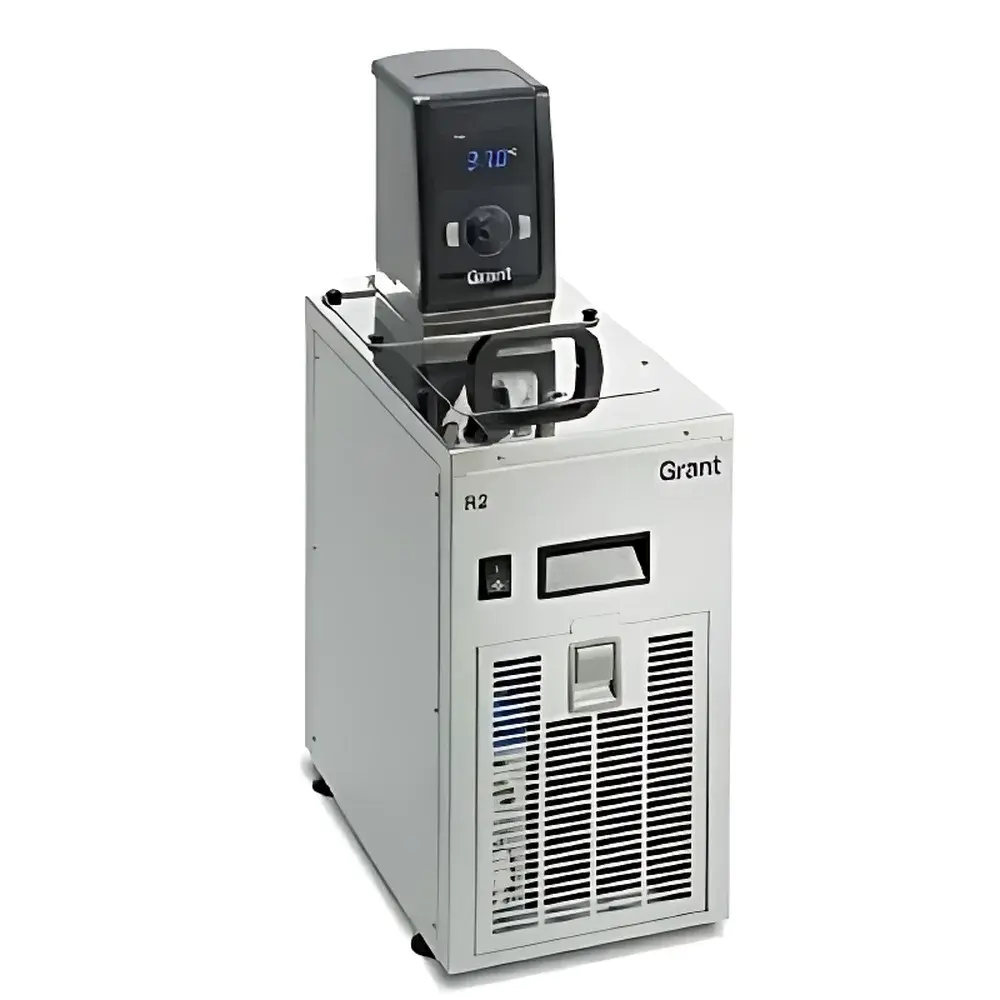
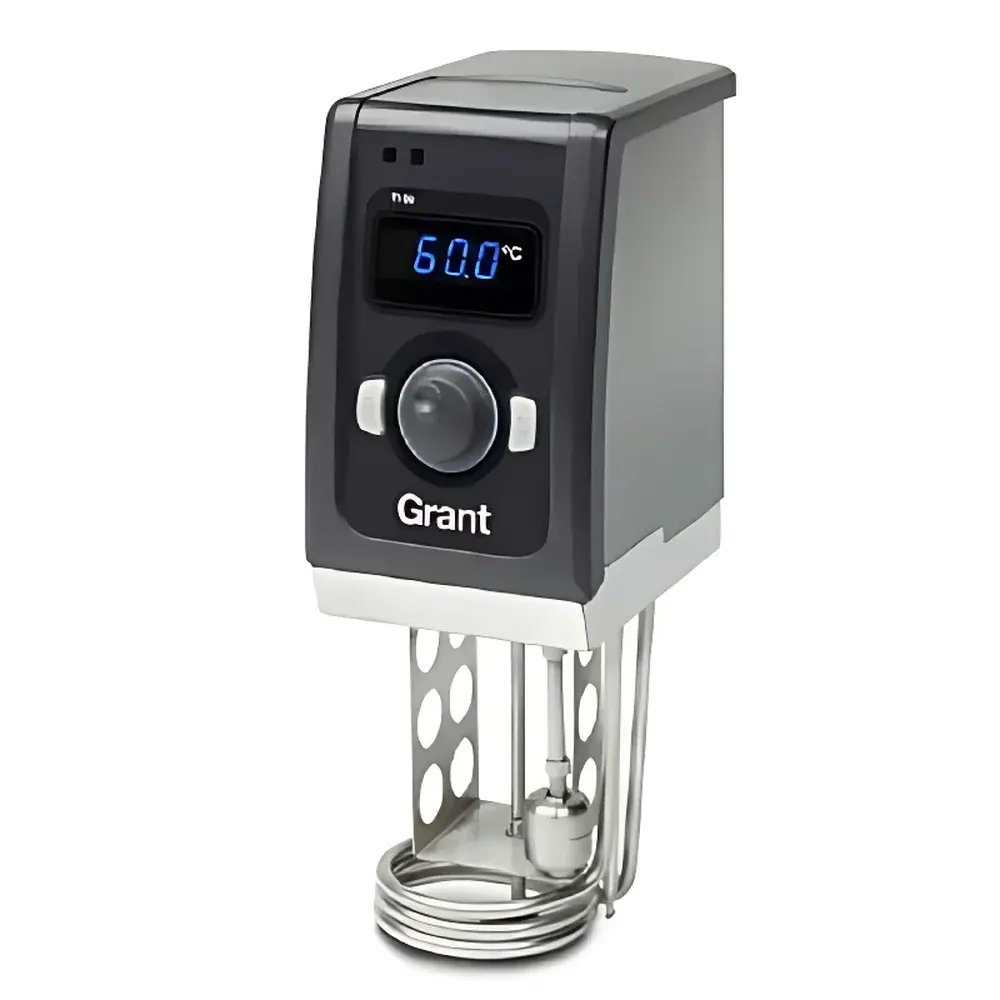
Optima T100-R Refrigerated Circulating Chiller
| Origin | UK |
|---|---|
| Manufacturer Type | Authorized Distributor |
| Origin Category | Imported |
| Model | Optima T100-R |
| Pricing | Available Upon Request |
| Temperature Range | –47 °C to 100 °C (model-dependent) |
| Temperature Stability | ±0.1 °C |
| Dual Heating Power | 2 kW |
| Pump Max Flow Rate | 21 L/min (adjustable) |
| Pump Max Pressure | 460 mbar |
| External Pt1000 Probe Input | Yes |
| Display | Dual—high-brightness LED for setpoint + 2×16-character LCD for menu navigation |
| Preset Temperatures | 3 user-definable |
| Calibration | User-accessible offset adjustment |
| Alarm System | Visual & audible high/low temperature alerts |
| Interface Languages | 5 selectable (English, German, French, Spanish, Italian) |
| Optional Bath Volumes | 5 L, 12 L, or 20 L |
| Drain Port | Included on GP200-R2 through GP200-R5 models |
| Refrigeration Capacity @ 20 °C | 250–1100 W (model-dependent) |
| Refrigeration Capacity @ –10 °C | 140–1050 W (model-dependent) |
Overview
The Optima T100-R Refrigerated Circulating Chiller is a precision-engineered thermal management system designed for laboratory and industrial applications requiring stable, bidirectional temperature control across an exceptionally wide operational range—from –47 °C to 100 °C. Built upon a dual-mode architecture combining high-efficiency vapor-compression refrigeration with robust resistive heating, the unit delivers rapid thermal response and exceptional long-term stability of ±0.1 °C at setpoint. Its core function is to circulate conditioned fluid (typically water/glycol mixtures) through external equipment—such as spectrophotometer jackets, reactor jackets, calorimeters, or material testing chambers—enabling precise thermal regulation of processes or samples independent of ambient conditions. The chiller’s modular design accommodates five distinct refrigeration configurations (GP200-R1 to GP200-R5), each optimized for specific cooling capacity, bath volume, and low-temperature performance requirements, ensuring technical alignment with application-specific thermal loads and spatial constraints.
Key Features
- Dual heating system delivering 2 kW total power for rapid warm-up and precise maintenance above ambient temperature
- High-resolution dual-display interface: bright LED for primary setpoint visibility and a 2-line × 16-character LCD for intuitive menu navigation and status feedback
- Integrated variable-speed circulation pump with adjustable flow (0–21 L/min) and maximum pressure capability of 460 mbar—suitable for systems with moderate hydraulic resistance
- External Pt1000 sensor input enabling remote, in-line temperature monitoring and closed-loop feedback control outside the bath
- User-accessible calibration offset function for traceable temperature accuracy verification and fine-tuning at critical operating points
- Configurable high/low temperature alarms with simultaneous visual indicator and audible alert—supporting GLP-compliant process interruption protocols
- Five-language UI support (English, German, French, Spanish, Italian) for multinational lab environments and multi-site deployment consistency
- Energy-efficient refrigeration modules with model-specific capacities ranging from 250 W to 1100 W at 20 °C, enabling selection based on thermal load profiling and sustainability targets
Sample Compatibility & Compliance
The Optima T100-R is compatible with standard aqueous and glycol-based heat transfer fluids (e.g., 30% propylene glycol/water). Its sealed bath designs—available in 5 L, 12 L, and 20 L configurations—minimize evaporation and contamination risk during extended operation. Drain ports are integrated into GP200-R2 through GP200-R5 variants to facilitate routine maintenance and fluid replacement in GMP-aligned workflows. The unit complies with IEC 61010-1:2010 for electrical safety in laboratory equipment and meets EMC directive 2014/30/EU. While not intrinsically rated for hazardous locations, its construction supports use in ISO Class 5–8 cleanrooms when installed with appropriate fluid filtration and particulate control measures. Temperature stability data is validated per ASTM E2777–19 (Standard Practice for Calibration of Thermal Cycling Equipment).
Software & Data Management
The Optima T100-R operates autonomously via its embedded firmware and does not require host PC connectivity for basic functionality. However, optional RS232 or USB-to-serial interfaces enable integration with LabVIEW, MATLAB, or custom SCADA platforms for automated logging and remote setpoint modulation. All alarm events—including temperature excursions, pump faults, and refrigerant pressure anomalies—are timestamped and stored in non-volatile memory for audit trail generation. Though the device itself does not implement FDA 21 CFR Part 11 electronic signature controls, its event log structure supports manual export and inclusion in broader quality documentation systems compliant with ISO/IEC 17025 or GLP Annex 11 requirements.
Applications
- Thermostatic control of UV-Vis, FTIR, and fluorescence spectrophotometers requiring jacketed cell temperature stabilization
- Cooling of high-power lasers and optical components in metrology and photonics laboratories
- Temperature conditioning of polymer rheology test fixtures and DSC sample stages
- Environmental simulation for accelerated aging studies of pharmaceutical packaging materials
- Process cooling in small-scale chemical synthesis reactors and bioreactor temperature loops
- Calibration reference baths for thermocouple and RTD probe validation against NIST-traceable standards
FAQ
Can the refrigeration module be disabled while maintaining heating-only operation?
Yes—the refrigeration circuit can be fully de-energized via front-panel configuration, allowing the unit to operate as a high-stability heated circulator up to 100 °C without compressor engagement.
What is the recommended maintenance interval for the refrigeration system?
Under normal laboratory use (8 hrs/day, 5 days/week), annual inspection of refrigerant charge, condenser coil cleanliness, and pump seal integrity is advised. Full service by certified technicians is recommended every 24 months.
Is the unit suitable for continuous operation at –47 °C?
The GP200-R5 model is specifically engineered for sustained operation at –47 °C; however, ambient temperature must remain ≤25 °C, and fluid composition must be optimized (e.g., 50% ethylene glycol/water) to prevent freezing in external loops.
Does the chiller support external PID control input?
No—external analog setpoint modulation is not supported. Control is limited to internal setpoint programming or serial command-based setpoint updates via optional communication interface.
How is temperature uniformity verified within the bath?
Uniformity is characterized per ISO 17025-accredited test reports: typical axial/radial gradients are ≤0.2 °C across the full bath volume when operated at steady state with nominal flow rate and no external load.



