
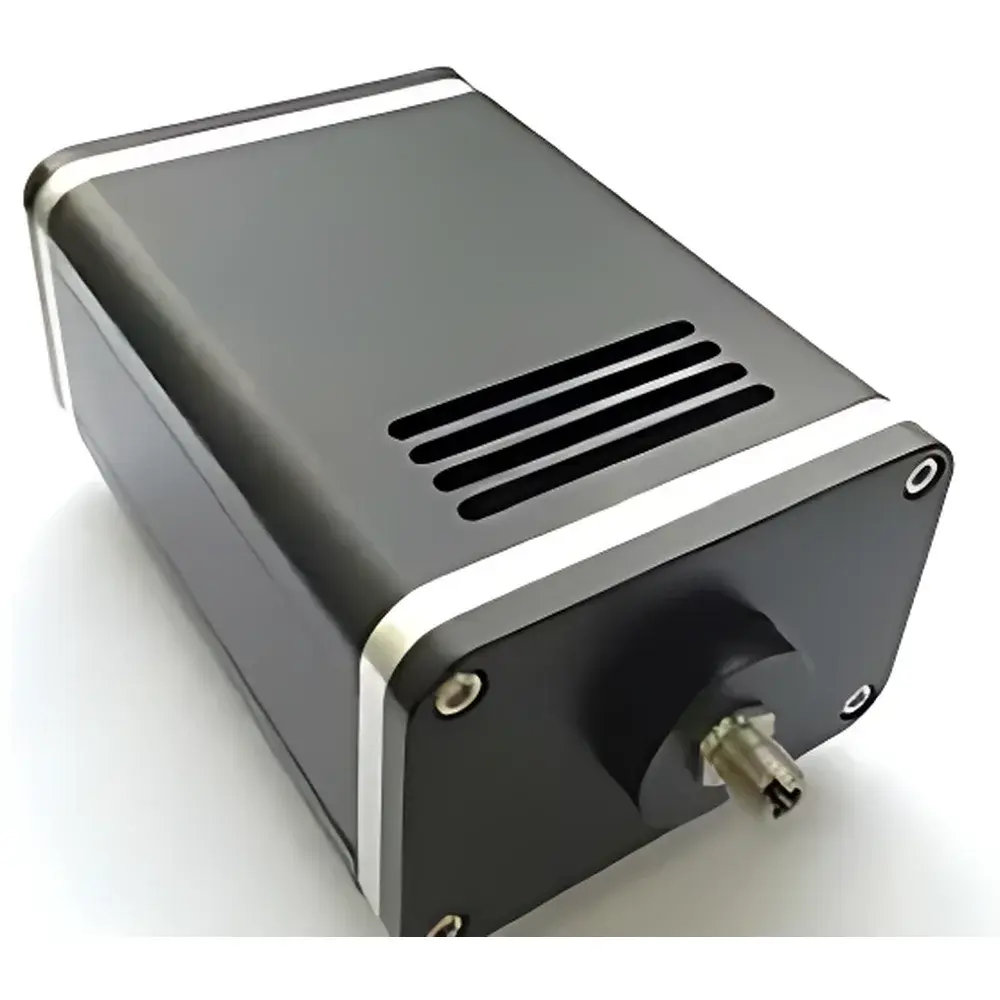
SPL-HL Series Fiber-Coupled Tungsten-Halogen Light Source
| Brand | SPL |
|---|---|
| Origin | Zhejiang, China |
| Manufacturer Type | Authorized Distributor |
| Product Origin | Domestic (China) |
| Model | SPL-HL- |
| Pricing | Upon Request |
| Spectral Range | 360–2500 nm |
| Output Stability | ±0.2% (RMS, over 8 hours) |
| Lifetime | SPL-HL-H — 2,000 h |
| Cooling | Active fan-cooled thermal management |
| Optical Coupling | SMA905 or FC/PC fiber interface (configurable) |
| Power Efficiency | High luminous efficacy (>18 lm/W typical) |
| Design | Modular, OEM-integration ready |
Overview
The SPL-HL Series Fiber-Coupled Tungsten-Halogen Light Source is a precision-engineered broadband illumination system designed for demanding optical measurement applications requiring stable, continuous-spectrum output across the visible and near-infrared (VIS-NIR) spectral region. Operating on the principle of incandescent blackbody radiation enhanced by halogen regeneration chemistry, the SPL-HL delivers spectrally smooth and reproducible irradiance from 360 nm to 2500 nm—covering key absorption bands for spectroscopic analysis, reflectance calibration, and spectral radiometric validation. Its integrated optical train features optimized condenser and collimation optics to maximize coupling efficiency into multimode silica fibers (core diameters 200 µm to 1000 µm), minimizing étendue loss and spatial non-uniformity at the fiber output. The source is not intended for pulsed or modulated operation; it is engineered for DC-stable, low-noise continuous-wave (CW) output suitable for high-fidelity reference illumination in laboratory and industrial metrology environments.
Key Features
- Ultra-broad spectral coverage: 360–2500 nm, enabling compatibility with UV-Vis-NIR spectrometers, hyperspectral imagers, and colorimetric sensors
- Two lifetime configurations: SPL-HL-H (2,000 h rated operational life) and SPL-HL-LL (10,000 h extended-life version with reinforced filament architecture and improved quartz envelope durability)
- High luminous efficacy (LPW): Optimized tungsten filament geometry and halogen cycle kinetics yield >18 lm/W typical efficiency under nominal operating conditions
- Exceptional short- and long-term stability: ±0.2% RMS intensity variation over 8-hour continuous operation, achieved via precision low-drift voltage regulation and thermal feedback control
- Modular mechanical design: Standard 3U rack-mountable chassis (optional benchtop housing available); front-panel fiber port (SMA905 or FC/PC) with alignment lock mechanism
- Active thermal management: Dual-stage axial fan system with temperature-triggered speed control ensures consistent junction temperature (<85°C) and mitigates spectral drift due to thermal load
- Replaceable lamp module: Field-serviceable cartridge design enables rapid lamp replacement without realignment or recalibration
Sample Compatibility & Compliance
The SPL-HL Series is compatible with standard multimode optical fibers (e.g., Ocean Insight QP series, Thorlabs M31L01, or equivalent 0.22 NA silica fibers). It meets mechanical and electrical safety requirements per IEC 61010-1:2010 for laboratory electrical equipment. While not certified to ISO/IEC 17025 as a calibrated standard, its spectral stability and repeatability support traceable use in GLP-compliant workflows when paired with NIST-traceable reference detectors (e.g., Hamamatsu S1337 series or IDT PDM series). The source complies with RoHS 2011/65/EU and REACH (EC) No. 1907/2006 directives. No laser safety classification applies, as output is incoherent broadband radiation.
Software & Data Management
The SPL-HL operates as a standalone analog device with no embedded firmware or digital interface. Intensity control is performed via external 0–10 V analog input (optional TTL-compatible on/off trigger available). For automated integration, users may interface the source with LabVIEW, Python (PyVISA), or MATLAB via programmable DC power supplies (e.g., Keysight N6705B) that provide synchronized voltage ramping and logging. Output stability data (intensity vs. time) can be acquired using a calibrated photodiode sensor and digitizer (e.g., National Instruments USB-6211), supporting audit-ready records required under FDA 21 CFR Part 11 when implemented within validated systems.
Applications
- Calibration of VIS-NIR spectrometers (e.g., OceanInsight Flame, Avantes AvaSpec, or StellarNet Black-Comet)
- Reference illumination for integrating sphere-based reflectance/transmittance measurements (ASTM E275, ISO 11664-5)
- Broadband excitation source in fluorescence lifetime imaging (FLIM) reference channels and white-light interferometry
- Stability testing of optical detectors, CCD/CMOS sensors, and InGaAs array modules
- Teaching labs for radiometry, photometry, and spectral characterization fundamentals
- OEM integration into portable NIR analyzers for agriculture, pharmaceutical, and food quality inspection platforms
FAQ
Is the SPL-HL Series NIST-traceably calibrated?
No—SPL-HL units are supplied as stable broadband sources without factory spectral irradiance calibration. Users requiring absolute radiometric accuracy must perform independent calibration using a NIST-traceable spectroradiometer.
Can the output be modulated at kHz frequencies?
No—the SPL-HL is a thermally dominated incandescent source with inherent thermal inertia; modulation bandwidth is limited to <1 Hz. For fast modulation, consider LED or supercontinuum alternatives.
What fiber connector types are supported?
Standard configuration includes SMA905; FC/PC and ST adapters are available upon request. Custom numerical aperture matching optics can be specified for specialty fibers.
Does the SPL-HL-LL model require special power conditioning?
No—it operates from standard 100–240 VAC, 50/60 Hz input. However, use of an online UPS with sine-wave output is recommended to prevent voltage sags that accelerate filament degradation.
Is remote monitoring of lamp hours possible?
Not natively—the unit lacks internal hour-meter circuitry. Integration with external PLCs or DAQ systems via auxiliary relay outputs (optional) enables runtime logging.





