
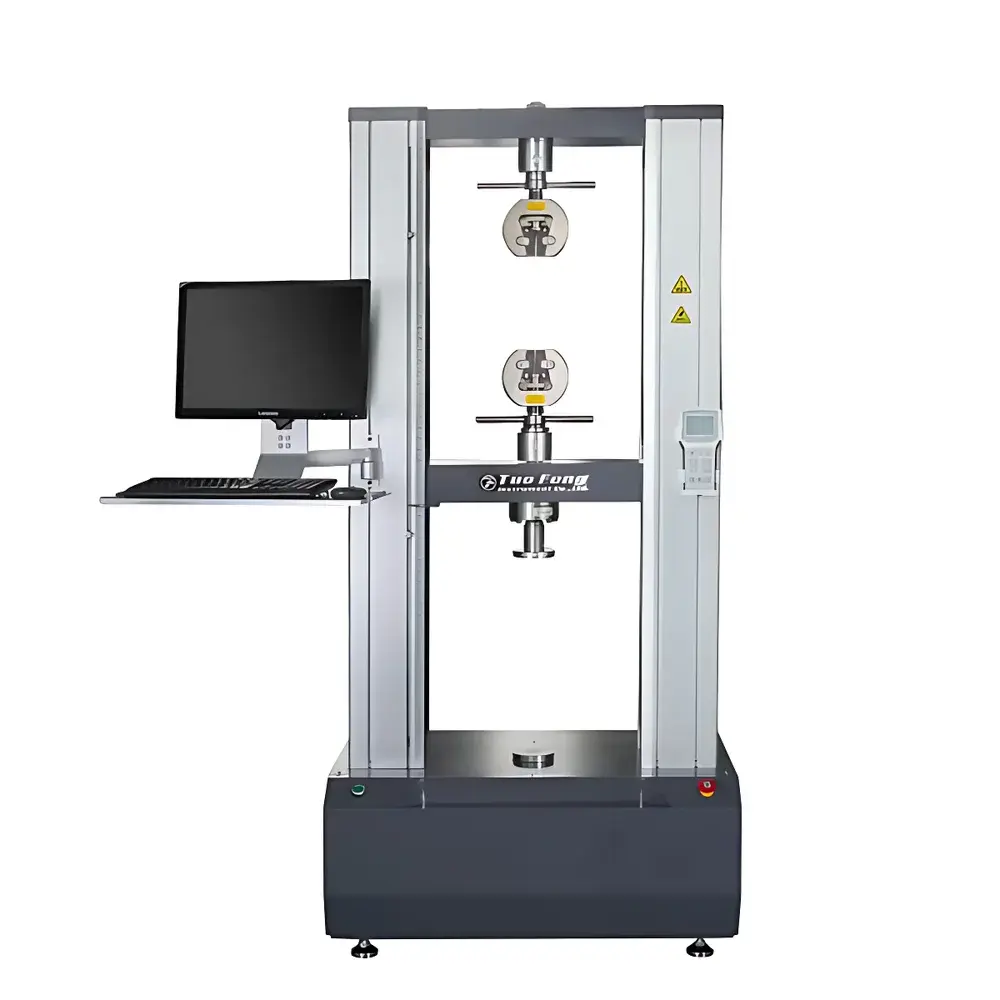
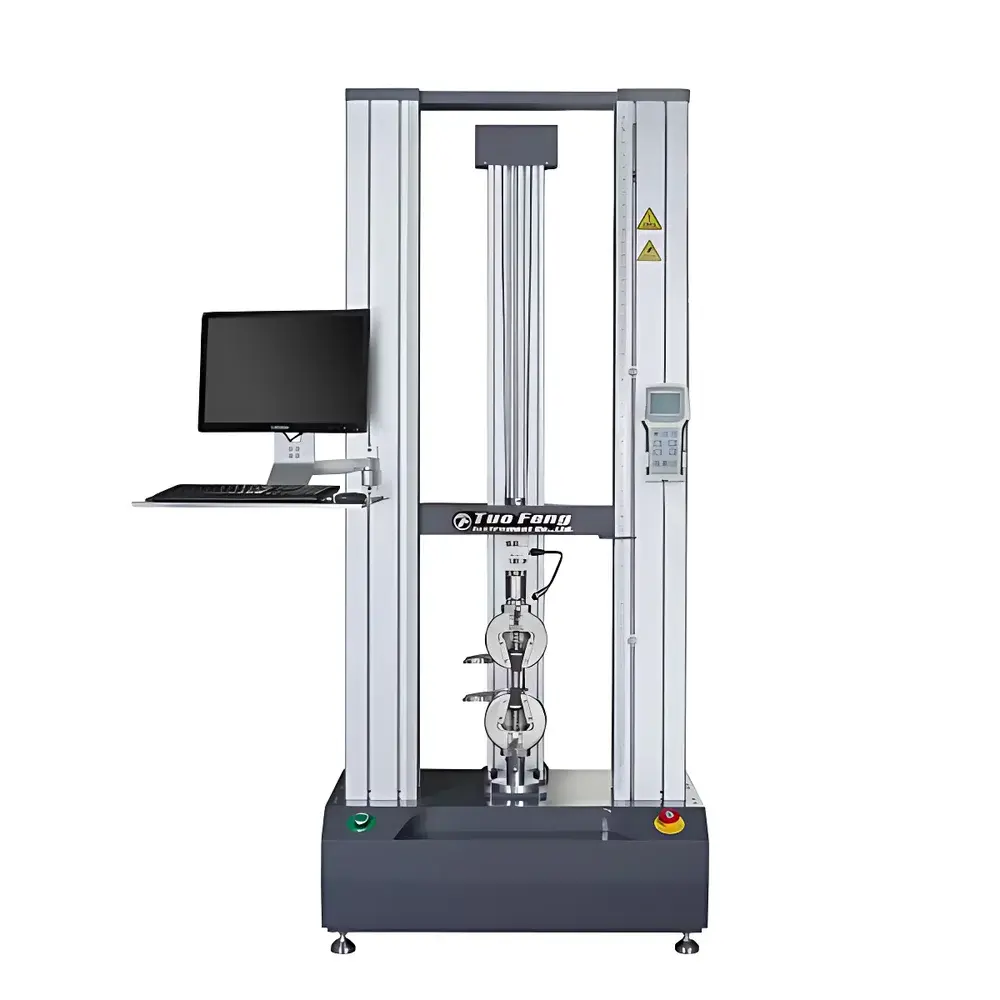
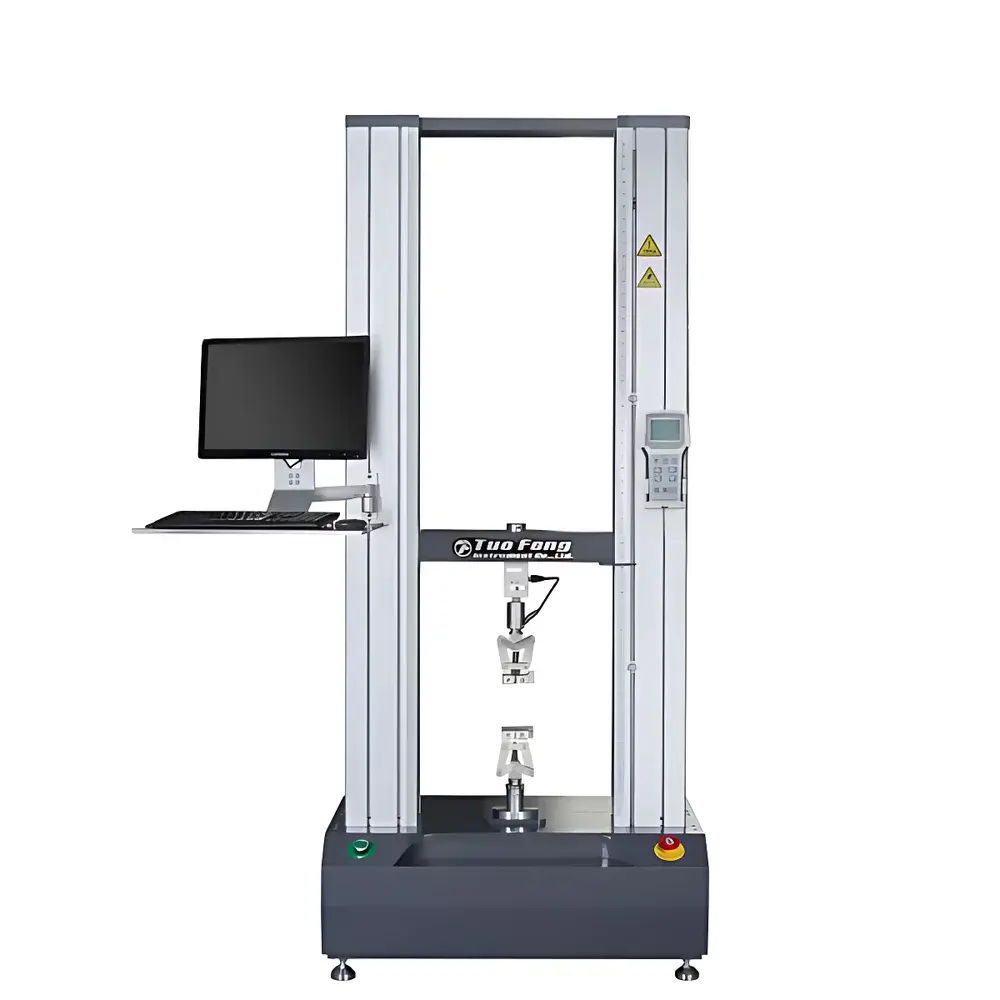
Tuofeng TFW-153 Microcomputer-Controlled Electronic Universal Testing Machine
| Brand | Tuofeng |
|---|---|
| Model | TFW-153 |
| Type | Electromechanical Universal Testing Machine |
| Max Test Load | 15 kN (standard configuration) |
| Accuracy Class | 0.5 |
| Effective Force Range | 0.2–100% of full scale |
| Force Measurement Accuracy | ±0.005% of reading |
| Load Cell Resolution | 1 part in ±500,000 (full-scale, single-range, no auto-ranging) |
| Drive System | Imported servo motor with precision worm-gear reducer |
| Lead Screw | High-precision preloaded ball screw |
| Effective Test Width | 400 mm (customizable up to 600 mm) |
| Traverse Stroke | 800 mm (extendable) |
| Speed Range | 0.001–500 mm/min (infinitely variable, closed-loop controlled) |
| Displacement Measurement | Optical encoder |
| Displacement Accuracy | ±0.005% of reading |
| Strain Measurement | Optional extensometer (clip-on or video-based) or large-deformation sensor |
| Strain Accuracy | ±0.005% of reading |
| Safety Protection | Dual-limit electronic travel stops, emergency stop button, overload cutoff (>110% FS), software-based load/position interlock |
| Crosshead Control | Dual-speed (fast/slow) motorized adjustment with jog function and automatic return-to-start |
| Power Supply | 220 V AC, 1.0 kW |
| Dimensions (W×D×H) | 780 × 560 × 1700 mm |
| Approx. Weight | 280 kg |
| Compliance | GB/T 16491–2008, JJG 475–2008, ASTM E4, ASTM E8, ASTM D638, ISO 6892-1, ISO 7500-1, DIN 51221, JIS Z2241 |
Overview
The Tuofeng TFW-153 Microcomputer-Controlled Electronic Universal Testing Machine is an electromechanical force-testing platform engineered for high-fidelity mechanical property characterization of metallic, polymeric, composite, and ceramic materials. Based on the principle of controlled axial loading via a servo-driven ball-screw actuation system, it delivers precise, repeatable, and traceable force-displacement data under tension, compression, bending, shear, peel, tear, and puncture configurations. Its architecture adheres to international metrological standards for static mechanical testing—specifically calibrated to meet ISO 7500-1 (Class 0.5) and verified per JJG 475–2008 and GB/T 16491–2008 requirements. Designed for laboratory-grade reliability, the system integrates real-time closed-loop control, sub-micron displacement resolution, and dual-channel synchronized acquisition of load and deformation signals—enabling accurate determination of modulus, yield point, ultimate strength, elongation at break, Poisson’s ratio, and energy absorption metrics.
Key Features
- High-resolution force measurement: 1/500,000 full-scale resolution with zero drift compensation and temperature-stable load cell electronics
- True single-range architecture: No manual or automatic range switching—maintains consistent resolution across 0.2% to 100% of full scale (15 kN)
- Precision motion control: Imported servo motor coupled to a preloaded ground ball screw ensures minimal backlash (<0.01 mm) and velocity linearity within ±0.1% over full speed range (0.001–500 mm/min)
- Dual-mode displacement feedback: Integrated optical encoder (±0.005% accuracy) plus optional high-accuracy clip-on or non-contact extensometry (ASTM E83 Class B-1 compliant)
- Integrated safety triad: Hardware-based emergency stop, dual electronic limit switches, and programmable overload cutoff (110% FS trigger threshold)
- Intelligent crosshead operation: Motorized fast/slow positioning with jog mode, programmable return-to-origin, and position memory for multi-step test sequences
- Rigid monolithic frame: Steel-reinforced base and crosshead assembly minimizes deflection (<0.05 mm/kN) and ensures alignment stability per ISO 20413
Sample Compatibility & Compliance
The TFW-153 accommodates standardized specimens per ASTM, ISO, GB, DIN, JIS, and BS geometries—including flat tensile bars (ASTM D638 Type I–V), round rods (ASTM E8), compression cylinders (ASTM C39), 3-point/4-point bend fixtures (ASTM D790), peel fixtures (ASTM D903), and puncture probes (ASTM D3787). Fixture mounting follows ISO 26203-2 interface specifications. All mechanical calibrations are traceable to NIM (National Institute of Metrology, China) or equivalent national metrology institutes. The system supports GLP-compliant audit trails when configured with optional 21 CFR Part 11–enabled software modules. It satisfies essential requirements of ISO/IEC 17025 for testing laboratories and is routinely deployed in GMP-regulated environments for raw material release testing and process validation.
Software & Data Management
Control and analysis are performed via Windows-native software supporting multilingual UI (English, Simplified/Traditional Chinese), customizable unit systems (N, kN, lbf, MPa, psi, %, mm, inch), and real-time display of up to four synchronized plots—including stress–strain, load–displacement, load–time, and strain–time. The software implements ASTM E2309-compliant test method templates for tensile, compression, flexural, and peel tests—with auto-detection of yield point (0.2% offset), ultimate tensile strength (UTS), modulus (secant/tangent), and elongation. Raw data export is supported in CSV, Excel, and XML formats; graphical reports include embedded metadata (operator ID, timestamp, calibration certificate ID, environmental conditions). Data integrity safeguards include write-protected archives, user-level access control (admin/operator/viewer), and electronic signature capability. Firmware and software updates are delivered remotely with version-controlled changelogs and backward-compatible data file handling.
Applications
The TFW-153 serves as a primary mechanical characterization tool across R&D, QA/QC, and production support functions. In aerospace, it validates titanium alloy sheet formability and carbon-fiber prepreg interlaminar shear strength. In automotive, it verifies polymer blend weld integrity and elastomeric bushing compression set. In medical device manufacturing, it quantifies suture tensile strength (ISO 10993-12) and balloon catheter burst pressure compliance. In construction materials, it assesses high-performance concrete compressive behavior and geotextile tensile durability (ISO 10319). Universities employ it for teaching fundamental mechanics of materials concepts and validating finite element models. Its modularity supports rapid reconfiguration between standardized and custom test protocols—reducing turnaround time for ASTM/ISO-certified reports required by third-party auditors and regulatory submissions.
FAQ
What standards does the TFW-153 comply with for calibration and verification?
It conforms to GB/T 16491–2008 (Chinese national standard), JJG 475–2008 (metrological verification regulation), ISO 7500-1:2018 (Class 0.5), and ASTM E4 for verifying force-measuring systems.
Can the system perform cyclic or hold tests?
Yes—it supports load-controlled hold, displacement-controlled hold, and ramp-hold-ramp profiles per ASTM D7078, enabling creep and stress-relaxation analysis with programmable dwell durations up to 999 hours.
Is third-party certification available for ISO/IEC 17025 accreditation?
Tuofeng provides factory-issued calibration certificates traceable to NIM; optional on-site verification by CNAS-accredited providers is available upon request.
How is data integrity ensured during long-duration tests?
The system logs all critical events (load peaks, limit triggers, power interruptions) with UTC timestamps; raw data buffers are mirrored to non-volatile memory to prevent loss during unexpected shutdowns.
What extensometer options are compatible?
Standard support includes ASTM E83 Class B-1 compliant clip-on axial extensometers (10–50 mm gauge length); optional video extensometry (ISO 9513 Class 1) and laser-based non-contact systems are available for brittle or high-temperature applications.



