
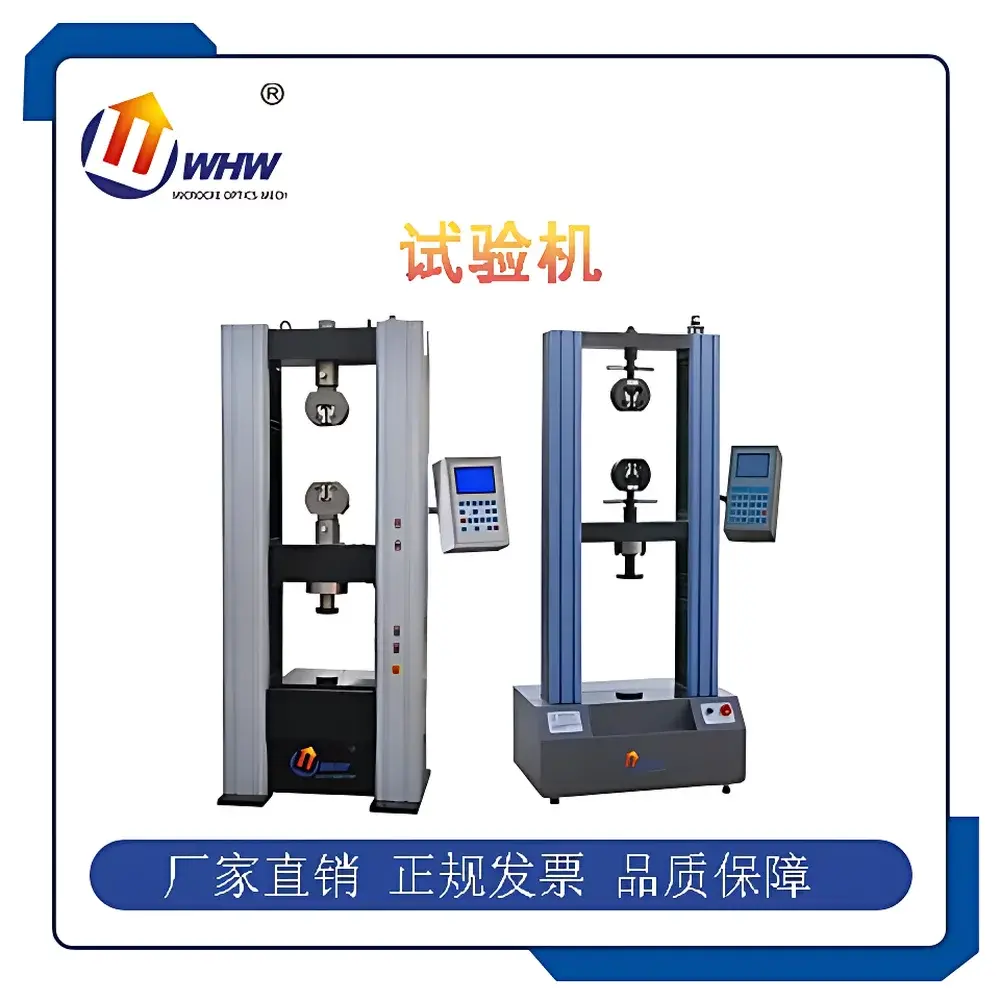
YANRUN MC009-WDS-300GL 0.5-Class High-Precision Floor-Mounted Digital Electronic Universal Testing Machine
| Brand | YANRUN |
|---|---|
| Origin | Shanghai, China |
| Manufacturer Type | Direct Manufacturer |
| Instrument Type | Electronic Universal Testing Machine |
| Model | MC009-WDS-300GL |
| Load Capacity Range | 1.2–300 kN |
| Load Accuracy | ±0.5% |
| Displacement Resolution | 0.0025 mm |
| Crosshead Speed Range | 0.001–500 mm/min (infinitely variable) |
| Test Space (Tension/Compression) | 600 mm |
| Effective Width | 570 mm |
| Frame Dimensions (W×D×H) | 800 × 1100 × 2600 mm |
| Weight | 2000 kg |
| Power Supply | Three-phase, 380 V ±10%, 50 Hz |
Overview
The YANRUN MC009-WDS-300GL is a floor-mounted, high-precision electronic universal testing machine engineered for static mechanical property evaluation of metallic and non-metallic materials under tension, compression, bending, peel, shear, and flexural loading conditions. Designed to meet ISO 7500-1:2018 and ASTM E4 calibration standards for Class 0.5 force measurement systems, this instrument delivers traceable load accuracy of ±0.5% across its full 1.2–300 kN operating range. Its robust dual-column steel frame—optimized for minimal deflection and high rigidity—ensures dimensional stability during high-force testing, while the precision-ground lead screws and preloaded ball-screw drive system enable smooth, backlash-free crosshead motion. The system integrates high-stability load cells (imported from certified global suppliers) and servo-controlled AC motors with a speed control ratio exceeding 1:100,000, supporting both quasi-static and low-speed dynamic protocols required in QC laboratories, R&D centers, and third-party certification facilities.
Key Features
- Floor-standing structural architecture with reinforced welded steel frame, delivering high torsional and axial stiffness (deflection < 0.05 mm at 300 kN load)
- Imported high-linearity load cells calibrated to ISO 376 Class 0.5 specifications, ensuring long-term repeatability and thermal drift compensation
- Servo-driven actuation system with programmable speed profiles (0.001–500 mm/min), enabling compliance with ASTM D638, ISO 527, ISO 178, and EN 10002-1 test methods
- Dual-channel digital displacement measurement via high-resolution optical encoder (0.0025 mm resolution) and optional extensometer interface (ASTM E83 Class B1 compatible)
- Integrated hardware safety subsystem including mechanical limit switches, overload cut-off, overcurrent protection, and emergency stop circuitry compliant with IEC 60204-1
- Modular design supporting customization of column height, grip types (pneumatic, wedge, hydraulic), environmental chambers (–70°C to +300°C), and video extensometry integration
Sample Compatibility & Compliance
The MC009-WDS-300GL accommodates specimens ranging from fine-diameter metal wires (≥0.1 mm) to thick-section structural alloys (up to 80 mm diameter), as well as polymer sheets, composites, textiles, medical tubing, PCB substrates, and adhesive bonds. Standard configurations support ASTM E8/E8M (tensile testing of metals), ASTM D3039 (composite tensile), ISO 1133 (melt flow index correlation), and GB/T 228.1–2021 (Chinese national standard for metallic materials). All firmware and data acquisition modules are designed to support audit-ready operation under GLP and GMP environments, with optional 21 CFR Part 11-compliant software packages available for regulated industries including medical device manufacturing and pharmaceutical packaging validation.
Software & Data Management
The system operates with YANRUN’s proprietary TESTMaster v4.2 software—a Windows-based platform supporting real-time curve plotting, multi-step test programming, automatic yield point detection (0.2% offset method), modulus calculation (secant/tangent), and fracture energy integration. Raw data is stored in ASCII CSV and XML formats with embedded metadata (operator ID, timestamp, calibration certificate ID, environmental conditions). The software includes built-in report templates aligned with ISO/IEC 17025 requirements and supports direct export to LIMS via ODBC or RESTful API. Optional modules provide automated pass/fail decision logic, statistical process control (SPC) dashboards, and electronic signature workflows compliant with FDA 21 CFR Part 11 Annex 11.
Applications
- Mechanical characterization of structural steels, aluminum alloys, titanium grades, and high-strength fasteners per ASTM A370 and ISO 6892-1
- Tensile strength and elongation testing of thermoplastics (PP, PE, PC), elastomers (EPDM, silicone), and fiber-reinforced composites (CFRP, GFRP)
- Peel and shear adhesion testing of pressure-sensitive tapes, laminated films, and biomedical adhesives (ISO 29862, ASTM D903)
- Bending stiffness and flexural modulus evaluation of printed circuit boards (IPC-TM-650 2.4.4), ceramic tiles (ISO 10545-4), and thin-film substrates
- Compression testing of foams, elastomeric mounts, concrete cores, and orthopedic implant materials (ISO 13314, ASTM F1717)
- Quality conformance verification for automotive hoses, aerospace sealants, and wire harness assemblies per OEM-specific standards (e.g., GMW14872, Ford WSS-M99P1111-A)
FAQ
What international standards does the MC009-WDS-300GL comply with for force calibration?
It meets ISO 7500-1:2018 Class 0.5 requirements and is supplied with factory calibration certificates traceable to NIM (China National Institute of Metrology) or optionally UKAS-accredited providers.
Can the system be integrated into an existing laboratory network for centralized data management?
Yes—TESTMaster supports TCP/IP communication, OPC UA server mode, and configurable database logging for seamless integration with enterprise LIMS or MES platforms.
Is extensometer compatibility available for high-accuracy strain measurement?
Standard configuration includes analog/digital inputs for clip-on and non-contact video extensometers meeting ASTM E83 Class B1 or ISO 9513 Class 1 specifications.
What maintenance intervals are recommended for long-term accuracy retention?
Load cell recalibration is advised annually; mechanical alignment and drive system lubrication should be performed every 12 months or after 5,000 test cycles, whichever occurs first.
Does the system support multi-specimen batch testing with automated reporting?
Yes—TESTMaster allows parameterized test sequences, auto-naming conventions based on barcode input, and consolidated PDF/Excel reports with statistical summaries (mean, SD, Cp/Cpk) per batch.



