
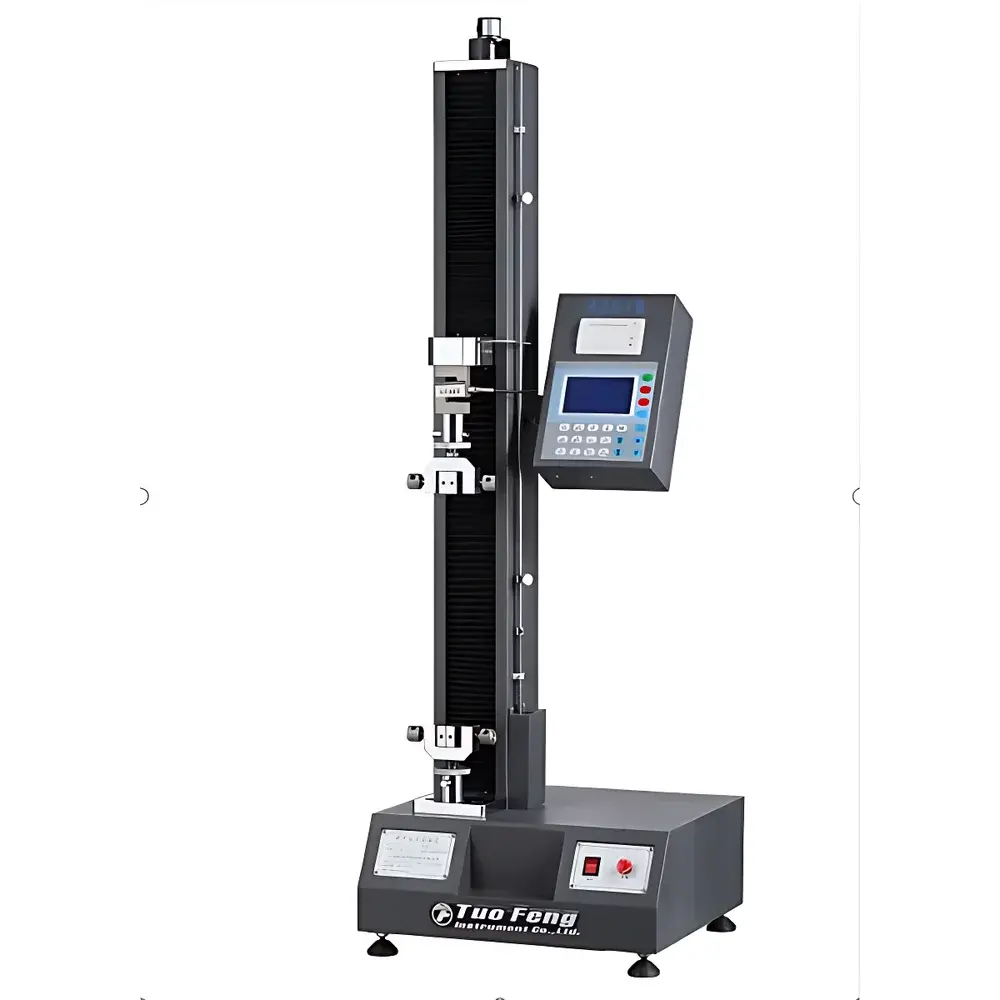
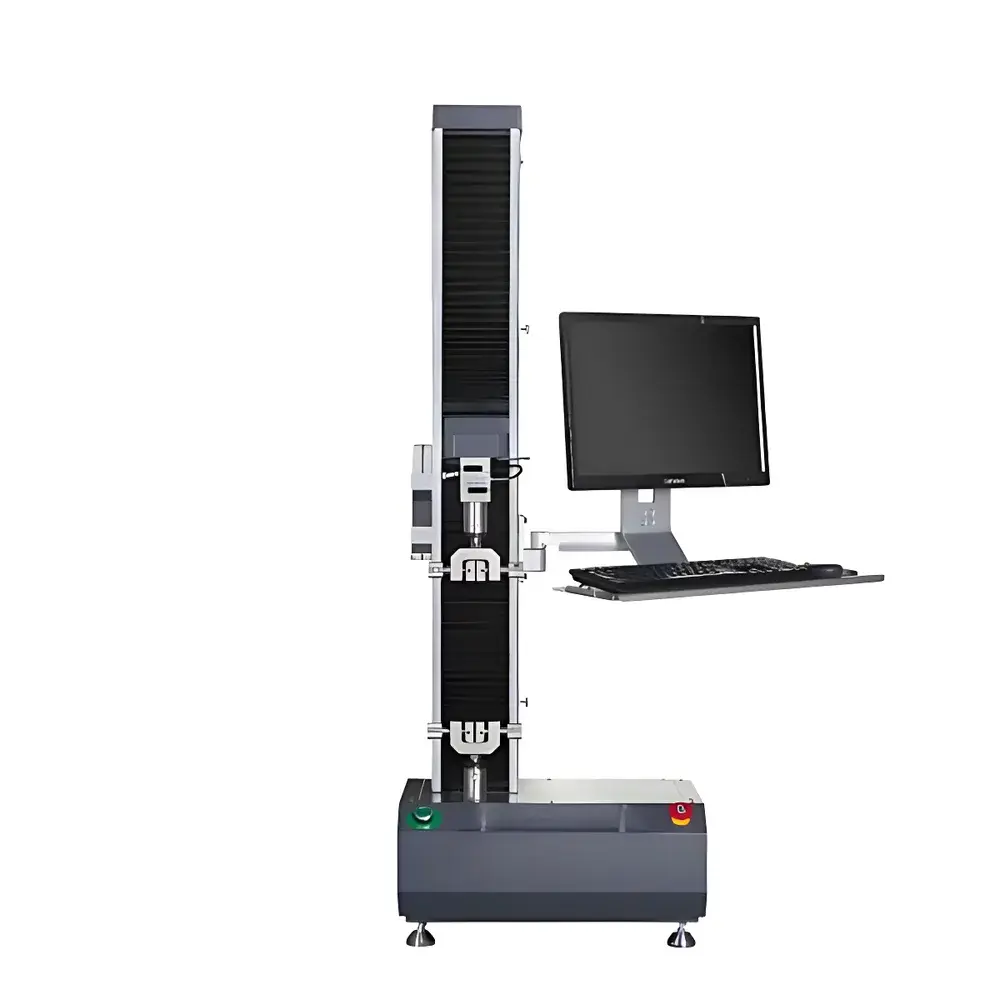
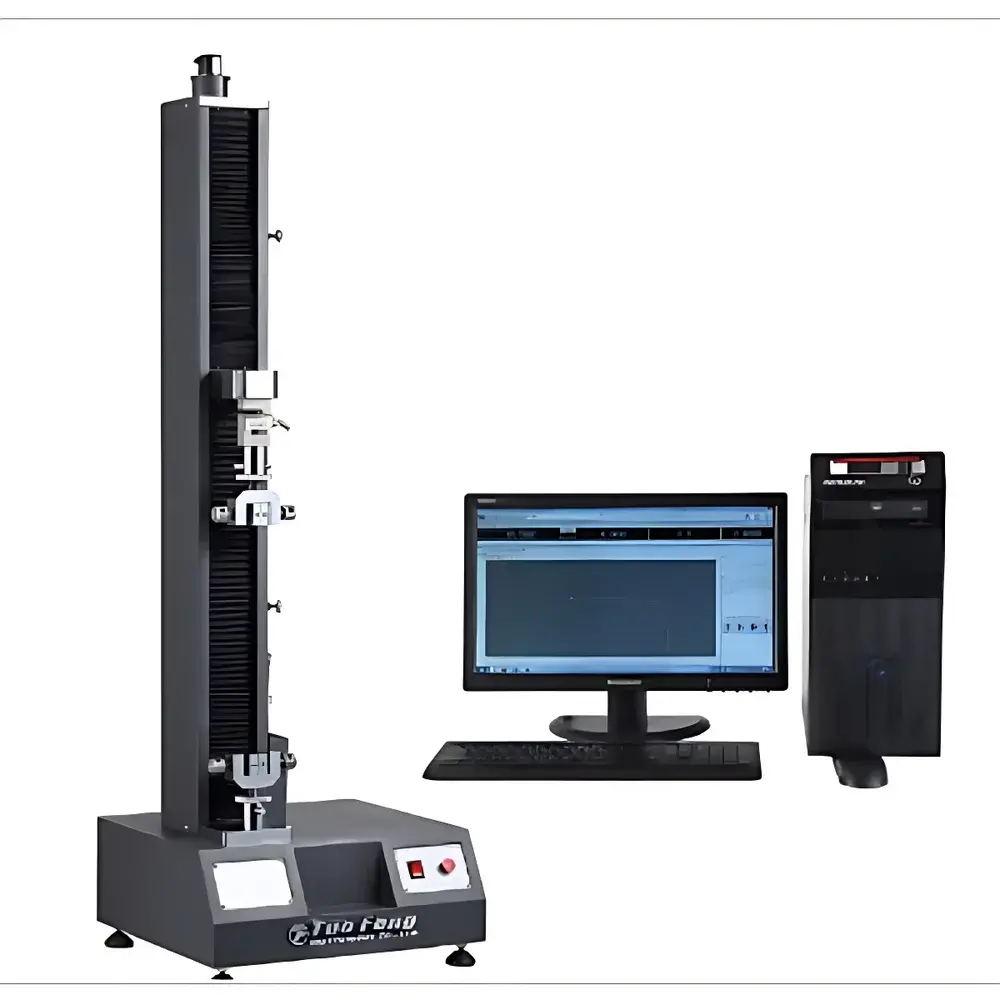
Tuofeng TFW-251 Computer-Controlled Electronic Tensile Testing Machine
| Brand | Tuofeng |
|---|---|
| Origin | Shanghai, China |
| Manufacturer Type | Direct Manufacturer |
| Product Category | Domestic |
| Model | TFW-251 |
| Price Range | USD 1,400 – 2,800 (FOB) |
| Instrument Type | Electromechanical Tensile Testing Machine |
| Maximum Test Load | 5 kN |
| Force Measurement Range | 0.4%–100% of Full Scale (FS) |
| Force Accuracy | ±0.5% of reading |
| Crosshead Travel | 700 mm |
| Displacement Resolution | ±0.5% of reading |
Overview
The Tuofeng TFW-251 is a precision-engineered electromechanical tensile testing machine designed for standardized mechanical property evaluation of flexible and semi-rigid materials in R&D laboratories, quality control departments, and contract testing facilities. It operates on the principle of controlled uniaxial force application via a servo-controlled AC motor-driven crosshead, coupled with high-fidelity load cell feedback and optical encoder-based displacement tracking. The system complies with fundamental mechanical testing paradigms defined in ISO 6892-1 (metallic materials), ISO 527-1/2 (plastics), ASTM D638 (tensile properties of plastics), ASTM D5034 (breaking strength of textiles), ASTM D882 (thin plastic sheeting), and GB/T 228.1 (Chinese national standard for metallic materials). Its architecture supports static and quasi-static mechanical characterization—including tensile strength, yield point, elongation at break, modulus of elasticity, peel strength, tear resistance, and adhesive bond strength—across diverse substrate classes without hardware reconfiguration.
Key Features
- High-stability 5 kN load frame with rigid two-column steel construction and precision-ground guide rails ensuring minimal lateral deflection during high-force testing.
- Force measurement via calibrated S-type load cell traceable to national metrology institutes; accuracy maintained at ±0.5% of reading across 0.4%–100% FS without range switching.
- Displacement sensing via quadrature-output optical encoder with resolution stability guaranteed at ±0.5% of reading over full 700 mm travel.
- Variable-speed crosshead drive (0.01–500 mm/min), infinitely adjustable via closed-loop PID control, enabling precise strain-rate control per ISO 6892-1 Annex A.
- Dual-mode operation: manual jog control for fixture alignment and fully automated test sequences triggered by software-defined protocols.
- Integrated safety subsystems including electronic limit switches, emergency stop circuitry (EN 60204-1 compliant), overload cutoff (>110% FS), and programmable soft limits.
- Modular fixture interface compatible with pneumatic, wedge-grip, roller, peel, and custom-designed clamping solutions for fibers, films, nonwovens, laminates, and composite tapes.
Sample Compatibility & Compliance
The TFW-251 accommodates specimens ranging from fine textile filaments (diameter ≥10 µm) to rigid polymer sheets (thickness ≤10 mm) and metallic foils (thickness ≥0.025 mm). Standardized grips support flat, round, and irregular cross-sections per ISO 20795-2 (denture base materials), ASTM D1709 (impact resistance of plastic film), and ISO 1133 (melt flow index auxiliary tensile verification). All mechanical outputs—including stress (MPa), strain (%), Young’s modulus (GPa), and toughness (MJ/m³)—are calculated in real time using user-input geometric parameters (width, thickness, gauge length) and automatically logged with timestamped metadata. The system meets essential requirements for GLP-compliant environments: audit trail capability (user login, parameter changes, test initiation/termination), electronic signature support, and raw data immutability upon export.
Software & Data Management
The Windows-based TensilePro v3.2 software (compatible with Windows 10/11 64-bit) provides full IEC 62304-aligned test lifecycle management. It supports multi-language UI (English, Simplified Chinese, Traditional Chinese, Spanish, German), customizable unit systems (N/kN/lbf, mm/inch, MPa/psi), and dynamic curve overlay for comparative analysis of up to 16 datasets. Real-time plotting includes load–time, load–displacement, stress–strain, and extension–time graphs with auto-scaling and derivative calculation (e.g., tangent modulus). Post-test reporting generates PDF or Excel files containing statistical summaries (mean, SD, CV%), pass/fail flags against preset limits, and embedded calibration certificates. Data export conforms to ASTM E1447 (standard practice for electronic data interchange in materials testing) and supports CSV, XML, and proprietary .TPR binary formats for long-term archival.
Applications
- Textile QA: Breaking strength and elongation of woven/nonwoven fabrics, yarns, and elastic bands per ASTM D5034 and ISO 13934-1.
- Packaging validation: Seal integrity (peel strength), puncture resistance, and burst pressure of laminated pouches (ASTM F88, ASTM F1140).
- Medical device component testing: Tensile properties of suture materials (ISO 10555-1), catheter tubing (ISO 10993-12), and wound dressing adhesives (ISO 2286-2).
- Electronics manufacturing: Bond strength of flex circuits, solder joint reliability simulation, and connector retention force (IEC 60512-2).
- Automotive interiors: Tear resistance of seat fabrics, tensile modulus of headliner substrates, and seam slippage testing (SAE J829).
FAQ
Does the TFW-251 comply with FDA 21 CFR Part 11 for electronic records and signatures?
Yes—TensilePro v3.2 includes configurable audit trail logging, role-based access control, and electronic signature workflows meeting ALCOA+ principles for regulated industries.
Can the system be integrated into an existing LIMS or MES environment?
Yes—via OPC UA server interface or RESTful API endpoints supporting JSON/XML payloads for test method upload, result ingestion, and status polling.
Is calibration certification included with shipment?
Each unit ships with NIST-traceable factory calibration certificate covering load, displacement, and speed axes; optional ISO/IEC 17025 accredited field calibration available.
What is the warranty coverage and service response time?
Standard 24-month parts-and-labor warranty; technical support available 24/5 via remote diagnostics; on-site service within 72 business hours for priority contracts.
Are custom test methods programmable without developer assistance?
Yes—users define multi-step protocols (preload → ramp → hold → return) using drag-and-drop sequence builder with conditional logic and pass/fail branching.



