
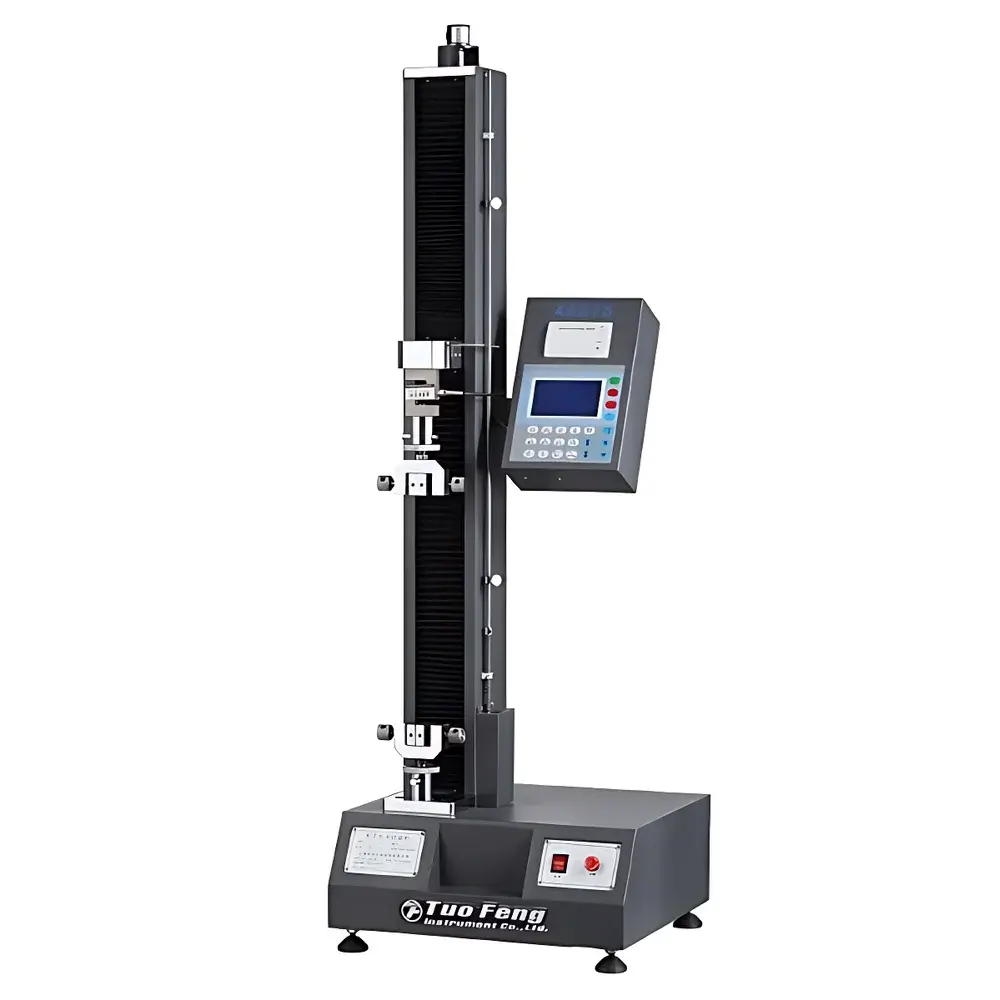
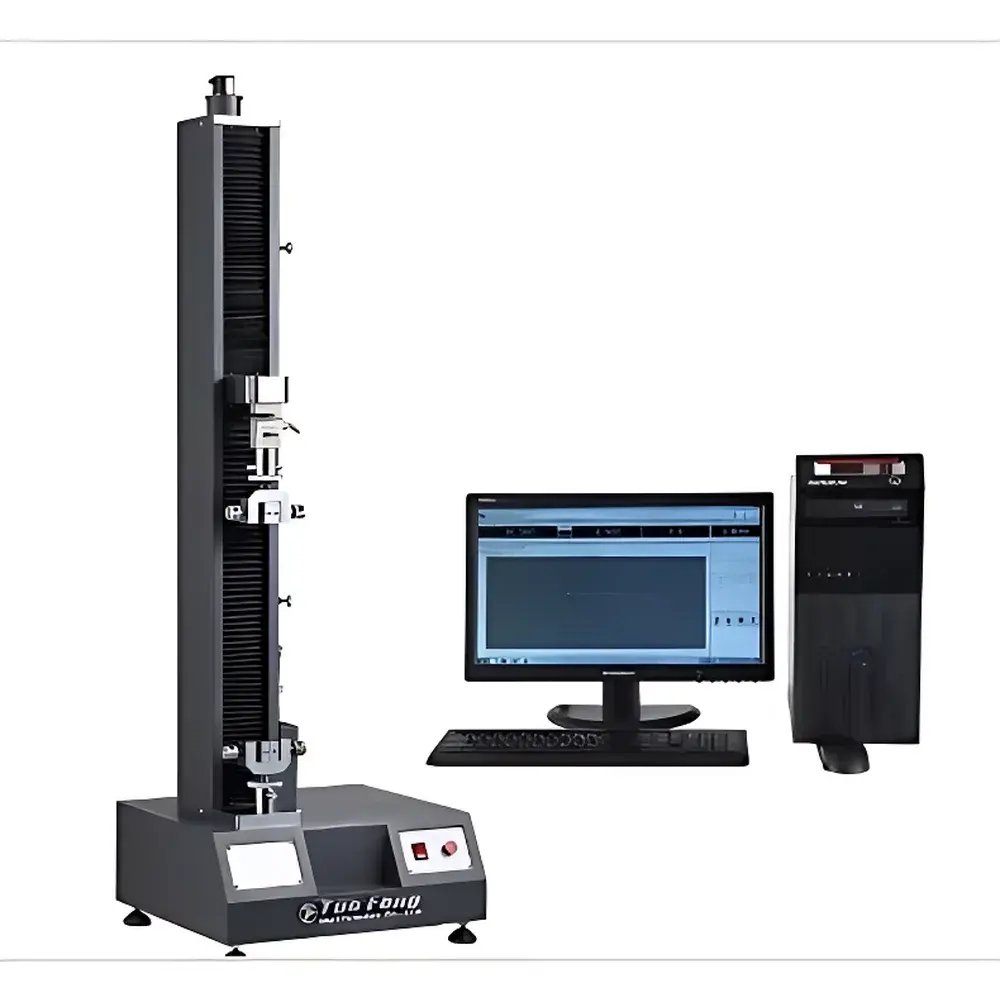
TuoFeng TFL-18 Desktop Electronic Tensile Testing Machine
| Brand | TuoFeng |
|---|---|
| Origin | Shanghai, China |
| Manufacturer Type | OEM/ODM Producer |
| Country of Origin | China |
| Model | TFL-18 |
| Instrument Type | Electronic Tensile Testing Machine |
| Maximum Test Load | 0.1 kN (100 N) |
| Force Measurement Range | 1–1000 N |
| Force Accuracy | ±0.5% of reading |
| Crosshead Travel | 700 mm |
| Displacement Resolution | 0.0001 mm |
Overview
The TuoFeng TFL-18 is a precision-engineered desktop electronic tensile testing machine designed for routine mechanical property evaluation in quality control laboratories, R&D facilities, and academic institutions. Based on servo-controlled electromechanical actuation and high-fidelity load cell transduction, the system operates under controlled displacement or load-rate conditions to measure fundamental mechanical responses—including tensile strength, yield point, elongation at break, peel adhesion, tear resistance, and bond strength—across a broad spectrum of low-force materials. Its single-column architecture ensures compact footprint (<0.5 m²), making it ideal for benchtop deployment without compromising structural rigidity or measurement stability. The instrument complies with core mechanical testing principles defined in ISO 6892-1 (metallic materials), ISO 527-1 (plastics), ASTM D882 (thin plastic sheeting), ASTM D3330 (pressure-sensitive adhesives), and GB/T 228.1 (Chinese national standard for metallic tensile testing).
Key Features
- Servo-motor-driven crosshead with smooth, backlash-free motion across a full 700 mm vertical travel range
- High-resolution load measurement via calibrated S-type load cell (100 N max capacity, 0.5% FS accuracy per ISO 7500-1 Class 0.5)
- Sub-micron displacement resolution (0.0001 mm) enabled by quadrature optical encoder feedback
- Adjustable test speed from 0.01 to 500 mm/min, continuously variable without gear shifting
- Dual-mode operation: closed-loop displacement control and closed-loop load control
- Integrated safety systems including electronic limit switches, emergency stop button, and automatic overload cutoff at 110% of full scale
- Motorized crosshead positioning with three preset speed modes (fast/medium/slow) and programmable return-to-start functionality
- Modular fixture interface compatible with wedge-action grips, pneumatic clamps, peel fixtures, and custom-designed holders
Sample Compatibility & Compliance
The TFL-18 accommodates specimens ranging from fine-diameter metal wires (≥0.05 mm), polymer filaments, thin foils, and coated films to laminated packaging substrates, textile yarns, medical tubing, and adhesive tapes. Its 100 N maximum force rating targets applications where high sensitivity—not brute-force capacity—is critical. All test protocols adhere to internationally recognized standards, including but not limited to ASTM D638, ISO 527, ISO 1184, EN 1392, GB/T 1040, and JIS K 7113. Data traceability meets GLP requirements through timestamped audit logs, user authentication, and configurable electronic signatures. Optional configuration supports 21 CFR Part 11-compliant software modules for regulated environments.
Software & Data Management
The Windows-based TensilePro™ v3.2 software provides comprehensive test definition, real-time monitoring, and post-processing capabilities. It supports multi-language UI (English, Simplified Chinese, Traditional Chinese), customizable unit systems (N, kgf, lbf, MPa, psi), and dynamic curve visualization—including stress-strain, load-displacement, load-time, and strain-time plots. Automated calculations include tensile strength, Young’s modulus, yield offset (0.2%), elongation at break, peel strength (N/mm), and tear propagation energy. Raw data exports to CSV, Excel, and PDF formats; batch analysis tools enable statistical comparison across up to 99 samples per report. Software architecture includes encrypted local database storage, version-controlled method templates, and built-in calibration certificate tracking. Lifetime free updates ensure long-term compatibility with evolving OS platforms and security standards.
Applications
- Mechanical characterization of biomedical sutures, hydrogel films, and dissolvable polymer matrices
- Peel strength validation of flexible printed circuit board (FPCB) coverlays and conformal coatings
- Tensile integrity testing of lithium-ion battery electrode coatings and separator membranes
- Adhesion performance assessment of pressure-sensitive labels, medical tapes, and wound dressings
- Quality assurance of food-grade laminated pouches, blister packaging, and thermoformed trays
- Evaluation of textile fiber tenacity, yarn knot strength, and nonwoven web cohesion
- Routine verification of wire bonding pull strength in semiconductor packaging lines
FAQ
What is the maximum specimen thickness this machine can accommodate?
The standard grip opening allows specimens up to 25 mm thick; custom jaw inserts extend capability to 50 mm.
Does the system support extensometer integration?
Yes—optional clip-on or non-contact video extensometers can be synchronized via TTL trigger and USB interface for strain measurement per ISO 9513.
Is third-party calibration certification available?
Factory-calibrated units ship with NIST-traceable certificates; accredited external calibration services (ISO/IEC 17025) are offered upon request.
Can test methods be password-protected and locked for SOP compliance?
Yes—user roles (Operator, Technician, Administrator) enforce method editing restrictions and require digital sign-off for protocol changes.
What maintenance intervals are recommended?
Biannual lubrication of lead screws and annual verification of load cell linearity and encoder resolution are advised per manufacturer guidelines.



