
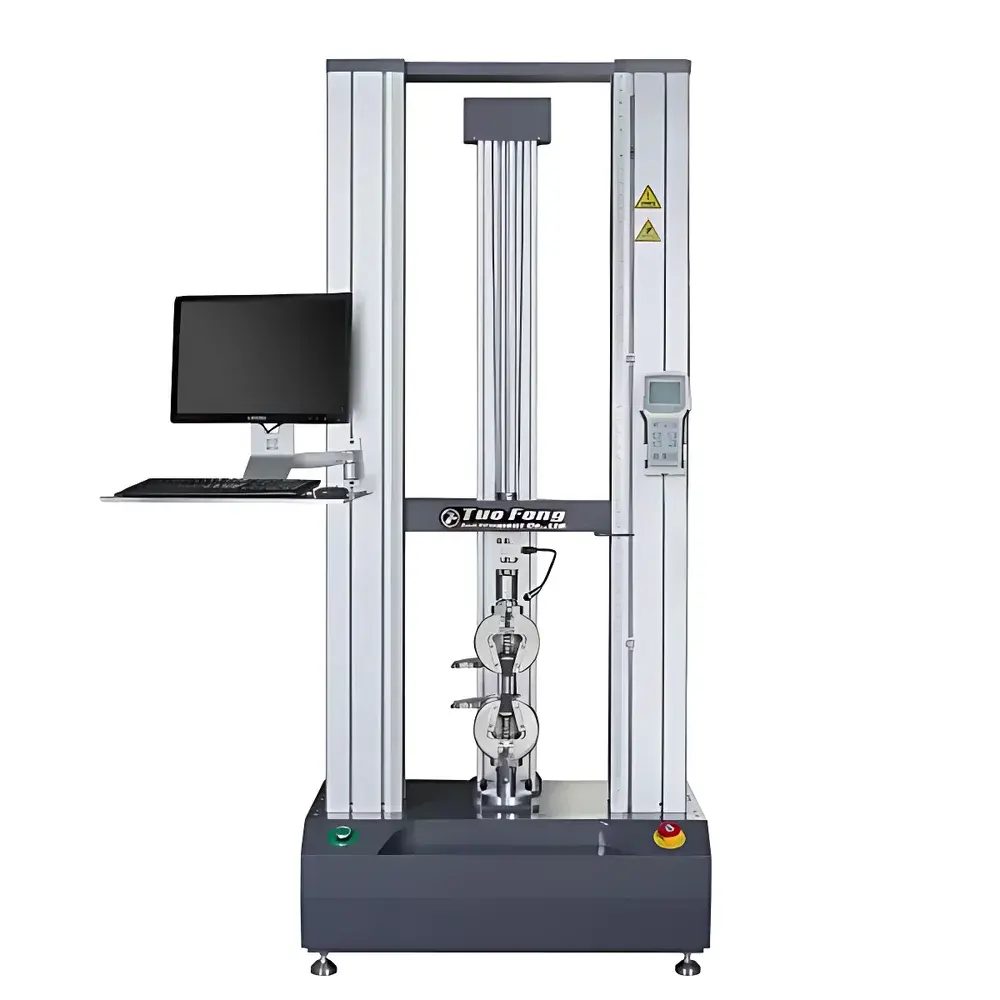
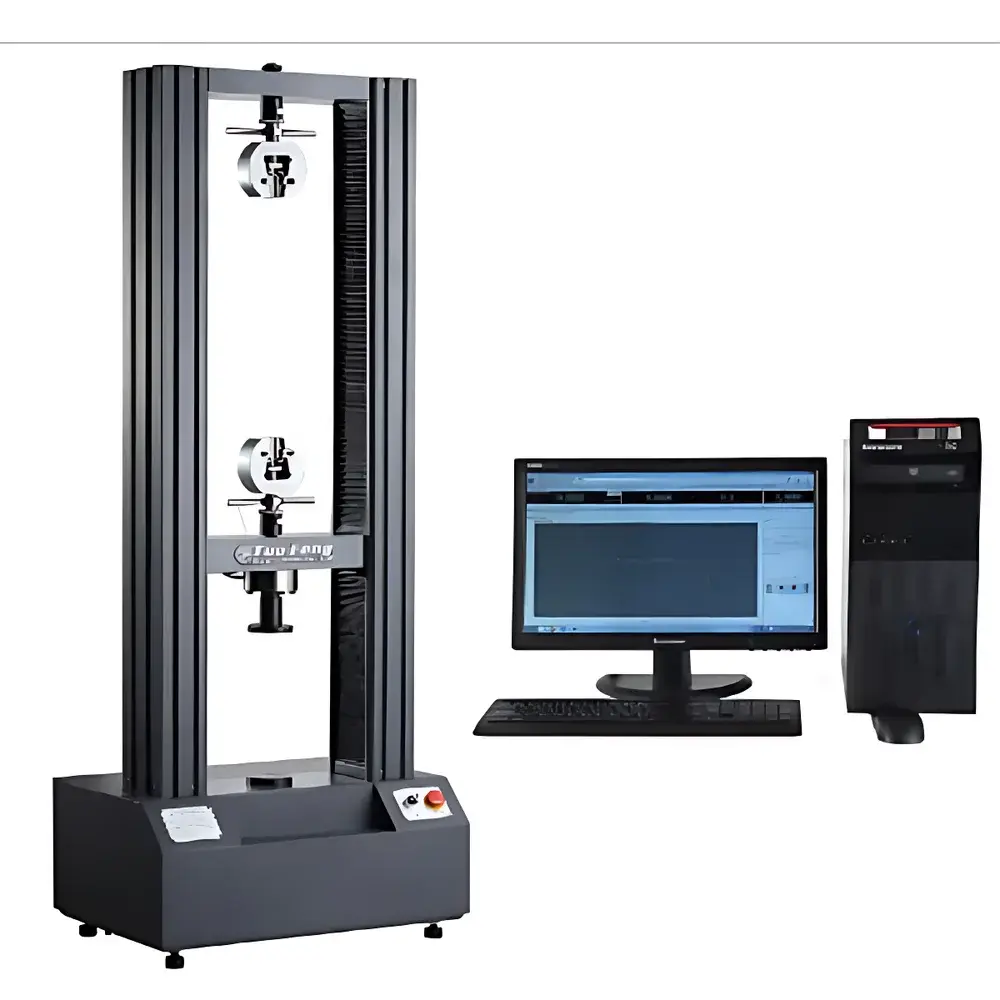
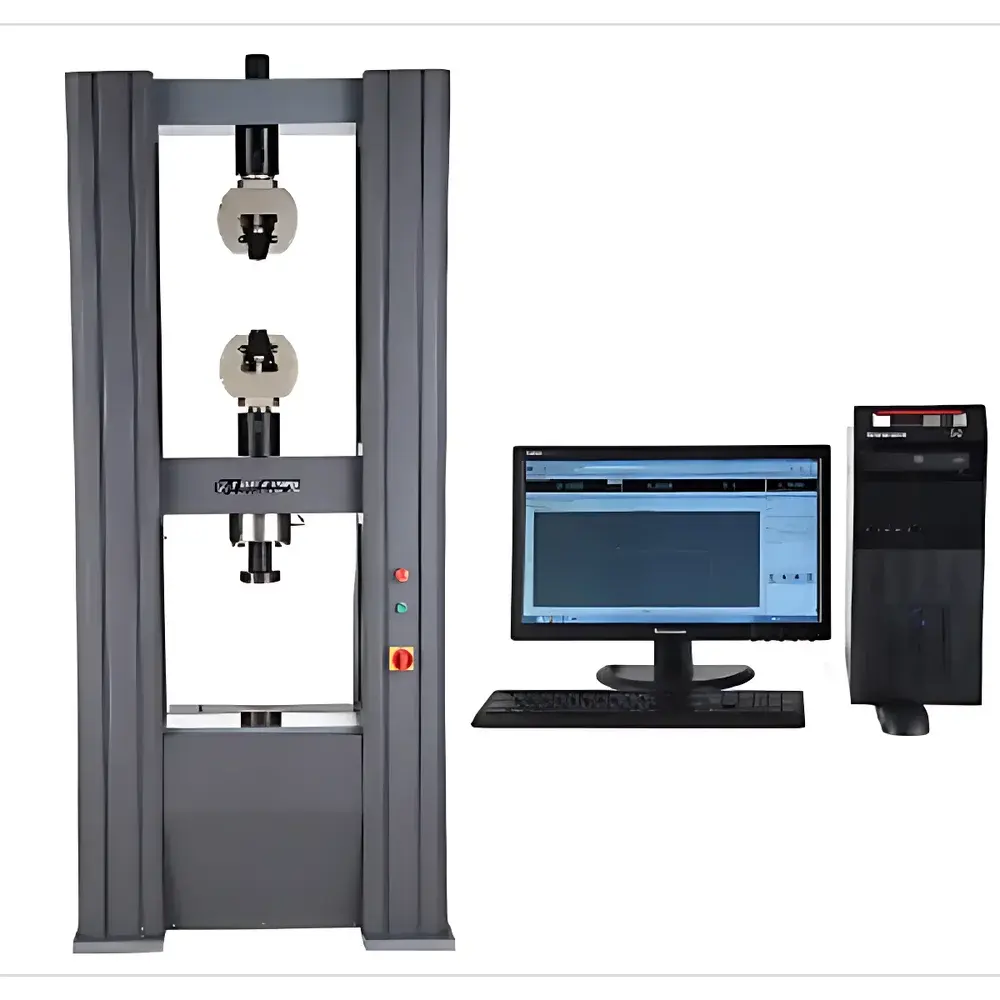
Tuofeng TFW-237 Microcomputer-Controlled Electronic Universal Testing Machine for Wire Terminal Pull-Off Force Testing
| Brand | Tuofeng |
|---|---|
| Origin | Shanghai, China |
| Manufacturer Type | Direct Manufacturer |
| Product Category | Domestic |
| Model | TFW-237 |
| Instrument Type | Electromechanical Universal Testing Machine |
| Maximum Test Load | 20 kN |
| Accuracy Class | 0.5 |
| Effective Force Measurement Range | 0.2–100% of full scale |
| Force Measurement Accuracy | ±0.005% of reading |
| Force Resolution | 1/500,000 codes (full-scale, no range switching) |
| Drive System | Imported servo motor with precision worm gear reducer |
| Lead Screw | High-precision preloaded ball screw |
| Effective Test Width | 600 mm (customizable) |
| Stroke | 800 mm (extendable) |
| Speed Range | 0.001–500 mm/min (infinitely variable) |
| Displacement Measurement | Optical encoder |
| Displacement Accuracy | ±0.005% of reading |
| Strain Measurement | Optional extensometer or large-deformation sensor |
| Safety Protection | Electronic limit switches, emergency stop, overload protection (10% over capacity), dual-speed motorized crosshead control |
| Software | Windows-based, multi-language (EN/CN/TC), ASTM/ISO/GB-compliant data acquisition and reporting |
Overview
The Tuofeng TFW-237 is a microcomputer-controlled electromechanical universal testing machine engineered for high-precision mechanical property evaluation of wire terminals, crimped connectors, solder joints, and related electrical interface components. It operates on the fundamental principle of controlled uniaxial tensile loading—applying calibrated axial force to a specimen while simultaneously measuring load, displacement, and (optionally) strain in real time. Designed in strict compliance with GB/T 16491–2008 and JJG 475–2008 metrological verification standards, the system delivers traceable, repeatable, and audit-ready test results suitable for quality assurance, process validation, and failure analysis in wire harness manufacturing, automotive electronics, aerospace wiring systems, and industrial connector production. Its modular architecture supports both standard pull-off tests per IEC 60512-2-1, IPC-TM-650 2.4.1, and UL 486A-B, as well as custom-defined protocols for proprietary termination geometries.
Key Features
- High-resolution force measurement system with ±0.005% reading accuracy and 1/500,000 internal resolution—ensuring detection of subtle yield transitions and interfacial slippage during terminal pull testing.
- Preloaded high-precision ball screw actuation paired with an imported servo motor and worm gear reducer, enabling smooth, low-noise operation across the full speed range (0.001–500 mm/min).
- Dual-speed motorized crosshead control with programmable return function: rapid repositioning between tests and precise low-speed approach for delicate specimen engagement.
- Integrated safety architecture including electronic travel limits, hardware-based emergency stop circuitry, and automatic overload cutoff at 110% of rated capacity.
- Modular fixture interface compatible with standardized pneumatic, hydraulic, or manual clamping solutions for flat, round, or irregularly shaped wire terminations (e.g., F-type, ring, spade, fork, and insulated crimps).
- Thermally stable structural frame with reinforced base and column assembly—minimizing deflection under dynamic loading and ensuring long-term calibration stability.
Sample Compatibility & Compliance
The TFW-237 accommodates a broad spectrum of terminal-substrate configurations: AWG 32–1/0 copper/aluminum conductors, tin-plated or nickel-coated brass terminals, heat-shrink insulated assemblies, and PCB-mounted press-fit contacts. Standard test setups include vertical pull-perpendicular-to-wire-axis (per IEC 60512-2-1), shear-to-failure of crimp barrels, and peel testing of adhesive-bonded terminations. All test procedures are fully configurable to meet ISO 527, ASTM D638/D790/D1876, GB/T 228.1, and UL 486A-B requirements. The system’s mechanical design and software validation package support GLP/GMP environments, with optional 21 CFR Part 11-compliant audit trail logging, electronic signatures, and user-access-level controls.
Software & Data Management
The embedded Windows-based testing software provides deterministic real-time control across multiple test modes—including constant-rate loading, load-hold, displacement-hold, and closed-loop strain control. Users may define up to 10 independent test steps per method, assign pass/fail criteria based on force thresholds, elongation limits, or energy absorption, and trigger automated actions (e.g., stop on break, record peak load, initiate video capture). Data visualization includes synchronized overlay of force–displacement, stress–strain, and load–time curves—with selectable interpolation algorithms and digital filtering options. Export formats include CSV, XML, PDF, and proprietary .TFS binary archives. Raw data files retain full metadata (operator ID, timestamp, environmental conditions, calibration certificate ID), and all processing operations are non-destructive and reversible. Firmware and software updates are delivered via secure HTTPS channel with SHA-256 signature verification.
Applications
- Quantification of crimp retention force for automotive wire harness terminals subjected to thermal cycling and vibration fatigue.
- Validation of solder joint integrity in high-reliability avionics interconnects under thermomechanical stress.
- Comparative analysis of crimp barrel compression ratios across different tooling sets and conductor stranding configurations.
- Quality gate testing for UL-listed terminal manufacturers requiring batch-level statistical process control (SPC) reporting.
- Root cause investigation of field failures involving insulation displacement connectors (IDCs) and blade-style quick-connect terminals.
- Material qualification of novel alloy terminals (e.g., beryllium copper, phosphor bronze) for high-current applications.
FAQ
Does the TFW-237 comply with international standards for wire terminal testing?
Yes—it is designed and verified to support test methods defined in IEC 60512-2-1, IPC-TM-650 2.4.1, UL 486A-B, and ASTM B570, with full traceability to national metrology institutes.
Can the system perform cyclic loading or fatigue tests on terminals?
Standard configuration supports static monotonic tests; optional add-on modules enable programmed load-controlled or displacement-controlled cycling up to 10⁶ cycles with real-time hysteresis monitoring.
Is third-party calibration documentation included with shipment?
Each unit ships with a factory calibration certificate accredited to ISO/IEC 17025, covering force, displacement, and speed channels—valid for 12 months under normal operating conditions.
What level of technical support and software maintenance is provided?
Tuofeng offers lifetime remote diagnostics, biannual software updates, and on-site service contracts with SLA-governed response times—no subscription fees required for core functionality or security patches.



