


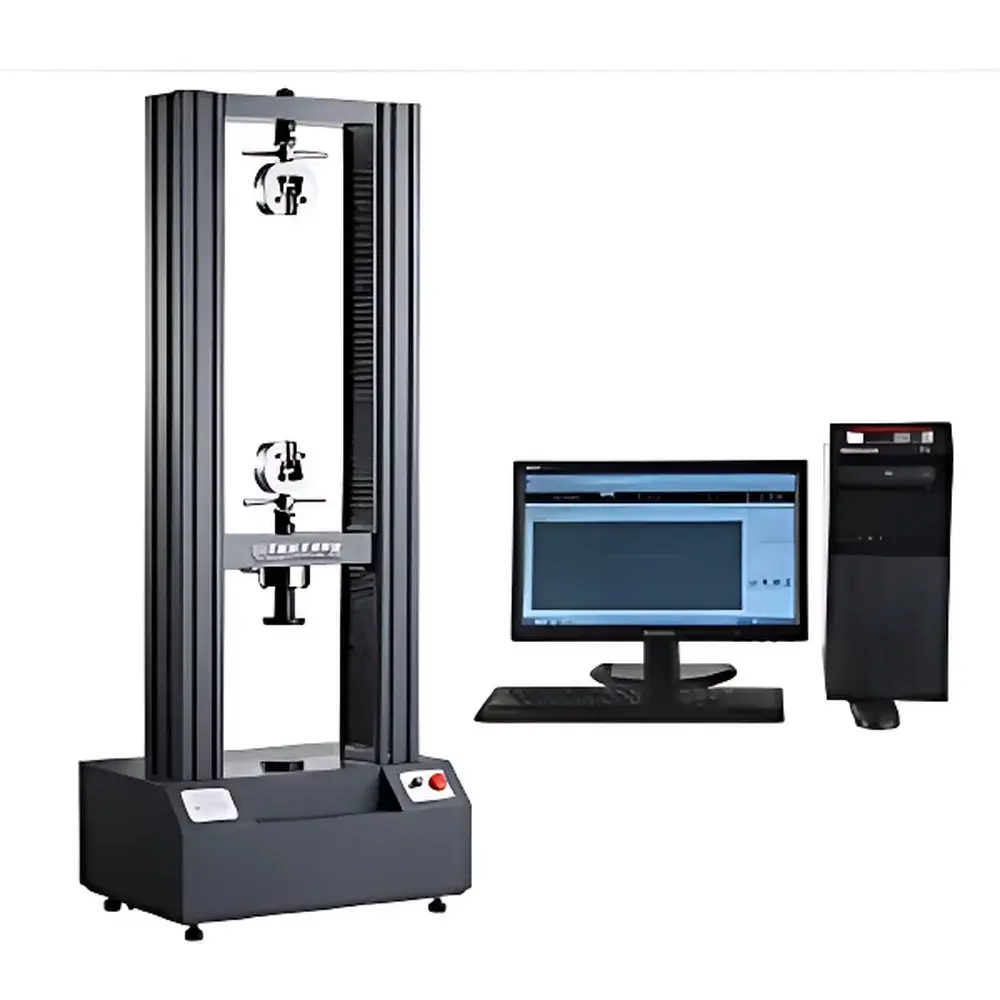
TopFeng TFW-200S Microcomputer-Controlled Electromechanical Universal Testing Machine
| Brand | TopFeng |
|---|---|
| Origin | Shanghai, China |
| Manufacturer Type | Direct Manufacturer |
| Product Category | Domestic |
| Model | TFW-200S |
| Instrument Type | Electromechanical Universal Testing Machine |
| Maximum Test Load | 200 kN |
| Accuracy Class | ISO 5893 Class 0.5 |
| Effective Force Range | 0.2–100% of Full Scale |
| Force Measurement Accuracy | ±0.005% of Reading |
| Force Resolution | 1 part in ±300,000 of Full-Scale Load (Single-Range, Constant Resolution) |
| Drive System | Servo Motor with Precision Worm Gear Reducer |
| Lead Screw | High-Accuracy Ball Screw |
| Effective Test Width | 600 mm (customizable) |
| Max. Travel Distance | 600 mm (customizable) |
| Speed Range | 0.01–500 mm/min (standard), optional extended range |
| Displacement Measurement | Optical Encoder |
| Displacement Accuracy | ±0.005% of Reading |
| Strain Measurement (Optional) | Extensometer (gauge lengths: 25/50/100 mm |
| max. extension | 5/10/25 mm) or Large-Deformation Clip Gauge (min. gauge length: 10 mm |
| max. extension | 800 mm) |
| strain accuracy | ±0.005% of reading |
| Safety Protection | Electronic Limit Switches, Emergency Stop Button |
| Crosshead Adjustment | Dual-Speed Motorized (Fast/Slow), Jog Control |
| Return Function | Automatic or Manual Return to Initial Position at Maximum Speed Post-Test |
| Overload Protection | Automatic Shutdown at >110% of Rated Load |
| Fixture Customization | Application-Specific Grips Available |
| Dimensions (W×D×H) | 1100 × 900 × 2600 mm |
| Power Supply | 380 V AC, 4 kW |
| Approx. Weight | 1500 kg |
Overview
The TopFeng TFW-200S Microcomputer-Controlled Electromechanical Universal Testing Machine is a high-precision static mechanical testing system engineered for rigorous tensile, compressive, flexural, shear, peel, tear, and adhesion evaluation of metallic, non-metallic, polymeric, composite, and ceramic materials. Based on the fundamental principles of force transduction via precision load cell technology and displacement measurement via optical encoder feedback, the TFW-200S delivers traceable, repeatable, and compliant mechanical property data across R&D, quality control, and production validation environments. Its architecture adheres to ISO 7500-1 (static calibration of force-proving instruments), ISO 5893 (tensile/compression testing machines), and GB/T 16491–2008 (Chinese national standard for electromechanical universal testers), ensuring metrological integrity and international equivalence.
Key Features
- Class 0.5 force accuracy per ISO 5893 — certified for high-fidelity stress-strain characterization in accredited laboratories.
- Full-scale force resolution of 1 part in ±300,000 without range switching — eliminates step-change errors and guarantees consistent sensitivity from 0.2% to 100% of 200 kN capacity.
- High-rigidity dual-column frame with precision-ground ball screw drive and servo-controlled worm gear reduction — ensures minimal axial play, thermal stability, and long-term repeatability under cyclic loading.
- Dual-speed motorized crosshead with jog functionality and programmable return logic — enables rapid setup, precise positioning, and automated post-test recovery without manual intervention.
- Integrated electronic limit switches and hardware-based emergency stop circuitry — provides redundant mechanical and electrical protection aligned with IEC 60204-1 safety standards.
- Modular extensometry support — accommodates both clip-on extensometers (for small-strain modulus and yield point determination) and large-deformation gauges (for ductile polymer or elastomer elongation analysis).
Sample Compatibility & Compliance
The TFW-200S supports standardized test specimens conforming to ASTM E8/E21 (metals), ASTM D638/D790 (plastics), ISO 6892-1 (metal tensile), ISO 178 (flexural), ISO 1133 (melt flow index correlation), and GB/T 228.1–2021 (Chinese metal tensile standard). Its configurable test width (600 mm standard, extendable), vertical travel (600 mm standard, height-adjustable), and fixture-mounting interface allow seamless adaptation to ASTM D903 (peel), ASTM D1876 (T-peel), ISO 8510-2 (adhesive bond strength), and ISO 11343 (tear resistance) geometries. All mechanical and software outputs are fully compatible with GLP/GMP documentation workflows, including audit-trail-enabled user authentication, electronic signature support, and 21 CFR Part 11-compliant data archiving when paired with validated software configurations.
Software & Data Management
The Windows-based control and analysis suite (compatible with Windows XP through Windows 10 LTSB) offers multi-mode closed-loop control — including constant rate of extension (CRE), constant load ramping, position-hold, and dwell sequencing. Real-time visualization includes synchronized plots of load vs. time, load vs. displacement, stress vs. strain, and displacement vs. time. The software computes standardized mechanical parameters automatically: tensile/yield strength, Young’s modulus, elongation at break, compressive yield stress, flexural modulus, peel/adhesion strength, and tear propagation energy — all derived using user-input specimen geometry (cross-sectional area, gauge length) and calibrated sensor inputs. Data export supports CSV, XML, and PDF report generation with embedded metadata (operator ID, timestamp, environmental conditions, calibration certificate IDs). Version-controlled firmware and application updates are provided free of charge for the instrument’s operational lifetime.
Applications
The TFW-200S serves as a core platform in materials science labs evaluating structural alloys for aerospace fasteners, thermoplastic composites in automotive lightweighting programs, biomedical polymers for implantable device validation, rubber compounds for tire tread development, and adhesive formulations for electronics encapsulation. It is routinely deployed in third-party certification bodies performing ISO/IEC 17025-accredited testing, OEM supplier qualification audits requiring PPAP Level 3 submissions, and academic research investigating viscoelastic relaxation behavior under controlled strain-rate protocols. Its dual-range extensometry capability makes it suitable for both brittle fracture analysis (e.g., carbon fiber laminates) and hyperelastic deformation modeling (e.g., silicone elastomers).
FAQ
What international standards does the TFW-200S comply with for force calibration and mechanical testing?
It conforms to ISO 7500-1 (force calibration), ISO 5893 (machine verification), ASTM E4 (load verification), and GB/T 16491–2008 (electromechanical UTM specification), with optional UKAS/NIST-traceable calibration certificates available.
Can the system be integrated into an existing LIMS or MES environment?
Yes — the software provides OPC UA and TCP/IP-based API access for bidirectional data exchange with laboratory information management systems and manufacturing execution systems, supporting structured data ingestion and remote job queuing.
Is the deformation measurement system validated per ISO 9513?
When equipped with certified extensometers (e.g., HBM or MTS models), the full measurement chain — from transducer to software algorithm — meets ISO 9513 Class 0.5 requirements for strain measurement uncertainty.
What maintenance intervals and service support options are offered?
Preventive maintenance is recommended every 12 months or 2000 operational hours; TopFeng provides global technical support, on-site calibration services, and spare parts logistics with <72-hour response SLA for critical components.
Does the software support multi-user role-based access control?
Yes — administrator, operator, and reviewer roles can be defined with granular permissions for method editing, test execution, result approval, and raw data export, satisfying ALCOA+ data integrity principles.



