
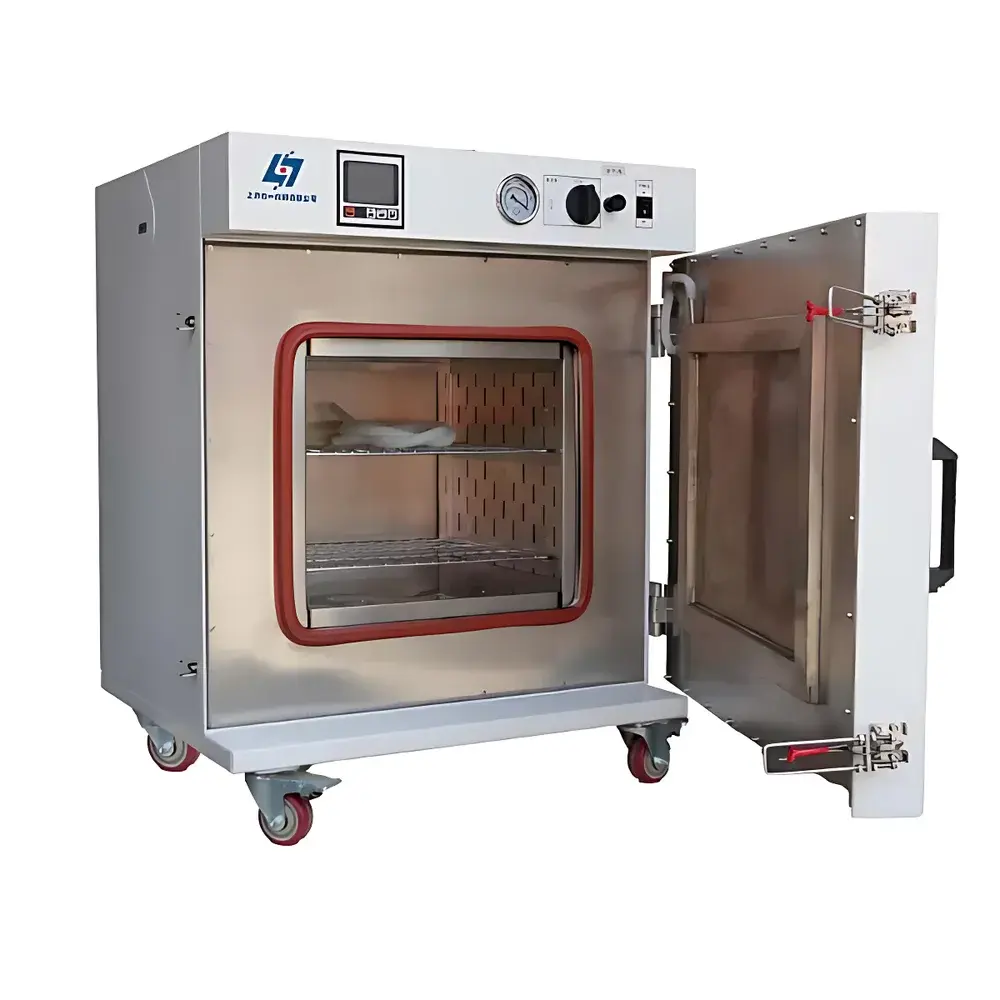
Shanghai Youyi GZF-6210B High-Temperature Vacuum Oven (500 °C)
| Brand | Shanghai Youyi (SHYY) |
|---|---|
| Origin | Shanghai, China |
| Manufacturer Type | Direct Manufacturer |
| Instrument Type | Vacuum Oven |
| Temperature Range | RT+10 °C to 500 °C |
| Temperature Uniformity | ±1 °C |
| Chamber Dimensions | 560 × 600 × 640 mm (L×W×H) |
| External Dimensions | 860 × 850 × 1195 mm (L×W×H) |
| Temperature Resolution | 0.1 °C |
| Chamber Material | 304 Stainless Steel |
| Heating Method | Electric Resistance Heating |
| Ultimate Vacuum Level | ≤133 Pa |
| Control Interface | 4.3″ LCD with Menu-Driven PID Programming |
| Safety Features | Over-Temperature Protection, Power-Failure Data Retention, Auto-Recovery Function |
Overview
The Shanghai Youyi GZF-6210B High-Temperature Vacuum Oven is an industrial-grade thermal processing system engineered for precise, oxygen-free drying, baking, sterilization, and thermal stabilization of heat-sensitive, oxidation-prone, or chemically complex samples. Operating within a controlled vacuum environment (≤133 Pa), the oven eliminates convective heat transfer and suppresses oxidative degradation by removing ambient oxygen—enabling safe thermal treatment of materials that decompose, polymerize, or oxidize under atmospheric conditions. Its 500 °C maximum operating temperature, combined with microprocessor-based PID temperature regulation and 0.1 °C resolution, ensures repeatable thermal profiles across extended dwell times. The unit complies with fundamental design principles outlined in ISO 17025 for laboratory equipment qualification and supports GLP-aligned operational documentation through programmable cycle logging.
Key Features
- Stainless steel 304 chamber construction with seamless welding and electropolished interior surface for corrosion resistance, cleanability, and minimal particle shedding.
- Electric resistance heating system with aluminum alloy heat-distribution plates—engineered for rapid thermal response and uniform temperature distribution without hot spots.
- Integrated silicone door gasket with adjustable clamping mechanism, ensuring long-term vacuum integrity and leak rates compliant with ISO 2859-1 sampling standards for vacuum system validation.
- 4.3-inch backlit LCD interface supporting multi-segment programmable temperature ramping (up to 5 segments), real-time parameter display, and user-defined alarm thresholds.
- Dual safety architecture: independent mechanical over-temperature cutoff and digital PID-based thermal runaway detection with audible/visual alert and automatic power cutoff.
- Power-failure recovery function retaining all setpoints and elapsed time data; resumes operation automatically upon grid restoration without manual reconfiguration.
Sample Compatibility & Compliance
The GZF-6210B accommodates diverse sample formats including glassware (vials, flasks, ampoules), ceramic crucibles, metal components, powder compacts, pharmaceutical granules, catalyst substrates, and porous composite materials. Its inert atmosphere capability—via optional nitrogen inlet valve and mass flow controller—enables processing under defined gas partial pressures per ASTM E145-22 Annex A3 guidelines for inert-gas-assisted drying. The vacuum chamber design meets dimensional requirements for standard ISO/IEC 17025 calibration traceability workflows and supports validation protocols aligned with FDA 21 CFR Part 11 when paired with audit-trail-enabled software (available as optional upgrade). All structural welds and gasket interfaces are rated for continuous operation at 500 °C under vacuum per ASME BPVC Section VIII Division 1 pressure boundary equivalency assessments.
Software & Data Management
While the base configuration features embedded firmware with local data logging (cycle start/stop timestamps, setpoint history, alarm events), optional RS485/Modbus RTU communication enables integration into centralized laboratory information management systems (LIMS) or SCADA platforms. When equipped with the programmable controller add-on, users can define up to five independent temperature ramps with dwell times, slope limits, and conditional branching logic. All logged data are stored in non-volatile memory with timestamping traceable to internal RTC (real-time clock) synchronized via NTP on network-connected variants. Audit trail functionality—including operator ID tagging, parameter change logs, and electronic signature support—is available through the optional compliance software module, satisfying requirements for regulated environments governed by EU Annex 11 and USP .
Applications
- Drying of thermolabile APIs and excipients without Maillard reactions or racemization.
- Post-synthesis solvent removal from nanomaterials and MOFs under inert purge to prevent surface hydrolysis.
- Pre-conditioning of moisture-sensitive sensors and MEMS devices prior to hermetic sealing.
- Thermal aging studies of polymer composites under accelerated vacuum conditions per ASTM D3045.
- Sterilization of reusable lab glassware where steam autoclaving is unsuitable due to thermal stress or component incompatibility.
- Residual solvent analysis preparation for GC-MS, ensuring quantitative recovery of volatile organics without thermal degradation.
FAQ
What vacuum level is required to achieve effective low-boiling-point solvent removal?
A vacuum level of ≤133 Pa (1 Torr) reduces the boiling point of water to ~50 °C and ethanol to ~25 °C, enabling gentle dehydration of sensitive matrices without thermal damage.
Can the oven be used for outgassing of ultra-high-vacuum components?
Yes—the 304 stainless chamber and high-temperature gasket system support bake-out cycles up to 500 °C, consistent with UHV component conditioning per ISO 14644-1 Class 5 cleanroom pre-bake specifications.
Is third-party calibration certification available?
Shanghai Youyi provides factory calibration reports traceable to CNAS-accredited laboratories; on-site IQ/OQ/PQ validation support is offered globally through authorized service partners.
How is temperature uniformity verified across the working volume?
Uniformity is validated using nine-point thermocouple mapping per ASTM E2203, with results documented in the Certificate of Conformance supplied with each unit.
What maintenance intervals are recommended for sustained vacuum performance?
Silicone gaskets should be inspected quarterly; vacuum pump oil (if externally coupled) requires replacement every 500 operating hours or per manufacturer’s specification—no internal consumables require routine servicing within the oven body itself.



