
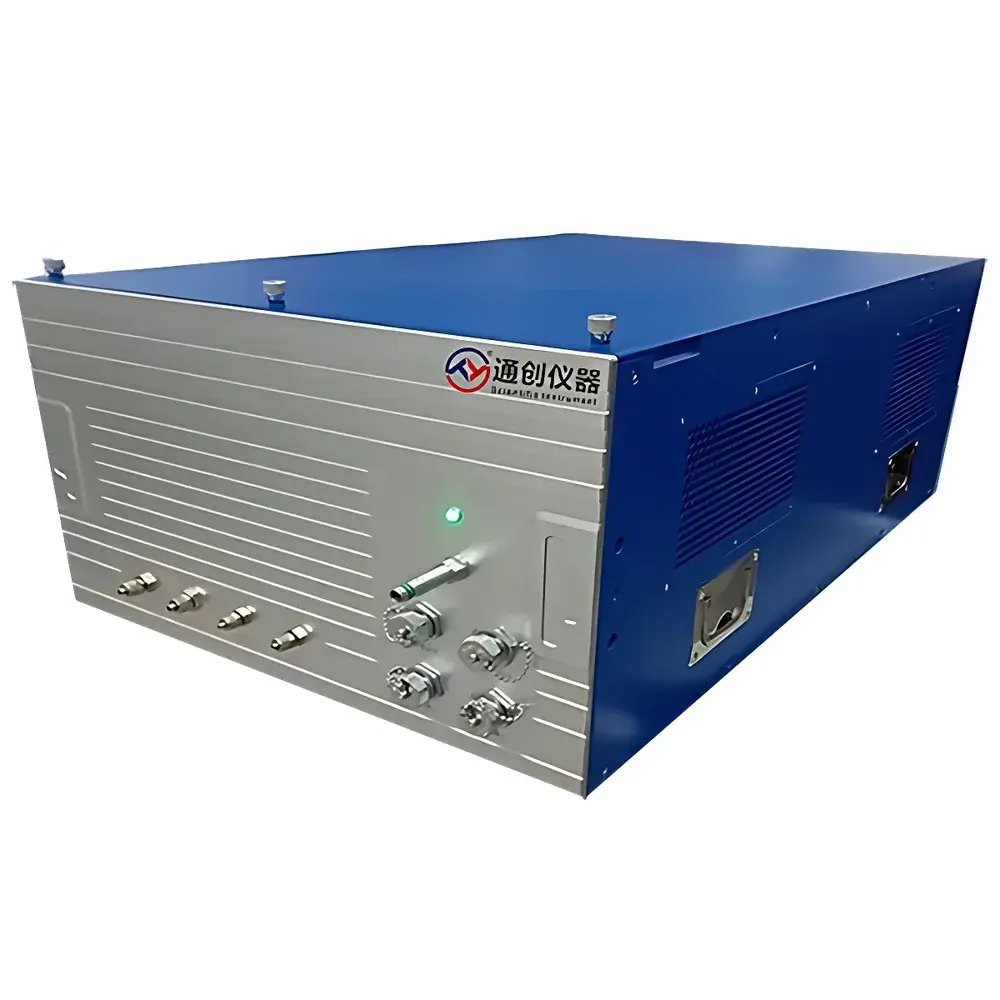
TCT CPA2000 Photoacoustic Transient Micro-Soot Meter
| Brand | TCT (Xiamen Tongchuang) |
|---|---|
| Origin | Fujian, China |
| Model | CPA2000 |
| Detection Principle | Photoacoustic Spectroscopy |
| Core Light Source | Semiconductor Laser |
| Sampling Frequency | 1–10 Hz |
| Measurable Target | Soot Particle Mass Concentration |
| Resolution | 1 µg/m³ |
| Range | 1–1000 mg/m³ (with dilution factor 1×–20×) |
| Response Time (t₁₀–₉₀) | ~1 s @ 3 L/min |
| Accuracy | ±2% of reading |
| Sample Flow Rate | 4 L/min |
| Inlet Pressure Tolerance | ±70 mbar (external pressure regulator required above 70 mbar) |
| Compressed Air Supply | 3 bar via 6 mm quick-connect fitting |
| Heated Line Temperature | >50 °C |
| Communication Interfaces | TCP/IP, AK Protocol (PUMA-compatible), CAN 2.0B (ISO 11898), RS-232/485 |
| Power | 200–240 VAC, 50–60 Hz, <500 W |
| Dimensions (L×W×H) | 765 × 360 × 320 mm |
| Weight | 30 kg |
| Operating Ambient Temperature | 5–35 °C |
| Internal System Temperature Range | 0–50 °C |
| Gas Pressure Range | 900–1100 mbar |
Overview
The TCT CPA2000 Photoacoustic Transient Micro-Soot Meter is a high-sensitivity, real-time soot mass concentration analyzer engineered for transient emission testing in engine development and regulatory compliance laboratories. It employs photoacoustic spectroscopy (PAS), a physical detection method based on the optoacoustic effect: when amplitude-modulated near-infrared laser light (from an integrated semiconductor laser source) irradiates soot-laden gas within a resonant photoacoustic cell, carbonaceous particles absorb photons and undergo rapid localized thermal expansion. This periodic heating generates pressure waves—acoustic signals—proportional to the instantaneous soot mass concentration. A low-noise electret microphone inside the PA cell captures these acoustic transients, which are then demodulated and quantified using lock-in amplification techniques. Unlike filter-based or light-scattering methods, PAS provides direct, calibration-stable measurement of particulate mass without reliance on optical path length or particle morphology assumptions—making it especially suitable for low-concentration, transient, and thermally unstable exhaust streams downstream of diesel particulate filters (DPF) or gasoline direct injection (GDI) engines.
Key Features
- Real-time soot mass concentration output at configurable sampling rates from 1 to 10 Hz, enabling cycle-resolved analysis of transient engine operation.
- Integrated heated sample line interface (≥50 °C) with three independent heating zones to prevent condensation and thermophoretic deposition of semi-volatile organic fractions (SOF) and nucleation-mode particles.
- Dual-gas inlet architecture: dedicated sample gas inlet and compressed air purge line (3 bar, 6 mm quick-connect), ensuring stable cavity pressure control and minimizing cross-contamination during rapid load changes.
- Multi-protocol digital communication suite: native support for TCP/IP Ethernet, CAN 2.0B (ISO 11898), RS-232/485 serial, and PUMA-compliant AK protocol—enabling seamless integration into AVL PUMA, Horiba MEXA, or custom test-bench control systems.
- Onboard calibration module with traceable zero and span verification capability; no external gas cylinders required for routine field validation.
- Robust mechanical design (30 kg, IP54-rated enclosure) optimized for engine-dyno bay deployment, including overpressure relief port and dual exhaust routing (main exhaust + safety vent).
Sample Compatibility & Compliance
The CPA2000 is validated for direct sampling of raw and diluted exhaust gases from internal combustion engines—including light-duty GDI, heavy-duty diesel, and alternative-fuel powertrains. Its 1 µg/m³ resolution and 1–1000 mg/m³ dynamic range (adjustable via 1×–20× dilution) meet requirements for both pre- and post-DFP measurements per ISO 8178-4, UN R49, and EPA 40 CFR Part 1065 Appendix J. The system’s pressure-compensated flow control (±70 mbar inlet tolerance) and active temperature stabilization ensure metrological consistency across variable backpressure conditions typical of engine transient cycles. All firmware and data logging modules comply with GLP-aligned audit trail requirements, supporting 21 CFR Part 11–ready configurations when deployed with validated third-party software platforms.
Software & Data Management
Raw acoustic signal acquisition, demodulation, and concentration conversion are performed onboard using FPGA-accelerated digital signal processing. Time-synchronized data streams—including analog outputs (0–10 V), CAN messages, and Ethernet packets—are timestamped with microsecond precision using internal GPS-synchronized clocking (optional). The instrument supports standard .csv export and HDF5 binary format for post-processing in MATLAB, Python (Pandas/NumPy), or AVL Workspace. Remote configuration, firmware updates, and diagnostic monitoring are accessible via web-based GUI (HTTPS) or command-line interface over TCP/IP. Data integrity is preserved through cyclic redundancy checks (CRC-32) on all transmitted frames and non-volatile storage of calibration history and event logs.
Applications
- Real-time DPF filtration efficiency assessment by concurrent upstream/downstream soot measurement during active regeneration cycles.
- Correlation studies between soot mass concentration and flame luminosity in diffusion-controlled combustion regimes.
- SOF correction modeling for total particulate matter (PM) estimation in low-sooting GDI engines.
- CVS dilution tunnel validation and low-concentration background drift characterization (e.g., <50 µg/m³).
- Fuel reformer and catalytic burner optimization in hydrogen and fuel-cell auxiliary power unit (APU) development.
- Transient soot kinetics analysis during WLTC, RDE, and NRTC test cycles under varying EGR and injection strategies.
FAQ
What is the minimum detectable soot concentration?
The CPA2000 achieves a limit of detection (LOD) of 1 µg/m³ under nominal 4 L/min flow and 1-second averaging, verified per ISO 11171 Annex C methodology.
Can the CPA2000 be used without dilution for raw exhaust measurement?
Yes—its full 1–1000 mg/m³ range covers undiluted diesel exhaust soot concentrations; however, heated sample conditioning and pressure regulation are mandatory to maintain accuracy and avoid sensor saturation.
Is the AK protocol implementation compatible with AVL PUMA 5.x and later?
Yes—the AK interface conforms to PUMA Application Layer Specification v3.2, supporting automatic device discovery, parameter mapping, and synchronous data streaming over CAN or Ethernet.
Does the system require annual recalibration?
No scheduled recalibration is mandated; however, users must perform documented zero/span verification before each test campaign per ISO 17025 and EU 2017/1151 Annex IIIA requirements.
How is condensation prevented in the acoustic cell during cold-start testing?
The PA chamber and all internal gas pathways are actively heated to ≥50 °C and insulated; inlet gas temperature is monitored in real time, and automatic flow throttling engages if dew point thresholds are approached.
Related Products





