
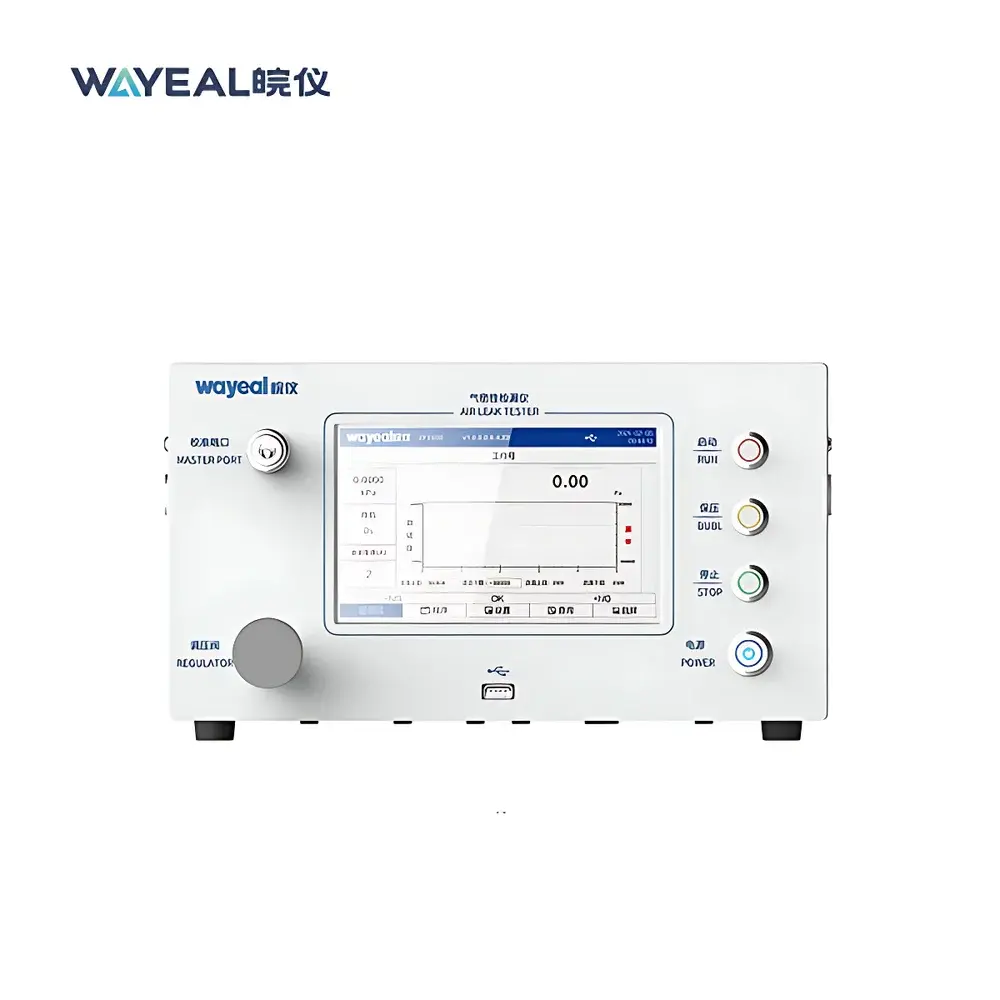
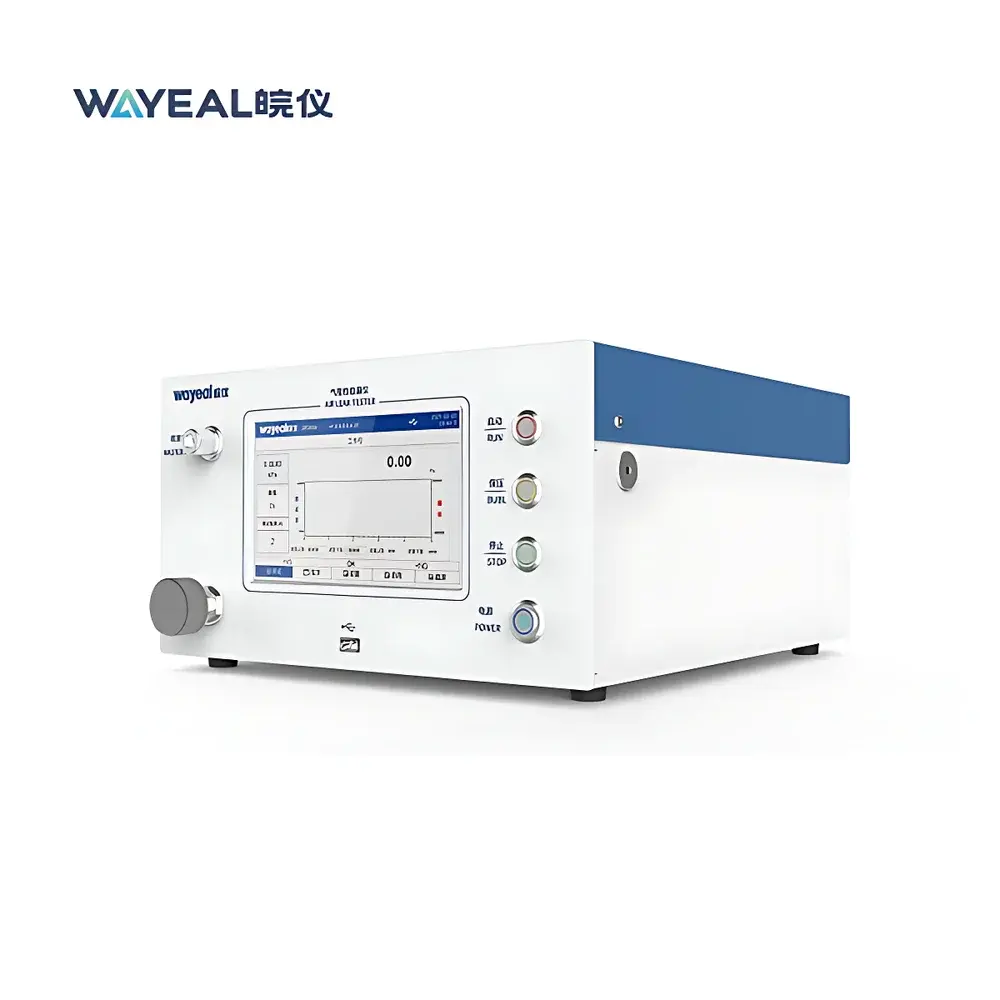
WAYEAL LC103(V5) / LC101(V6) Wide-Range Flow-Based Helium Mass Spectrometer Leak Detector
| Brand | WAYEAL |
|---|---|
| Origin | Anhui, China |
| Manufacturer Type | Direct Manufacturer |
| Regional Classification | Domestic (China) |
| Model | LC103(V5) / LC101(V6) Wide-Range Flow-Based Leak Detector |
| Price Range | USD 14,000 – 28,000 |
| Flow Range | 30–1000 mL/min (selectable) |
| Pressure Regulation | Mechanical, 10–600 kPa (selectable) |
| Test Pressure Units | kPa, MPa, kg/cm², psi, mbar, bar, Torr, mmH₂O, mmHg |
| Leak Rate Units | mL/s, mL/min, L/min, L/h, m³/h, Pa/min, g/h, SCCM |
| Display Resolution | Adjustable to 0–4 decimal places |
| Sensor Accuracy | ±3% F.S. (LC103 V5), ±0.1% F.S. (LC101 V6) |
| Programmable Test Profiles | 64 sets |
| Test Cycle Timing | 0–999 s |
| Max Test Duration | 1800 s |
| Power Supply | AC 220 V ±10%, 50 Hz |
| Required Test Gas Source | Clean, dry, ≥500 kPa supply pressure, at least 100 kPa above test pressure |
| Dimensions (V5) | 330 × 222 × 448 mm |
| Dimensions (V6) | 321 × 205 × 460 mm |
| Weight | ~16 kg |
Overview
The WAYEAL LC103(V5) and LC101(V6) are benchtop, flow-based helium mass spectrometer leak detectors engineered for high-reproducibility quantitative leak rate measurement across industrial and laboratory environments. Unlike traditional vacuum-mode helium detectors that require evacuated test chambers and complex pumping infrastructure, these instruments operate in flow mode—introducing calibrated helium tracer gas into a pressurized test object while continuously sampling the effluent stream via a built-in quadrupole mass spectrometer. This architecture enables real-time, absolute leak quantification without vacuum system dependency, significantly reducing test cycle time and operational complexity. The core detection principle relies on helium’s unique mass-to-charge ratio (m/z = 4), which is isolated and amplified by the mass filter under controlled ionization conditions. Signal intensity is linearly correlated to helium partial pressure, allowing direct conversion to standardized volumetric or mass-based leak rates (e.g., mL/min, SCCM, g/h). Designed for integration into automated production lines or QC labs, the system supports both manual and programmable operation with full traceability of test parameters and results.
Key Features
- Two platform variants: LC103(V5) optimized for general-purpose industrial leak testing; LC101(V6) delivering higher sensor accuracy (±0.1% F.S.) for metrology-critical applications such as medical device validation or aerospace component certification.
- Wide dynamic flow range: 30–1000 mL/min, selectable per application—enabling detection sensitivity down to 1×10⁻⁴ mL/s (equivalent to ~1×10⁻⁷ Pa·m³/s) under optimal calibration and environmental conditions.
- Multi-unit display and output support: Simultaneous configuration of test pressure (kPa, bar, psi, Torr, etc.) and leak rate (mL/min, SCCM, g/h, Pa/min) with user-selectable decimal resolution (0–4 digits).
- 64 programmable test profiles: Each profile stores pressure setpoint, flow threshold, test duration, pass/fail criteria, and data logging preferences—facilitating rapid reconfiguration across product families.
- Robust mechanical pressure regulation: Integrated adjustable regulator (10–600 kPa range) ensures stable test pressure delivery independent of upstream supply fluctuations.
- Compact, self-contained design: No external vacuum pumps or cryogenic traps required; operates with standard clean, dry compressed air or nitrogen as the carrier gas, with helium introduced only during active testing.
Sample Compatibility & Compliance
The LC103/V5 and LC101/V6 accommodate sealed components ranging from small electronic enclosures (10 L volume). Compatible geometries include welded housings, brazed joints, O-ring-sealed assemblies, and molded plastic containers. The system complies with ISO 10855-2:2021 (leak testing methodology), ASTM E499-22 (standard practice for helium mass spectrometer leak testing), and supports audit-ready documentation aligned with ISO/IEC 17025 and FDA 21 CFR Part 11 requirements when paired with optional secure software modules. All firmware and calibration routines are version-controlled and support GLP/GMP-compliant change management protocols. Traceable calibration certificates (NIST-traceable reference standards) are available upon request.
Software & Data Management
Embedded firmware provides local touchscreen control with intuitive menu navigation and real-time graphical trend display of leak rate versus time. Optional PC-based software (WAYEAL LeakView™) enables remote monitoring, batch report generation (PDF/CSV), SPC charting (X̄–R, Cpk), and integration with MES/SCADA systems via Modbus TCP or OPC UA. Audit trails record operator ID, timestamp, parameter changes, and result approvals. Data encryption, role-based access control, and electronic signature support meet regulatory expectations for quality-critical manufacturing environments.
Applications
- Automotive: EV battery module sealing verification, fuel rail integrity, brake caliper assembly testing.
- Medical Devices: Sterile barrier packaging (ISO 11607), implantable housing hermeticity, infusion pump manifold validation.
- Electronics: Hermeticity screening of MEMS sensors, RF shielding enclosures, and optoelectronic housings.
- Energy: Heat exchanger tube-to-tubesheet weld inspection, hydrogen pipeline component qualification.
- Aerospace: Hydraulic actuator housing certification, avionics enclosure leak budget verification per SAE AS9100 Rev D.
FAQ
What helium purity is required for reliable operation?
Helium ≥99.999% (5.0 grade) is recommended to minimize background interference from nitrogen or argon isotopes. Lower grades may elevate baseline noise and reduce detection limit stability.
Can the instrument detect non-helium leaks?
No—the system is specifically tuned to m/z = 4. It does not detect hydrogen, methane, or other gases unless they are used as alternative tracers with recalibration (not supported out-of-the-box).
Is external vacuum pumping necessary?
No. Flow-mode operation eliminates the need for roughing or turbomolecular pumps. Only a clean, dry, regulated pressure source (≥500 kPa) and helium supply are required.
How often must the mass spectrometer be calibrated?
Factory calibration is valid for 12 months under normal operating conditions. Annual recalibration using certified leak standards (e.g., Vici Metrology or Inficon-certified units) is recommended for ISO/IEC 17025 compliance.
Does the system support pass/fail automation with external PLCs?
Yes—digital I/O (8-channel TTL) and Ethernet-based communication protocols allow seamless integration into automated test cells with real-time GO/NO-GO signaling and fault logging.
Related Products





