
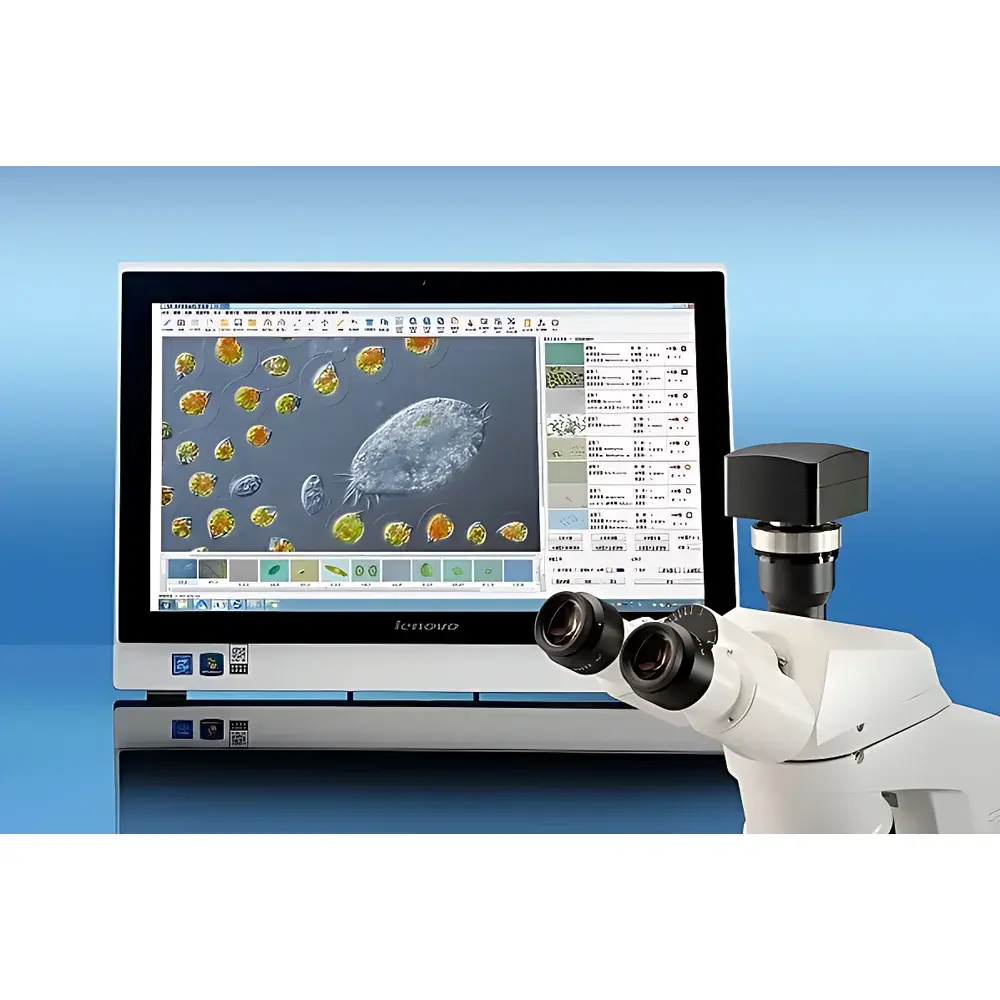
Xunshu Algacount T200 Intelligent Algal Identification and Enumeration System
| Brand | Xunshu |
|---|---|
| Origin | Zhejiang, China |
| Manufacturer Type | OEM Manufacturer |
| Region of Origin | Domestic (China) |
| Model | Algacount T200 |
| Instrument Type | Algal Identification & Enumeration System |
| Camera Resolution | 6.3 MP (Sony IMX178 CMOS, 1/1.8″ sensor) |
| Pixel Size | 2.4 × 2.4 µm |
| Optical Magnifications | 4×, 10×, 20×, 40× |
| Identification Methods | Morphological taxonomy, keyword-based search, similarity-driven image matching |
| Frame Rate | 15 fps @ 3072×2048 |
| Exposure Range | 0.244 ms – 2000 ms |
| Interface | USB 3.0 |
| Dynamic Range / SNR | 425 mV (G-light, 1/30 s) |
| Software Platform | Windows 10, proprietary Xunshu “XunSao” AI-assisted identification engine |
Overview
The Xunshu Algacount T200 Intelligent Algal Identification and Enumeration System is a purpose-built digital microscopy platform engineered for quantitative phytoplankton analysis in environmental monitoring laboratories. It integrates high-fidelity brightfield microscopy with a scientific-grade 6.3 MP CMOS imaging system and a domain-optimized software architecture grounded in botanical taxonomy and morphometric principles. Unlike generic image analysis tools, the Algacount T200 implements a tripartite identification paradigm—morphological pattern recognition, hierarchical taxonomic navigation, and similarity-based visual retrieval—enabling robust, reproducible identification of freshwater and marine microalgae at genus and species levels. Its core measurement principle relies on calibrated optical magnification, pixel-to-micron conversion, and geometric modeling to derive biologically meaningful metrics including cell volume, colony dimensions, chain length, biovolume, carbon/nitrogen biomass, and biodiversity indices (Shannon–Wiener, Pielou’s evenness, dominance). Designed for compliance with ISO 14442:2021 (Water quality — Guidance on enumeration and identification of phytoplankton), US EPA Method 10200 (Phytoplankton Enumeration by Microscopy), and national surface water monitoring protocols (e.g., China’s HJ 1081–2019), the system supports GLP-aligned data integrity through role-based access control and audit-trail-enabled electronic records.
Key Features
- Proprietary “XunSao” AI-assisted identification engine featuring three complementary modules: Multi-dimensional Progressive Similar Alga Search, Confusable Alga Discrimination, and Typical Morphological Association Retrieval
- Automated depth-of-field fusion across multiple focal planes to resolve vertically distributed algal cells within water column samples
- Seamless wide-field image stitching (horizontal/vertical) for high-resolution visualization of large colonies or filamentous structures
- Integrated morphometric toolkit: calibrated micrometric measurement, transparent digital scale, freehand annotation, and multi-point distance/area calculation
- Dedicated analytical modules for colonial and filamentous forms: mucilaginous colony subcell counting, chain-length estimation, and intercalary cell quantification
- Comprehensive biovolume computation using over 120 taxon-specific geometric models (spheres, ellipsoids, cylinders, prisms, and irregular polyhedra)
- Four-tier taxonomic database (Phylum → Order → Genus → Species) covering >1,200 freshwater taxa from China’s seven major river systems and 28 key lakes/reservoirs, plus >850 marine taxa from the Bohai, Yellow, East China, and South China Seas
- Role-based user management with administrator-level oversight, experiment-level data isolation, and immutable electronic record storage
Sample Compatibility & Compliance
The Algacount T200 accepts standard 20 mm × 40 mm microscope slides prepared via Utermöhl sedimentation or membrane filtration techniques. It supports both preserved (Lugol’s iodine, formalin) and live samples under phase contrast or brightfield illumination. All identification workflows conform to internationally recognized phytoplankton classification frameworks—including Komárek & Anagnostidis (Cyanobacteria), John et al. (Diatoms), and Guiry & Nic Dhonnchadha (Chlorophyta)—and are cross-referenced against AlgaeBase and WoRMS taxonomic authorities. Data outputs comply with ISO/IEC 17025:2017 documentation requirements and support 21 CFR Part 11–compatible electronic signatures when deployed with validated IT infrastructure. The system meets CE marking criteria for laboratory instrumentation (2014/30/EU EMC Directive and 2014/35/EU Low Voltage Directive).
Software & Data Management
The Algacount T200 runs on a dedicated Windows 10–based workstation equipped with quad-thread CPU, 4 GB RAM, and 1 TB SSD storage. Its software suite enforces full traceability: every captured image is timestamped, geotagged (optional), and linked to operator ID, sample ID, slide position, objective lens used, and exposure parameters. Statistical outputs—including total count, density (cells/mL), relative abundance (%), dominance index (Y), biovolume (mm³/L), carbon biomass (µg C/L), and diversity metrics—are exportable in CSV, Excel (.xlsx), or PDF formats with embedded metadata. Audit logs record all user actions (login/logout, image annotation, count modification, report generation), satisfying GLP/GMP audit readiness. Raw image archives and processed datasets are stored in encrypted SQLite databases with automatic backup scheduling.
Applications
- Regulatory monitoring of eutrophication indicators in rivers, lakes, reservoirs, and coastal waters
- Early warning detection of harmful algal blooms (HABs), including Microcystis, Anabaena, Alexandrium, and Karenia species
- Ecological assessment of trophic status using phytoplankton-based indices (e.g., Trophic Diatom Index, Phytoplankton Community Index)
- Long-term trend analysis in national water quality surveillance programs
- Research-grade morphometric studies on colonial development, chain formation, and mucilage dynamics
- Method validation and inter-laboratory comparison exercises under ISO 5725 or APHA proficiency testing schemes
- Training platform for taxonomic skill development in undergraduate and graduate limnology curricula
FAQ
Does the Algacount T200 support automated species-level identification without manual verification?
No. The system provides probabilistic candidate lists ranked by morphological similarity and taxonomic likelihood. Final identification requires expert confirmation per ISO 14442:2021 Clause 7.3.
Can the software distinguish between live and dead cells?
Not inherently. Viability assessment requires supplemental staining (e.g., fluorescein diacetate) and fluorescence-capable optics, which are outside the standard T200 configuration.
Is the database customizable for regional or project-specific taxa?
Yes. Administrators may import validated reference images and taxonomic metadata via structured XML templates, subject to internal review and version-controlled deployment.
What calibration standards are recommended for routine verification?
NIST-traceable stage micrometers (e.g., Graticule Co. 10 µm division) and certified phytoplankton reference slides (e.g., PHYTOPLAN™ series) are advised for quarterly performance checks.
How is data integrity maintained during multi-user operation?
Each session generates a cryptographically signed audit trail. Experimental data files are write-protected after finalization; modifications require explicit administrator override with justification logging.







