
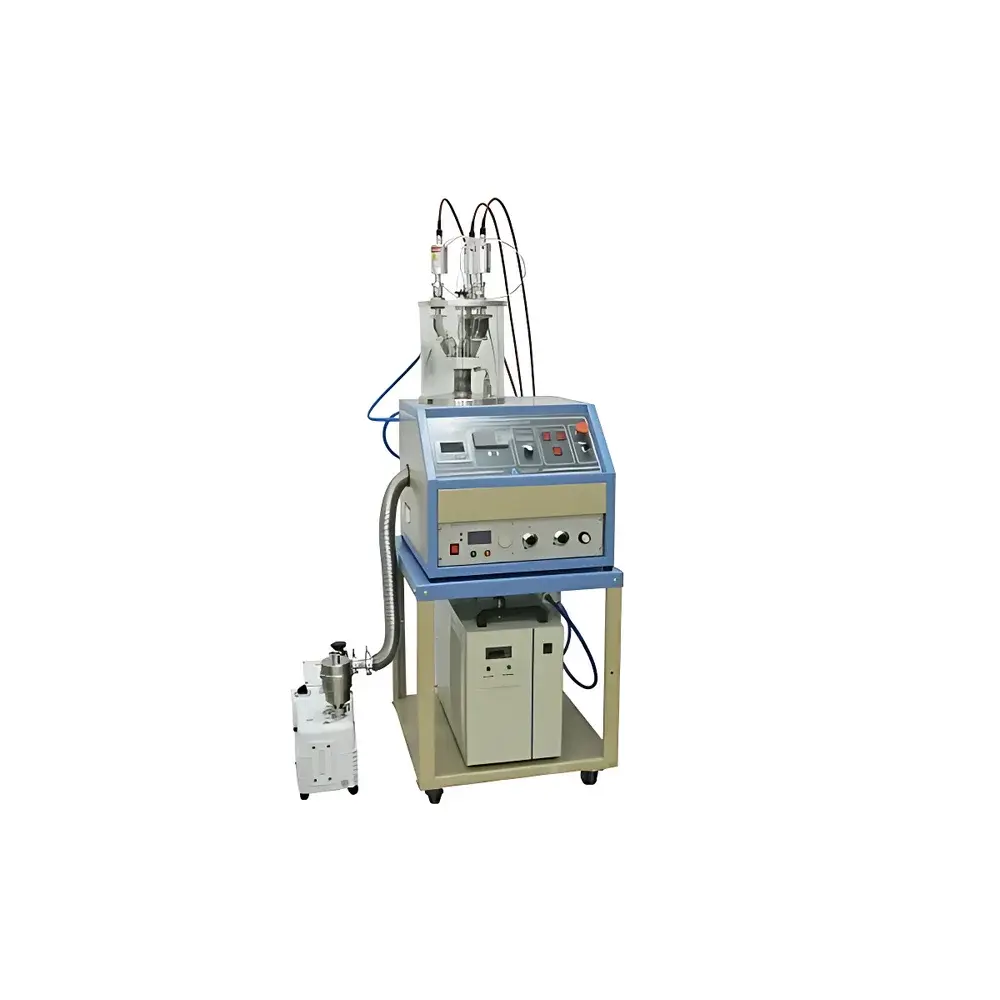
English Product Name
| Brand | Kojin (Hefei) |
|---|---|
| Origin | Anhui, China |
| Manufacturer Type | Authorized Distributor |
| Region of Manufacture | Domestic (China) |
| Model | VTC-3RF |
| Price Range | USD 7,000 – 14,000 |
| Input Power | 220 VAC, 50/60 Hz, Single-Phase, 800 W (including vacuum pump) |
| RF Power Supply | 13.56 MHz, 100 W (manual impedance matching) or optional 300 W (auto-matching) |
| Target Diameter | 25.4 mm (1 inch), Max Thickness: 3 mm |
| Cooling Water Flow Rate | 10 L/min (integrated 16 L/min recirculating chiller) |
| Chamber Dimensions | Ø256 mm × 250 mm ID × 276 mm H (high-purity quartz) |
| Chamber Seal | Aluminum flange (Ø274 mm) with silicone O-ring |
| Plasma Shielding | Stainless steel mesh enclosure |
| Base Pressure | <1.0×10⁻² Torr (dual-stage rotary vane pump) or <5×10⁻⁵ Torr (turbo-molecular pump option) |
| Substrate Stage | Rotatable (0–20 rpm), heated (max 700 °C short-term, 500 °C continuous), Ø50 mm (accommodates up to 2-inch wafers), temperature stability ±10 °C |
| Optional Quartz Crystal Microbalance (QCM) | Real-time thickness monitoring, 0.10 Å resolution, LED display with material parameter input |
| Certification | CE compliant |
| Warranty | 12 months, lifetime technical support |
Overview
The Kojin VTC-3RF is a compact, benchtop triple-target radio frequency (RF) magnetron sputtering coater engineered for precise deposition of electrically insulating thin films—particularly metal oxides—onto single-crystal and polycrystalline substrates. Unlike DC sputtering systems, which require conductive targets, the RF configuration enables stable plasma generation over dielectric materials (e.g., Al₂O₃, TiO₂, SiO₂, Y₂O₃) by oscillating ions and electrons at 13.56 MHz, thereby preventing target surface charging and arcing. The system employs three independently mounted 1-inch magnetron heads with water-cooled backing plates and quick-connect vacuum interfaces, allowing sequential or co-sputtering of multiple materials without breaking vacuum. Designed for academic research labs and R&D facilities focused on functional oxide thin-film development, the VTC-3RF balances reproducibility, operational flexibility, and cost-efficiency—making it suitable for exploratory synthesis, combinatorial library fabrication, and prototyping of optoelectronic, ferroelectric, and catalytic layers.
Key Features
- Triple independent 1-inch RF magnetron sources with integrated water cooling (10 L/min required; 16 L/min recirculating chiller included)
- Two RF power options: 100 W manual impedance matching (cost-optimized) or 300 W auto-matching (time-efficient for multi-target workflows)
- High-purity quartz vacuum chamber (Ø250 mm ID × 276 mm H) enclosed in grounded stainless steel mesh for electromagnetic shielding and operator safety
- Rotating and resistively heated substrate stage (0–20 rpm, up to 700 °C for ≤1 h; 500 °C rated for sustained operation), enabling uniform film growth and in-situ thermal treatment
- Modular vacuum architecture supporting dual-stage rotary vane pumps (base pressure <1×10⁻² Torr) or turbo-molecular pump upgrades (ultimate pressure <5×10⁻⁵ Torr)
- Integrated quartz crystal microbalance (QCM) thickness monitor (0.10 Å resolution) with real-time LED readout and programmable material density input
- Quick-action shutter assembly mounted directly on each magnetron flange for precise layer-by-layer deposition control
Sample Compatibility & Compliance
The VTC-3RF accommodates substrates up to 2 inches (50.8 mm) in diameter on its actively rotated and heated stage. It supports standard 1-inch (25.4 mm) circular targets with thicknesses up to 3 mm—including ceramic oxides, nitrides, and fluorides—provided they are bonded to copper backing plates. For optimal stoichiometric transfer and reduced oxidation artifacts, the system recommends high-purity argon (≥99.999% / 5N) pre-purified through in-line getters to reduce residual O₂ and H₂O (<1 ppm). Chamber conditioning via 2–3 cycles of 5% H₂/95% N₂ purge is advised prior to oxide deposition to minimize native oxide formation on chamber walls and targets. The instrument complies with CE safety directives (2014/30/EU EMC and 2014/35/EU LVD) and incorporates interlocked door sensors, over-temperature cutoffs, and RF leakage shielding per IEC 62471. While not GLP/GMP-certified out-of-the-box, its process repeatability and parameter logging capability support audit-ready documentation when paired with external data acquisition systems.
Software & Data Management
The VTC-3RF operates via front-panel tactile controls and an integrated LED interface—designed for intuitive, standalone use without PC dependency. All critical parameters—including RF forward/reflected power, chamber pressure (via Pirani + cold cathode gauges), stage temperature, rotation speed, and QCM thickness—are continuously displayed and manually logged. Optional RS-232 or USB-to-serial connectivity enables integration with LabVIEW, Python-based automation scripts, or third-party SCADA platforms for time-stamped parameter archiving. When used in regulated environments (e.g., university core facilities under ISO/IEC 17025), users may implement manual logbooks or supplement with validated electronic notebooks to satisfy traceability requirements per FDA 21 CFR Part 11 Annex 11 principles—though native electronic signature or audit trail functionality is not embedded.
Applications
This system is routinely deployed in solid-state physics, materials chemistry, and device engineering laboratories for: fundamental studies of epitaxial oxide growth kinetics; fabrication of transparent conducting oxides (e.g., ITO, AZO) for flexible electronics; deposition of gate dielectrics (e.g., HfO₂, Al₂O₃) in thin-film transistor test structures; preparation of ferroelectric Pb(Zr,Ti)O₃ (PZT) or multiferroic BiFeO₃ heterostructures; and synthesis of photocatalytic TiO₂ or WO₃ thin films for environmental sensing applications. Its ability to maintain low base pressures and enable controlled reactive sputtering (with optional MFC-controlled O₂ or N₂ inlet) supports both inert-gas sputtering and reactive processes—critical for tuning oxygen vacancy concentration in functional oxides.
FAQ
What types of non-conductive targets can be used with the VTC-3RF?
Ceramic oxides (e.g., Al₂O₃, SiO₂, ZnO), nitrides (e.g., Si₃N₄), fluorides (e.g., MgF₂), and complex perovskites (e.g., SrTiO₃) are compatible—provided they are sintered, dense, and bonded to thermally conductive backing plates.
Is the 100 W RF power supply sufficient for oxide sputtering?
Yes—for exploratory work and low-rate depositions (e.g., 0.1–0.5 nm/s for Al₂O₃ at 5 mTorr Ar). However, higher rates (>1 nm/s) or thicker films (>500 nm) benefit from the 300 W auto-matching option to maintain plasma stability across varying target conditions.
Can the system perform reactive sputtering?
Reactive sputtering is supported via optional mass flow controllers (MFCs) for introducing O₂, N₂, or CH₄ into the chamber—enabling synthesis of oxynitrides, nitrides, or carbon-doped films.
What vacuum level is recommended for high-quality oxide films?
A base pressure ≤5×10⁻⁴ Torr is typically sufficient for most oxide depositions; ultimate pressures below 5×10⁻⁵ Torr (with turbo pump) further reduce background contamination and improve film stoichiometry reproducibility.
Does the QCM thickness monitor compensate for deposition rate drift during long runs?
The QCM provides real-time thickness feedback but does not auto-adjust power or gas flow. Users must manually calibrate the acoustic sensitivity factor (Z-factor) for each target material using ex-situ profilometry validation.



