
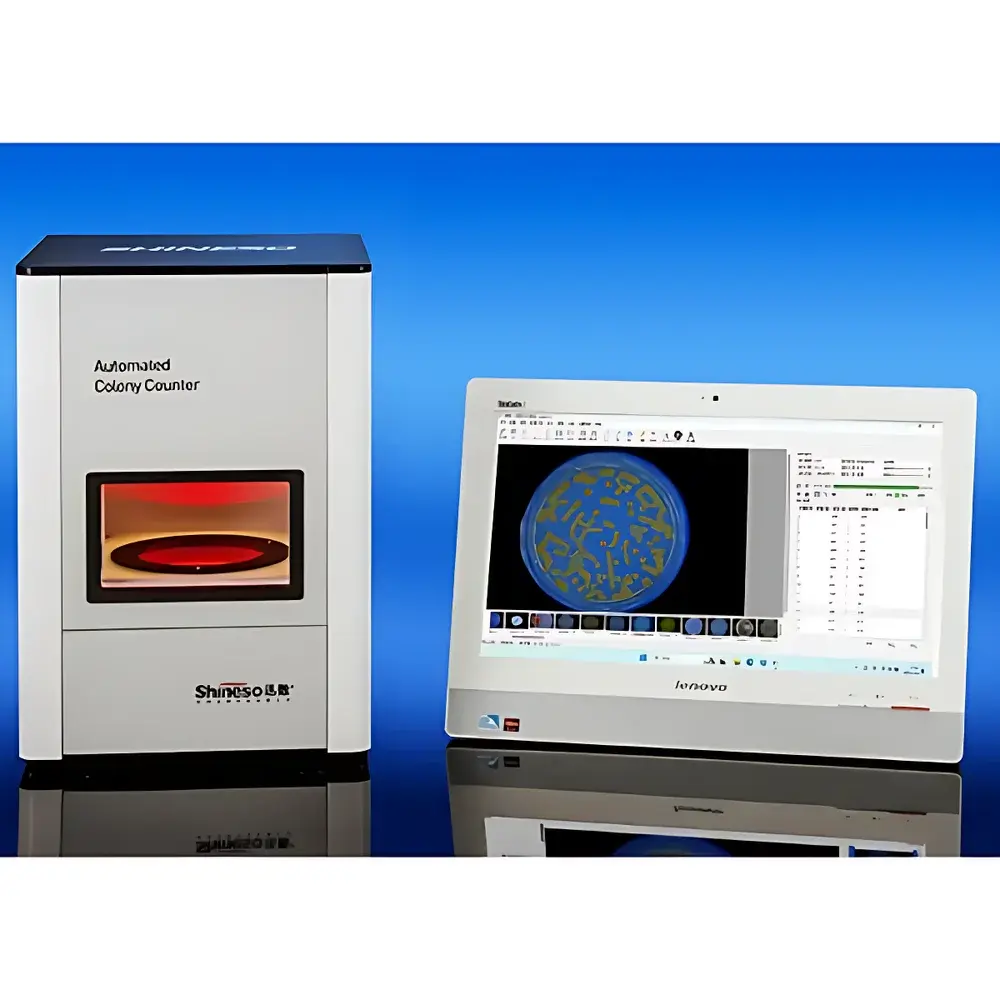
Xunshu HD1600 AI-Powered High-Resolution Colony Counter
| Brand | Xunshu |
|---|---|
| Origin | Zhejiang, China |
| Manufacturer Type | OEM Manufacturer |
| Instrument Type | Fully Automatic Colony Counter |
| Sample Types | Liquid media, solid media (pour plate, spread plate, membrane filtration, spiral plate, commercial test strips) |
| Petri Dish Capacity | 35–150 mm diameter |
| Counting Speed | 20,000 colonies/sec |
| Counting Accuracy | ≥98% for certified reference strains |
| Imaging System | Fixed-focus 12 mm lens, 10 MP resolution, 200 lp/mm MTF, f/1.8–f/32 aperture, C-mount interface |
| Sensor | 1/1.8" color CMOS, 20-megapixel effective resolution, 1.4 × 1.4 µm pixel size |
Overview
The Xunshu HD1600 AI-Powered High-Resolution Colony Counter is an industrial-grade, fully automated imaging system engineered for precise, high-throughput microbial colony enumeration in compliance with ISO 4833-1:2013, ISO 7218:2017, AOAC Official Method 977.27, and USP /. It employs a dual-path optical architecture combining high-fidelity digital imaging with deep learning–based segmentation algorithms trained on over two decades of real-world microbiological plate images. Unlike rule-based thresholding systems, the HD1600 implements a convolutional neural network (CNN) backbone fine-tuned for morphological variability—enabling robust detection across heterogeneous colony sizes, shapes, translucency, and spatial density—even under challenging conditions such as agar cracking, condensation artifacts, label overlay, or TTC-stained turbid backgrounds. Its measurement principle relies on multi-spectral illumination-assisted contrast enhancement followed by pixel-level semantic segmentation and post-hoc topological validation, ensuring traceable, auditable, and repeatable colony quantification suitable for GLP/GMP-regulated environments.
Key Features
- Five configurable illumination modes: suspended dark-field (ring LED broadband oblique illumination), gradient diffused fog-light (nanomaterial-scattered uniform surface lighting), translucent backlight (tunable 5-color LED transmission array with >90% illuminance uniformity), dual-path dual-wavelength chromatic illumination (angle-resolved spectral highlighting for membrane filters and selective media), and UVC-LED disinfection (265 nm, ozone-free, instant activation)
- Optically isolated aluminum alloy chassis (32 × 34 × 46 cm) with light-tight pull-down viewing window to eliminate ambient interference and UV leakage
- Fixed-focus C-mount lens (12 mm focal length, 200 lp/mm modulation transfer function, f/1.8–f/32 adjustable aperture) paired with a 20-megapixel 1/1.8″ color CMOS sensor (1.4 × 1.4 µm pixel pitch)
- Zero-parameter AI workflow: one-click batch acquisition and analysis without manual algorithm selection or threshold tuning
- Real-time verification overlay (“Verification Eye”) enabling visual confirmation of segmentation accuracy via toggle-marked colony boundaries
- Hardware-accelerated inference engine supporting concurrent processing of up to 200 standard Petri dishes (35–150 mm) within 180 seconds
Sample Compatibility & Compliance
The HD1600 accommodates all standard microbiological sample formats: pour plates, spread plates, membrane filtration units (including total coliform and E. coli test membranes), contact plates, spiral plates, and commercially available rapid test strips (e.g., 3M Petrifilm™). It maintains analytical integrity across variable agar thicknesses, dryness levels, discoloration, and background heterogeneity—including opaque or low-transmittance media. The system supports audit-ready data provenance per FDA 21 CFR Part 11 requirements through encrypted user authentication, immutable electronic lab notebook (ELN)-style project files, and full metadata capture (sample ID, dilution factor, operator, date/time stamp, instrument calibration log). All image and count data are stored in tamper-evident binary archives with SHA-256 checksum validation and optional external backup to NAS or LTO tape.
Software & Data Management
The proprietary AI Colony Analysis Suite provides role-based multi-user access control, with independent project workspaces for QC labs, R&D teams, or contract testing facilities. Each engineering project encapsulates raw images, annotated segmentation masks, statistical outputs (CFU/mL, CFU/g, log reduction), and customizable PDF/Excel reports compliant with ISO/IEC 17025 documentation standards. Advanced analytics include monochromatic classification (by hue saturation value clustering), dynamic reclassification (interactive boundary refinement), bias-estimated multiclass counting (for polymicrobial samples), level-set multi-model segmentation (adaptive to background texture shifts), inverse counting (for dominant background with sparse colonies), and automated foreign particle rejection (based on eccentricity, solidity, and chromatic divergence thresholds). All processing steps generate timestamped, user-attributed audit trails with version-controlled software binaries.
Applications
The HD1600 serves as a primary enumeration tool in pharmaceutical sterility testing (USP ), food safety pathogen screening (ISO 6579, ISO 11290), environmental monitoring (ISO 14698), cosmetic challenge testing (ISO 11930), water quality assessment (ISO 9308-1), and clinical microbiology QA/QC. Its validated performance extends to regulatory submissions requiring reproducible colony enumeration under variable lighting, media composition, and operator expertise—particularly where traditional manual counting introduces inter-observer variability exceeding ±15%. The system is routinely deployed in ISO 13485-certified medical device manufacturing, EU GMP Annex 1 cleanroom monitoring programs, and USDA-FSIS-approved meat and poultry laboratories.
FAQ
Does the HD1600 support FDA 21 CFR Part 11 compliance?
Yes—the software enforces electronic signature workflows, audit trail logging, and data integrity safeguards including write-protection, encryption, and backup verification.
Can it differentiate between viable and non-viable colonies on differential media?
No—it performs morphological enumeration only; viability determination requires correlated biochemical or molecular assays.
Is calibration traceable to NIST or other national standards?
Yes—optical calibration uses certified resolution test targets (ISO 12233 slanted-edge method); counting accuracy is verified annually using ATCC reference strain plates.
What operating system and hardware configuration is required?
The bundled workstation runs Windows 11 Pro (64-bit) with Intel Core i5 CPU, 16 GB RAM, 1 TB HDD + 512 GB SSD, integrated GPU, and 27-inch FHD display—fully optimized for real-time AI inference.
How is firmware and AI model updates delivered?
Updates are distributed via secure HTTPS portal with cryptographic signature verification and rollback capability to prior stable versions.




