
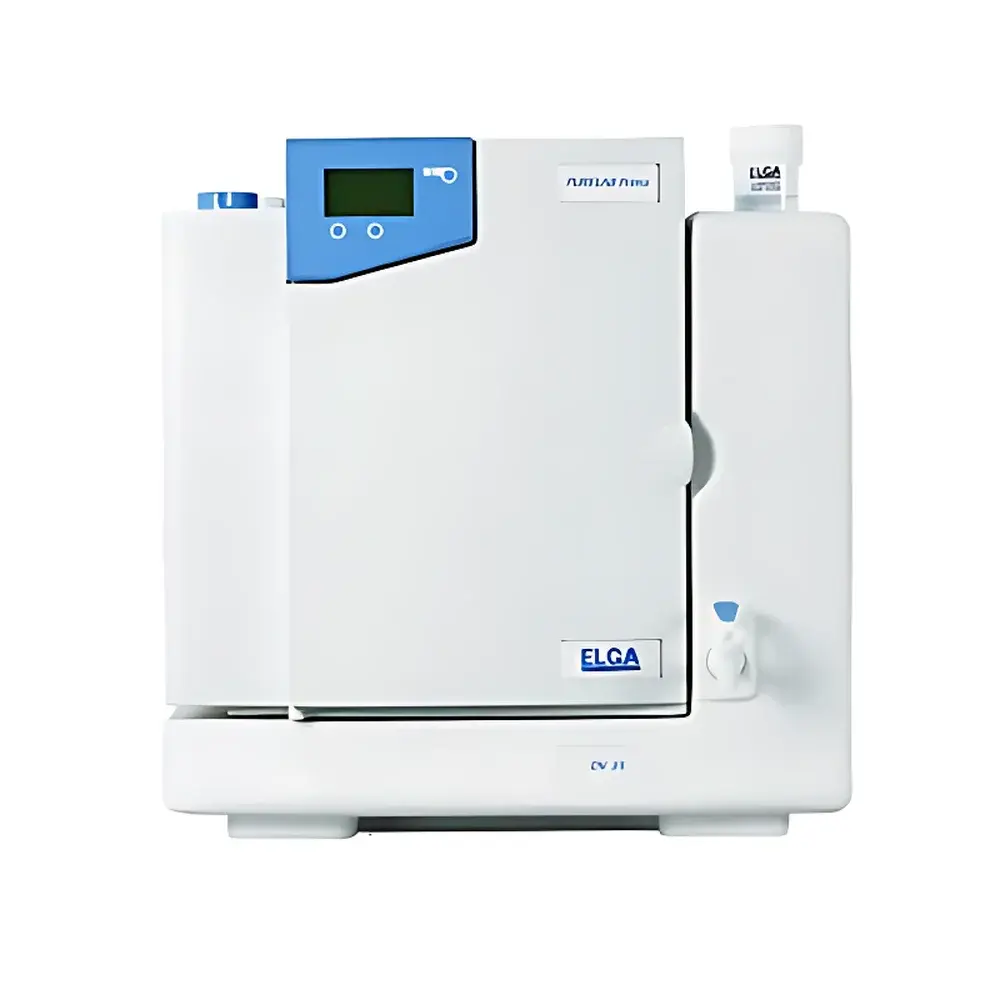
ELGA PURELAB Prima Series Pure Water System
| Brand | ELGA (Veolia) |
|---|---|
| Origin | United Kingdom |
| Manufacturer | Veolia Water Technologies |
| Product Category | Imported Laboratory Purification Equipment |
| Model | PURELAB Prima |
| Output Flow Rates | 7 / 15 / 30 L/hr |
| Resistivity | 0.2 MΩ·cm (Type III Water per ISO 3696 & ASTM D1193) |
| Heavy Metals & Soluble Silica | <0.1 ppb |
| Total Organic Carbon (TOC) | 20–50 ppb |
| Microbial Count | <5 CFU/mL |
| Endotoxin | <0.001 EU/mL |
| Particles (>0.1 µm) | <0.2 particles/mL |
| RO Salt Rejection | ≥98% |
| Service Support | Genuine spare parts and consumables available until 2026 |
Overview
The ELGA PURELAB Prima Series is a benchtop reverse osmosis (RO)-based pure water system engineered to consistently deliver Type III laboratory water in compliance with ISO 3696:2011 Grade 3 and ASTM D1193-20 Standard Specifications for Reagent Water. Designed and originally manufactured at ELGA’s UK production facility—now discontinued—the system remains operationally supported through authorized distribution channels in select markets, including China. Its core purification architecture integrates multi-stage pretreatment (including sediment and carbon filtration), high-rejection thin-film composite RO membranes, and post-RO polishing to achieve stable resistivity of 0.2 MΩ·cm at 25 °C, low TOC (20–50 ppb), sub-part-per-trillion heavy metal and soluble silica levels (<0.1 ppb), and microbiological control (<5 CFU/mL). The PURELAB Prima serves two primary roles: as a standalone source of general-purpose lab water for non-critical applications, and as a reliable pre-treatment feed for downstream ultra-pure water (UPW) systems—including ELGA’s own CENTRA and PURELAB Chorus platforms.
Key Features
- Three scalable flow-rate configurations (7, 15, and 30 L/hr) to match varying daily demand without over-sizing infrastructure
- Integrated real-time monitoring of feed water quality, RO performance (pressure, rejection rate), and product water resistivity
- Modular cartridge design enabling rapid, tool-free replacement of sediment filters, activated carbon blocks, and RO membranes
- Automated membrane flush cycle and programmable maintenance alerts aligned with ISO/IEC 17025 preventive maintenance guidelines
- Compact footprint (≤0.45 m²) with wall-mount or benchtop installation options and integrated leak detection sensors
- Ongoing technical support and certified consumables—including OEM RO membranes, carbon cartridges, and housing assemblies—guaranteed through 2026
Sample Compatibility & Compliance
The PURELAB Prima delivers water suitable for routine laboratory processes where stringent ionic or organic purity is not required. It meets the minimum specifications for feed water to autoclaves, environmental chambers, steam generators, glassware washers, hydroponic nutrient reservoirs, and distillation units. While not intended for HPLC, cell culture, or molecular biology applications, its output satisfies ISO 3696 Grade 3 and CLSI EP23-A validation requirements for preparatory reagent preparation and equipment rinsing. All wetted materials comply with USP Class VI biocompatibility standards; system construction adheres to CE Machinery Directive 2006/42/EC and RoHS 2011/65/EU. Documentation packages include Factory Acceptance Test (FAT) reports and material traceability dossiers for GLP/GMP-aligned laboratories conducting internal audit readiness assessments.
Software & Data Management
The PURELAB Prima operates via an embedded microcontroller with no external software dependency. All operational parameters—including cumulative runtime, filter service intervals, RO pressure differentials, and last-calibration timestamps—are stored in non-volatile memory and accessible via front-panel LCD navigation. Event logs retain up to 500 entries (e.g., “Carbon cartridge replaced”, “RO membrane flushed”, “Low feed pressure alarm”) with date/time stamps. While the system does not support network connectivity or electronic data interchange, its log structure conforms to ALCOA+ principles (Attributable, Legible, Contemporaneous, Original, Accurate, Complete, Consistent, Enduring, Available) to facilitate manual transcription into laboratory information management systems (LIMS) or paper-based quality records. Calibration certificates for built-in conductivity sensors are traceable to NPL (UK) standards.
Applications
- Feed water supply for centralized ultra-pure water systems requiring consistent low-TOC, low-silica inlet conditions
- Routine cleaning of volumetric glassware, pipettes, and stainless-steel labware in QC/QA environments
- Preparation of buffers, saline solutions, and media diluents for histology and basic microbiology
- Operation of steam-jacketed sterilizers, humidity-controlled incubators, and ultrasonic baths
- Water top-up for distilled water reservoirs and humidification systems in cleanrooms and animal facilities
- Non-critical irrigation in controlled-environment plant growth chambers and hydroponic research setups
FAQ
Is the PURELAB Prima still in active production?
No. Manufacturing ceased at ELGA’s UK facility in 2022. Units currently available are from remaining regional distributor inventory.
Can I integrate the PURELAB Prima with newer ELGA UPW systems?
Yes. Its stable output meets the feed water specifications for ELGA CENTRA and PURELAB Chorus series when paired with optional UV oxidation or additional deionization modules.
What is the expected service life of the RO membrane under typical lab conditions?
With proper pretreatment and adherence to scheduled maintenance, RO membranes typically achieve 24–36 months of functional service life before replacement.
Are consumables and spare parts guaranteed beyond 2026?
No. ELGA has formally committed to supplying certified consumables and mechanical spares only through December 31, 2026.
Does the system comply with FDA 21 CFR Part 11 requirements?
Not natively—the PURELAB Prima lacks electronic signature capability or audit-trail export functionality. However, its event log structure supports manual Part 11 compliance when integrated into validated paper-based or LIMS-managed workflows.



