
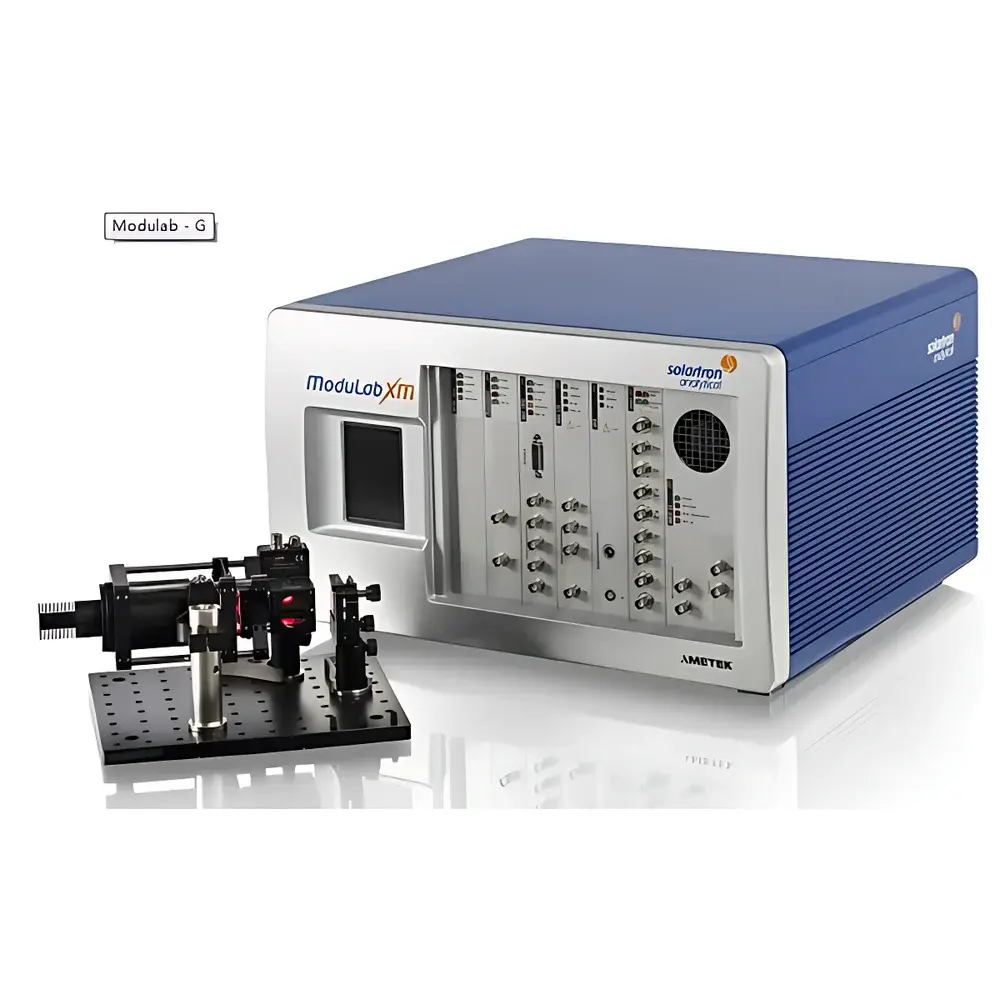
Solartron Analytical ModuLab XM PhotoChem IPCE Electrochemical Workstation
| Brand | Solartron Analytical |
|---|---|
| Origin | United Kingdom |
| Model | ModuLab XM PhotoChem IPCE |
| Current Range | ±300 mA |
| Current Accuracy | 0.1% reading + 0.05% range + 30 fA |
| Potential Accuracy | 0.1% reading + 0.05% range + 100 µV |
| Potentiostatic Range | ±8 V |
| EIS Frequency Range | 10 µHz – 1 MHz |
| Compliance | NIST-traceable light source calibration included |
| Software | ModuLab XM Suite with dedicated PhotoElectroChemical (PEC) experiment modules |
Overview
The Solartron Analytical ModuLab XM PhotoChem IPCE Electrochemical Workstation is a purpose-engineered, modular instrumentation platform designed for advanced photoelectrochemical (PEC) characterization in research and development environments. Built upon Solartron’s industry-proven ModuLab XM architecture, this system integrates high-precision potentiostat/galvanostat functionality with synchronized optical excitation control—enabling quantitative, time-resolved and frequency-domain analysis of light-driven electrochemical processes. Its core measurement principle combines controlled potential/current perturbation with intensity-modulated or steady-state illumination to extract kinetic and transport parameters—including charge transfer resistance, electron lifetime, effective diffusion coefficient, surface recombination rate, and incident photon-to-current efficiency (IPCE). The system is widely applied in next-generation energy materials research, such as dye-sensitized solar cells (DSSCs), metal oxide photoanodes (e.g., α-Fe2O3 for water splitting), perovskite photovoltaics, and photocatalytic CO2 reduction systems.
Key Features
- Modular hardware architecture supporting seamless integration of optical modules, LED light sources, and temperature-controlled sample stages
- High-fidelity frequency response analysis (FRA) engine with single-sine, multi-sine, and swept-frequency capabilities (10 µHz–1 MHz)
- NIST-traceable calibrated light source with onboard verification protocol for long-term irradiance stability and spectral fidelity
- Dedicated high-brightness monochromatic LED array (365–850 nm) enabling wavelength-resolved IPCE and action spectrum measurements
- Simultaneous dual-channel voltage monitoring with auxiliary divider for independent anode/cathode impedance and potential tracking
- Ultra-low current resolution down to 30 fA and sub-microvolt potential resolution ensure sensitivity for low-conductivity or nanostructured interfaces
- Thermally stabilized optical enclosure minimizing thermal drift during extended illumination experiments (e.g., IMPS/IMVS decay kinetics)
Sample Compatibility & Compliance
The ModuLab XM PhotoChem IPCE supports standard three-electrode PEC cells (working, counter, reference), custom optically transparent electrode (OTE) configurations, and gas-diffusion electrodes under inert or controlled atmospheres. It accommodates liquid electrolytes (aqueous/non-aqueous), solid-state hole transport layers, and thin-film photoabsorbers deposited on conductive substrates (FTO, ITO, NiO, TiO2). All electrical and optical calibrations comply with ISO/IEC 17025 traceability requirements. The integrated light source carries full NIST-traceable certification documentation, and software audit trails meet GLP and FDA 21 CFR Part 11 data integrity standards when configured with user access controls and electronic signatures.
Software & Data Management
The ModuLab XM Suite provides a unified interface for experimental design, real-time acquisition, and post-processing. Preconfigured experiment templates include IMPS, IMVS, Mott-Schottky, open-circuit voltage decay (OCVD), charge extraction (CE), dark CE, J–V sweeps under illumination, and wavelength-dependent IPCE mapping. Automated data analysis routines compute electron lifetime (τn), effective diffusion length (Ln), and surface recombination resistance directly from raw FRA or transient datasets—without requiring manual equivalent circuit modeling. Raw data are stored in vendor-neutral ASCII and HDF5 formats; metadata (instrument settings, calibration logs, environmental conditions) are embedded per measurement. Export options support MATLAB, Python (via PyModuLab), Origin, and Excel for cross-platform validation and publication-ready plotting.
Applications
- Quantitative IPCE and external quantum efficiency (EQE) mapping across UV–Vis–NIR spectra
- Dynamic characterization of charge carrier separation and recombination in hematite (α-Fe2O3), BiVO4, and WO3 photoanodes
- Interface engineering studies of passivation layers (e.g., Al2O3, NiOx) via bias-dependent EIS and OCVD
- In situ monitoring of photocorrosion onset and stability under operational illumination and bias
- Development and validation of mechanistic models using distributed element modeling (DEMS) and transmission line modeling (TLM)
- Standardized testing per ASTM E2527 (Standard Test Method for Measuring Incident Photon-to-Current Efficiency) and ISO 15593 (Photocatalytic Air Purification Materials)
FAQ
Can the ModuLab XM PhotoChem IPCE be upgraded from an existing ModuLab XM potentiostat?
Yes—existing ModuLab XM systems can be retrofitted with the PhotoChem IPCE option kit, including optical bench, LED drivers, shutter control module, and software license.
Is the light source intensity stable over long-duration experiments?
The thermally managed LED array maintains irradiance stability within ±0.5% over 24-hour continuous operation, verified by integrated photodiode feedback and periodic NIST-traceable recalibration.
Does the system support simultaneous illumination and EIS acquisition?
Yes—the FRA engine operates synchronously with optical modulation, enabling true intensity-modulated impedance spectroscopy (IMIS) and phase-resolved photocurrent analysis.
Are third-party optical components (e.g., monochromators, solar simulators) compatible?
The system features TTL and analog I/O ports for external trigger synchronization and analog intensity control, supporting integration with certified Class AAA solar simulators and grating monochromators.
How is data integrity ensured for regulatory submissions?
When deployed with role-based user accounts, electronic signatures, and audit trail logging enabled, the software complies with 21 CFR Part 11 requirements for electronic records and signatures in GMP/GLP environments.




