
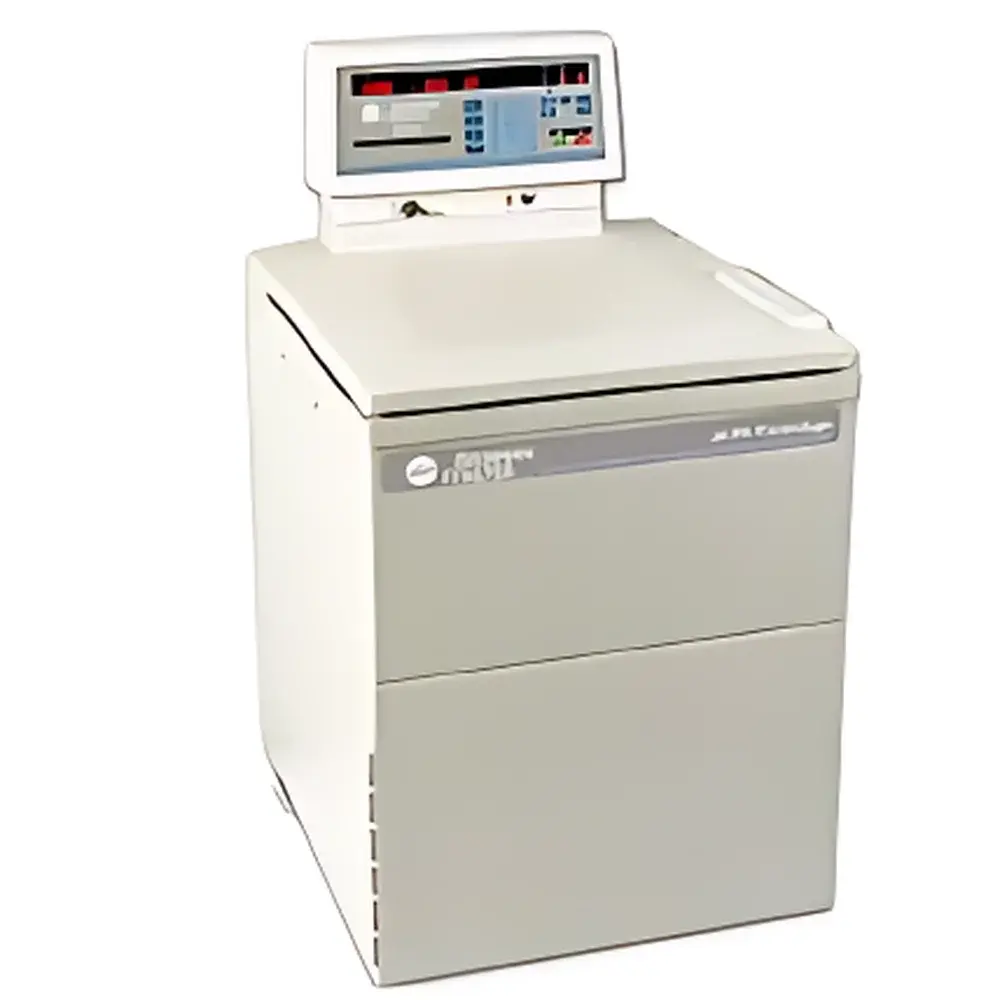
Beckman Coulter J6 Series High-Capacity Refrigerated Centrifuge
| Brand | Beckman Coulter |
|---|---|
| Origin | USA |
| Model | J6 |
| Maximum RCF | 6,835 × g |
| Maximum Speed | 6,000 rpm |
| Microprocessor Control | Yes |
| Acceleration/Deceleration Rates | 9/9 |
| Programmable Methods | 10 |
| Brushless Drive Motor | Yes |
| Capacity | 6 L (e.g., 12 blood bags, 18 microplates, or 336 RIA tubes) |
| Rotor Compatibility | JS-4.2A, JS-4.2SMA ARIES (auto-balancing within ±50 g), JE-6B & JE-5.0 elutriation rotors |
Overview
The Beckman Coulter J6 Series High-Capacity Refrigerated Centrifuge is an engineered solution for high-throughput, temperature-sensitive separation tasks in clinical, transfusion medicine, and bioprocessing laboratories. Designed around a robust refrigerated horizontal rotor architecture, the system operates on the principle of sedimentation under controlled gravitational force (RCF), enabling reproducible pelleting, phase separation, and density-gradient fractionation of biological suspensions. Its 6-liter maximum capacity supports large-volume processing—such as whole-blood fractionation into packed red cells, platelet-rich plasma, and cryoprecipitate—without requiring batch splitting or manual intervention. The integrated refrigeration system maintains sample integrity across extended runs (typically −10 °C to +40 °C), critical for preserving labile analytes, cell viability, and coagulation factor activity during clinical specimen handling.
Key Features
- High-capacity refrigerated platform delivering up to 6,835 × g at 6,000 rpm, with precise temperature control (±1 °C) across the full operating range.
- Brushless induction drive motor ensures maintenance-free operation, consistent torque delivery, and long-term rotational stability—essential for GMP-aligned production environments.
- Multi-Disc tube carrier system accommodates heterogeneous vessel geometries—including conical-bottom centrifuge tubes, round-bottom culture vessels, blood bags, microtiter plates, and RIA tubes—without adapter changes; carriers are autoclavable (121 °C, 20 min) for sterile workflow integration.
- ARIES-series rotors (JS-4.2A and JS-4.2SMA) incorporate dynamic imbalance compensation, automatically adjusting rotational dynamics within ±50 g mass differential—reducing operator dependency and minimizing run aborts in high-turnover blood bank settings.
- Dedicated elutriation rotors (JE-6B and JE-5.0) enable continuous-flow counter-current centrifugal separation of heterogeneous cell populations based on size and density—a core technique in hematopoietic stem cell enrichment and leukapheresis process development.
- Aeroseal lid option provides physical containment during deceleration, significantly reducing aerosol generation and cross-contamination risk—particularly valuable when processing infectious or biohazardous specimens under CLSI H26-A3 or WHO BSL-2 guidelines.
Sample Compatibility & Compliance
The J6 platform is validated for use with standard clinical consumables compliant with ISO 8536-1 (glass containers) and ISO 8536-4 (plastic blood bags). Its rotor certification meets ISO 15189:2022 requirements for pre-analytical equipment performance verification. When operated with traceable calibration protocols and documented maintenance logs, the system supports GLP and FDA 21 CFR Part 11–aligned workflows—especially where electronic records, audit trails, and user access controls are enforced via optional networked data export. All refrigeration components comply with UL 61010-1 and IEC 61010-2-020 safety standards for laboratory equipment.
Software & Data Management
The microprocessor-based control interface stores up to 10 user-defined methods, each retaining speed, time, temperature, acceleration/deceleration ramp profiles, and rotor identification. Method recall includes automatic RCF recalculation based on selected rotor radius—preventing inadvertent over-speeding. While the base unit lacks Ethernet or USB connectivity, analog output signals (0–10 V) support integration with centralized building management systems (BMS) for environmental monitoring. For regulatory traceability, printed run reports (via optional thermal printer interface) include timestamp, operator ID, rotor serial number, and final brake status—meeting minimum documentation criteria outlined in CAP Laboratory Accreditation Standards COM.42520 and CLIA ’88 Condition Code §493.1253.
Applications
- Blood banking: Separation of whole blood into components (RBCs, WBCs, platelets, plasma) per AABB Technical Manual Chapter 7 protocols.
- Clinical diagnostics: High-volume serum/plasma preparation from EDTA, heparin, or citrate anticoagulated specimens prior to immunoassay or mass spectrometry analysis.
- Biopharmaceutical manufacturing: Clarification of mammalian cell culture harvests and large-scale protein precipitation steps under cGMP Annex 1 Annex II guidance.
- Cell therapy: Elutriation-based enrichment of CD34+ hematopoietic progenitor cells using JE-series rotors—validated against ISCT minimal criteria for potency assays.
- Research core facilities: Scalable centrifugation for metabolomics sample prep, extracellular vesicle isolation, and nucleic acid purification workflows requiring >4 L batch volume.
FAQ
Does the J6 Series support rotor validation per ISO 20957-2?
Yes—each rotor carries a CE-marked conformity statement and is supplied with a certified radius value and maximum load specification traceable to NIST standards.
Can the Aeroseal lid be used with all J6-compatible rotors?
The Aeroseal lid is specifically engineered for compatibility with JS- and JE-series horizontal rotors; it is not rated for use with fixed-angle or vertical rotors.
Is firmware upgrade capability available through Beckman Coulter service channels?
Firmware updates are delivered exclusively via authorized field service engineers during scheduled PM visits and require password-protected diagnostic mode activation.
What is the mean time between failures (MTBF) for the brushless drive system?
Based on 2022 Beckman Coulter Field Reliability Report, the MTBF for the J6 drive assembly exceeds 25,000 operational hours under typical clinical duty cycles.
How is temperature uniformity verified during IQ/OQ qualification?
Temperature mapping must be performed using calibrated thermocouples placed at ≥9 spatial locations per ICH Q5C Annex 1, with ≤±1.5 °C deviation across the chamber at setpoint.
Related Products



