
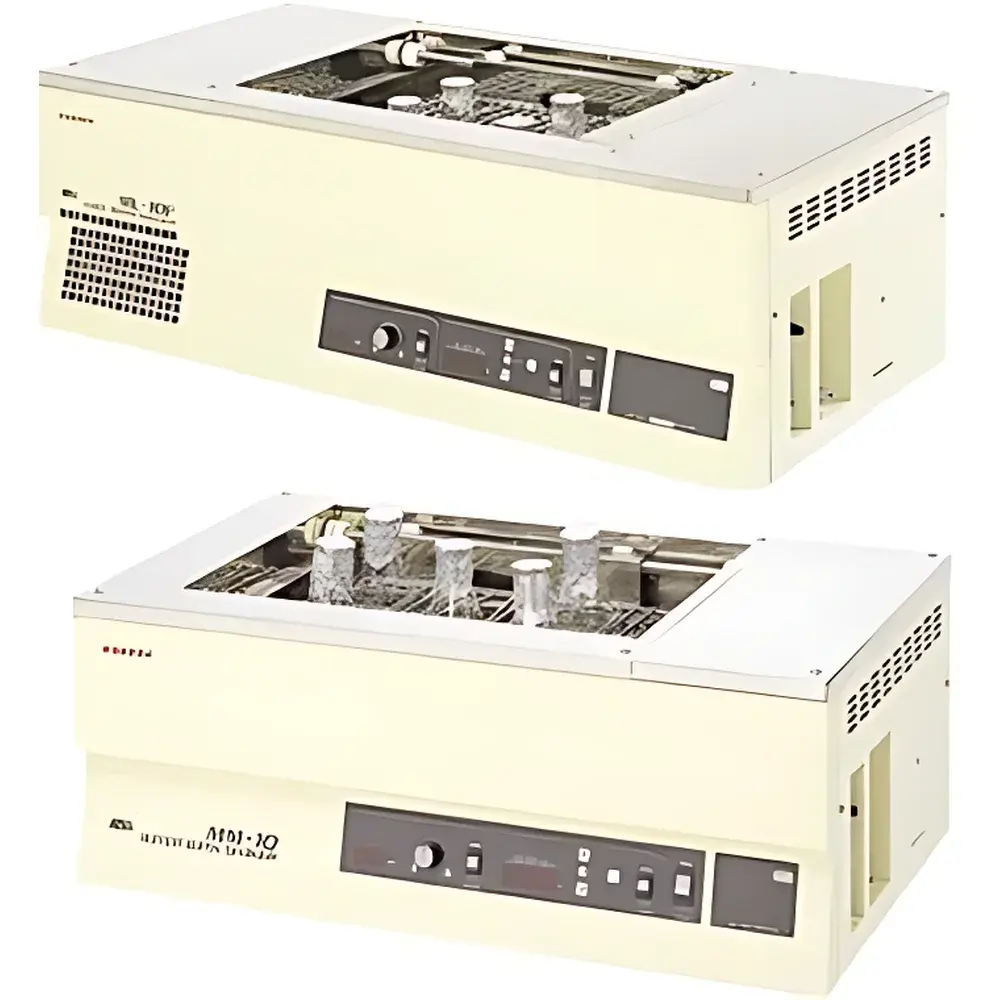
TAITEC MM-10 / ML-10F Precision Orbital Water Bath Incubator Shaker
| Brand | TAITEC |
|---|---|
| Origin | Japan |
| Model | MM-10, ML-10F |
| Temperature Range | Ambient +5°C to 80°C (MM-10), 0°C to 50°C (ML-10F) |
| Temperature Accuracy | ±0.02–0.1°C (MM-10), ±0.05–0.2°C (ML-10F) |
| Oscillation Mode | Reciprocating |
| Adjustable Amplitude | 10–40 mm (stepless) |
| Speed Range | 20–160 rpm |
| Platform Dimensions | 400 × 300 mm (MM-10), 530 × 365 mm (ML-10F) |
| Water Bath Capacity | ~25 L (60% fill, MM-10), ~35 L (80% fill, ML-10F) |
| Heating Power | 1.3 kW (MM-10), 800 W (ML-10F) |
| Cooling System | Integrated refrigeration unit (125 W, ML-10F only) |
| Safety Features | Dual-loop thermal cutoff, dry-run protection, overtemperature sample safeguard, sensor fault self-diagnosis, ΔT display, remote temperature setting |
| Compliance | Designed for GLP-compliant microbiological and mutagenicity assay workflows including OECD 471 and ISO 10993-3 |
Overview
The TAITEC MM-10 and ML-10F are high-precision, microprocessor-controlled orbital water bath incubator shakers engineered for reproducible cultivation of microbial cultures under tightly regulated thermal and mechanical conditions. Unlike conventional air-jacketed incubators or benchtop platform shakers, these instruments integrate a fully submerged, thermostatically stabilized water bath with programmable reciprocating motion—enabling uniform heat transfer, minimized thermal gradients (<0.1°C spatial deviation), and consistent shear stress across suspension volumes. The ML-10F variant incorporates an integrated refrigeration system, extending operational capability down to 0°C for cold-adapted strain propagation, cryopreservation pre-incubation, and low-temperature Ames test protocols. Both models comply with the thermal stability and mechanical reproducibility requirements outlined in OECD Test Guideline 471 (Bacterial Reverse Mutation Assay) and ISO 10993-3 (Biological evaluation of medical devices — Part 3: Tests for genotoxicity, carcinogenicity and reproductive toxicity), making them suitable for regulatory-grade mutagenicity screening in pharmaceutical and toxicology laboratories.
Key Features
- Stepless amplitude adjustment (10–40 mm) and digitally controlled speed range (20–160 rpm) allow empirical optimization of oxygen transfer efficiency and cell suspension homogeneity for diverse microbial systems—from Escherichia coli DH5α to Saccharomyces cerevisiae BY4741.
- Modular accessory architecture supports method-specific configurations: optional arc reciprocating adapter for L-tube formats and water-sealed gas exchange hood for anaerobic/microaerophilic culture conditions.
- Spring-grid oscillating platform is tool-free detachable, facilitating rapid cleaning and validation between batches—critical for labs operating under cGMP Annex 1 or ISO/IEC 17025 quality management systems.
- ML-10F integrates a sealed refrigeration circuit (125 W compressor) with PID-controlled cooling, enabling stable sub-ambient operation without external chillers or ice baths—reducing condensation risk and improving long-term temperature drift performance (<±0.05°C over 24 h at 4°C).
- Dual-sensor thermal monitoring with real-time ΔT display and automatic fault diagnosis ensures traceable thermal integrity; all setpoints and deviations are logged internally with timestamping for audit readiness.
Sample Compatibility & Compliance
The shaker accommodates standard microbiological vessels via universal spring-clamp mounting: up to 204 × φ16 mm test tubes (vertical), 24 × 50 mL Erlenmeyer flasks, 12 × 200–250 mL flasks, 9 × 300 mL, 6 × 500 mL or 2 × 2 L flasks per cycle. Vessel loading patterns are validated per ASTM D7212–19 (Standard Practice for Determining Mutagenic Activity Using the Salmonella Typhimurium/Mammalian Microsomal Assay), ensuring adequate headspace-to-volume ratios and consistent agitation-induced aeration. All wetted components—including bath chamber, platform frame, and drain assembly—are constructed from electropolished SUS316 stainless steel and corrosion-resistant PTFE-coated fasteners, meeting USP extractables profile requirements for Class VI plastic contact surfaces. Device firmware supports configurable alarm thresholds aligned with FDA 21 CFR Part 11 data integrity expectations when paired with optional RS-485 or Ethernet-enabled data loggers.
Software & Data Management
While the base unit operates via intuitive membrane keypad interface with LED status indicators, optional PC connectivity modules (TAITEC PU-6 Program Unit) enable full protocol automation—including multi-step temperature ramping, synchronized oscillation parameter sequencing, and timed start/stop triggers essential for standardized Ames assay execution. Logged data (temperature, rpm, amplitude, duration) are exportable as CSV or XML files with embedded digital signatures for ALCOA+ compliance. Audit trail functionality records user ID, timestamp, parameter changes, and error events—retained for ≥36 months on internal flash memory. Remote setpoint adjustment via analog 0–10 V input allows integration into centralized lab environmental control networks compliant with ISO 14644-1 cleanroom monitoring frameworks.
Applications
- Regulatory mutagenicity testing per OECD 471 using S. typhimurium TA98, TA100, TA1535, and TA1537 strains with S9 metabolic activation.
- High-yield recombinant protein expression in E. coli BL21(DE3) under controlled dissolved oxygen regimes enabled by amplitude-speed coupling.
- Cryotolerance assays in S. cerevisiae involving sequential cold shock (4°C) and recovery-phase shaking at 30°C.
- Pre-analytical sample conditioning for MALDI-TOF MS microbial identification workflows requiring standardized biomass harvesting.
- Stability studies of thermolabile biologics (e.g., mRNA-LNPs) under accelerated degradation conditions (40°C/75% RH simulated via bath immersion).
FAQ
What distinguishes the ML-10F from the MM-10 in terms of thermal control?
The ML-10F features an integrated refrigeration module enabling operation from 0°C to 50°C with ±0.05–0.2°C accuracy, while the MM-10 is heating-only (ambient +5°C to 80°C) with ±0.02–0.1°C stability.
Can the shaker be validated for IQ/OQ/PQ according to GAMP 5 guidelines?
Yes—the instrument includes factory-calibrated NIST-traceable PT100 sensors, documented uncertainty budgets, and a comprehensive validation support package (URS template, FAT/SAT checklists, calibration certificates) available upon request.
Is the water bath compatible with sterilization cycles using hydrogen peroxide vapor (HPV)?
The stainless-steel chamber and removable platform are HPV-compatible; however, electronic control panels must be isolated during decontamination per IEC 61000-4-2 ESD immunity specifications.
Does the system meet electromagnetic compatibility (EMC) requirements for laboratory environments?
Yes—certified to IEC 61326-1:2020 (Class B emission limits) and IEC 61000-6-3:2019, ensuring interference-free operation alongside HPLC, GC-MS, and microplate readers.
How is temperature uniformity verified across the bath volume?
TAITEC provides a 9-point thermal mapping report (per ASTM E2251-17) with positional deviation ≤±0.15°C at steady state, measured using calibrated thermistors traceable to NIST SRM 1968.




