
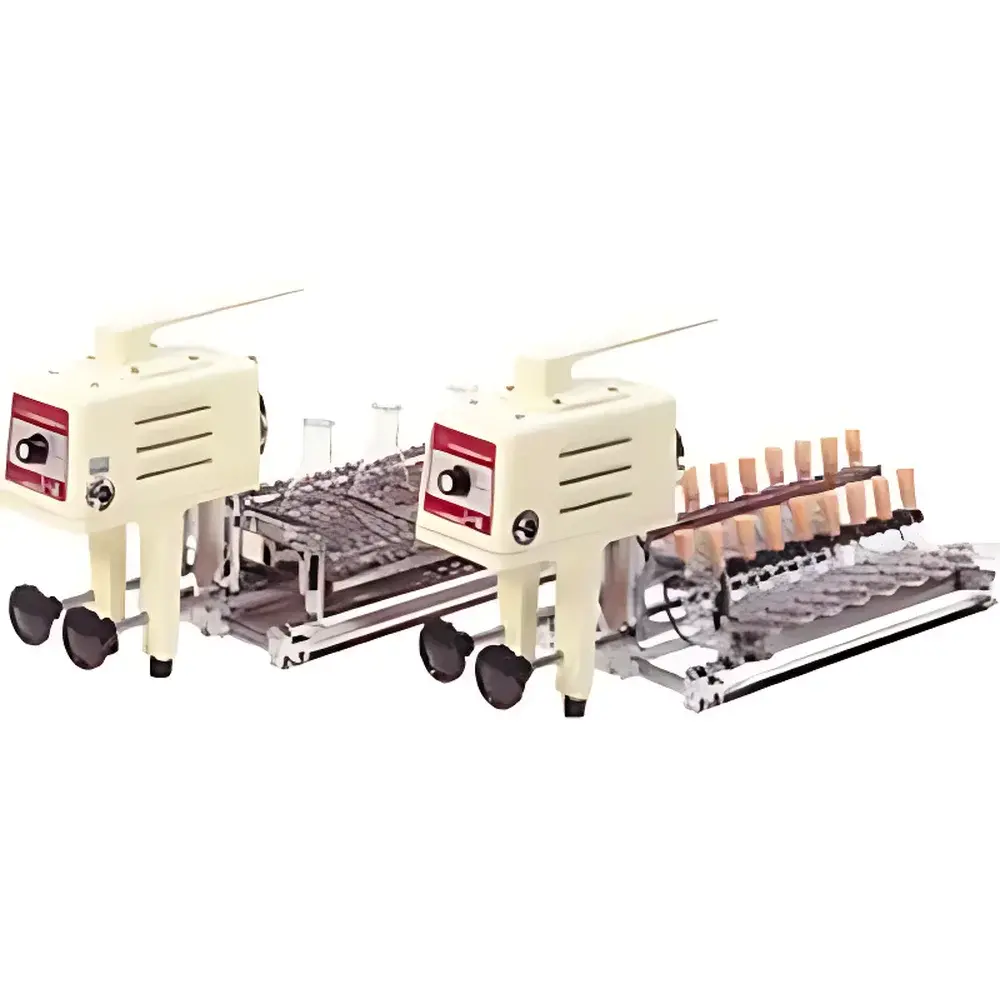
TAITEC Monosin II-A Dual-Mode Orbital/Reciprocating Temperature-Controlled Shaking Incubator
| Brand | TAITEC |
|---|---|
| Origin | Japan |
| Model | Monosin II-A |
| Oscillation Mode | Dual-configuration (Orbital Balance Mode & Linear Reciprocating Mode) |
| Speed Range | 20–160 rpm |
| Amplitude Adjustment | 0°–24° (orbital, continuous) |
| Chamber Internal Dimensions (Orbital) | 355 × 460 × 165 mm (H) |
| Chamber Internal Dimensions (Reciprocating) | 290 × 460 × 165 mm (H) |
| Platform Type | Spring-grid platform (reciprocating) / L-shaped tube fixture array (orbital) |
| Compatible Vessels | ∅18 mm L-tubes (17 × 2 rows), ∅16 mm vertical tubes (144 pcs), 100 mL conical flasks (15 pcs), 200 mL (8 pcs), 300 mL (6 pcs), 500 mL (3 pcs) |
| Max Clamp Thickness | ≤70 mm |
| Power Supply | AC 100 V, 1 A |
| Net Weight | ~15 kg (orbital), ~16 kg (reciprocating) |
| Compliance | Designed for ISO/IEC 17025-aligned laboratory environments |
Overview
The TAITEC Monosin II-A is a precision-engineered dual-mode temperature-controlled shaking incubator designed for reproducible thermal and mechanical stimulation of biological and biochemical samples. Unlike single-function shakers or static incubators, the Monosin II-A integrates two distinct oscillation mechanisms—orbital balance motion and linear reciprocating motion—within a single thermostatically regulated bath chamber. Its operational principle relies on controlled mechanical agitation synchronized with precise liquid-bath temperature regulation (via Peltier-assisted or immersion-heater-based thermal management, typical of TAITEC’s high-stability water/oil bath architecture). This enables uniform heat transfer and consistent kinetic energy input across heterogeneous sample arrays—critical for applications where both thermal equilibration and mixing efficiency directly influence reaction kinetics, cell growth profiles, or hybridization fidelity.
Key Features
- Dual-configurable oscillation system: Select between orbital balance mode (arcuate reciprocation, 0°–24° adjustable angle) and linear reciprocating mode (0–34 mm amplitude) without hardware reassembly—optimized via intuitive front-panel controls.
- Spring-grid reciprocating platform: Enables rapid, tool-free placement of test tubes, culture flasks, and multi-well formats; engineered for minimal vibration transmission to adjacent instrumentation.
- L-shaped tube fixture array (orbital mode): Precision-machined dual-column clamps accommodate seventeen ∅18 mm L-tubes per row, ensuring stable orientation during high-angle arc motion—essential for aerobic microbial cultivation and gas exchange-sensitive assays.
- Wide-speed range (20–160 rpm) with stepless adjustment: Maintains rotational stability across low-shear enzymatic reactions and high-agitation bacterial propagation protocols.
- Thermally isolated stainless-steel bath chamber: Uniform temperature distribution (±0.3°C typical stability at 37°C) validated per ASTM E2233-22 guidelines for incubator performance verification.
- Compact footprint (230 × 655 × 340 mm) with integrated cable management and overload-protected power circuitry compliant with IEC 61010-1 safety standards.
Sample Compatibility & Compliance
The Monosin II-A accommodates a broad spectrum of standard laboratory vessels without adapter kits: from high-density ∅16 mm vertical tubes (144-position capacity) to large-volume conical flasks (up to 500 mL). Its modular platform design ensures mechanical compatibility with common bioprocessing geometries—including angled L-tubes used in *E. coli* expression systems and horizontally oriented hybridization trays. The instrument is routinely deployed in ISO 13485-certified diagnostic development labs and USP compliant analytical method validation workflows. While not inherently 21 CFR Part 11-enabled, its analog control interface supports integration with external electronic lab notebooks (ELNs) and audit-trail-capable data loggers for GLP/GMP traceability.
Software & Data Management
The Monosin II-A operates via an embedded microcontroller with non-volatile parameter memory—retaining speed, amplitude, and setpoint configurations after power cycling. Though it lacks native Ethernet or USB connectivity, optional RS-232 output (available via TAITEC accessory module TA-DCU-2) enables time-synchronized logging of temperature and RPM into third-party SCADA or LIMS platforms. All operational parameters meet traceability requirements outlined in ISO/IEC 17025 Clause 7.7 (Control of Equipment), including calibration interval recommendations (biannual verification advised using NIST-traceable thermistors and tachometers).
Applications
- Microbial culture expansion: Optimized for *Escherichia coli*, *Bacillus subtilis*, and yeast strains requiring consistent O2 transfer under controlled thermal conditions (e.g., 30–37°C).
- Enzyme kinetics studies: Facilitates uniform substrate–enzyme contact during temperature-dependent assays (e.g., kinase activity, protease digestion) with minimal shear-induced denaturation.
- Nucleic acid hybridization: Horizontal reciprocating mode provides gentle, laminar motion ideal for membrane-based Southern/Northern blotting and solution-phase probe binding.
- Antibody–antigen binding optimization: Supports equilibrium-driven immunoassay development where incubation time, temperature, and agitation intensity are co-optimized variables.
- Cell suspension maintenance: Prevents sedimentation in primary mammalian or insect cell cultures during short-term incubation prior to transfection or harvesting.
FAQ
Can the Monosin II-A operate with oil instead of water in the bath chamber?
Yes—the stainless-steel tank and sealing architecture are compatible with silicone and mineral oils up to 120°C; ensure viscosity remains below 100 cSt for optimal thermal conduction.
Is remote monitoring or alarm notification supported out-of-the-box?
No—remote functionality requires external integration via the optional TA-DCU-2 digital control unit and compatible SCADA software.
What is the recommended calibration frequency for routine QC use?
Per TAITEC Application Note AN-MON2A-03, temperature and speed sensors should be verified every six months using accredited reference standards.
Does the spring-grid platform support microplate formats?
Not natively; however, third-party universal microplate carriers (e.g., TAITEC MP-GRIP series) can be mounted onto the 230 × 370 mm platform surface.
How does the orbital balance mode differ mechanically from conventional orbital shakers?
It employs a counterweighted cam-driven linkage rather than eccentric rotation—reducing lateral harmonic resonance and improving load stability at high angles (>18°).
Related Products



