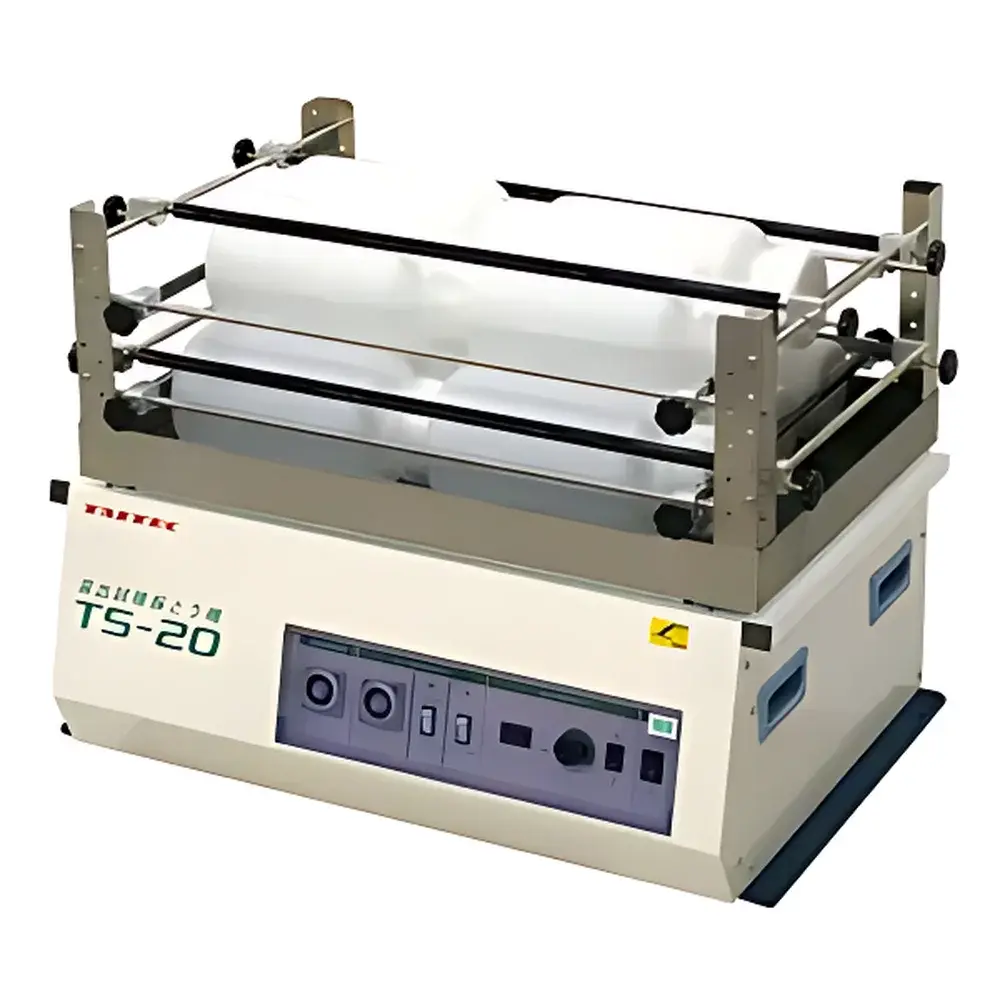
TAITEC TS-20 Dissolution Shaker
| Brand | TAITEC |
|---|---|
| Origin | Japan |
| Model | TS-20 |
| Oscillation Mode | Reciprocating |
| Speed Range | 25–200 rpm |
| Amplitude | 10–50 mm (continuously adjustable) |
| Max Load Capacity | ~20 kg (excluding platform and clamping rods) |
| Timer Function | Dual independent timers (start time + runtime), up to 300 h total |
| Platform Configuration | Multi-plate compatible |
| Power Supply | AC 100 V, 1 A |
| Power Consumption | 70 W/h |
| Dimensions | 820 × 601 × 591 mm (H) |
| Weight | ~100 kg |
| Standard Accessories | Long clamping rods (×4), short clamping rods (×4), timer adjustment wrench |
Overview
The TAITEC TS-20 Dissolution Shaker is a precision-engineered reciprocating shaker designed specifically for standardized leaching and extraction protocols in environmental and regulatory testing laboratories. It operates on the principle of controlled linear oscillation—generating consistent shear and mixing forces across large-volume polyethylene containers—to ensure reproducible mass transfer between solid-phase soil matrices and aqueous extraction media. Its mechanical architecture complies with JIS K 0102 (Japanese Industrial Standard for Testing Methods for Industrial Wastewater), making it a primary instrument for pre-analytical sample preparation in soil leaching tests mandated under Japan’s Soil Contamination Countermeasures Act. Unlike orbital or rotary shakers, the TS-20’s reciprocating motion minimizes vortex formation while maximizing contact efficiency in low-surface-tension, high-viscosity suspensions—critical for accurate quantification of extractable heavy metals (e.g., Cd, Pb, As, Cr) and other priority pollutants.
Key Features
- Reciprocating oscillation mechanism engineered for uniform energy distribution across heterogeneous slurry samples
- Continuously adjustable amplitude (10–50 mm) to optimize mixing intensity for varying container sizes and matrix densities
- Dual digital timer system: independent scheduling of start time and runtime, supporting unattended operation for up to 300 hours
- High-load capacity platform (up to 20 kg net load) constructed from reinforced steel with corrosion-resistant surface treatment
- Modular clamping system: includes eight standard rods (four long, four short) with tool-free rotational locking—enabling rapid reconfiguration for diverse PE bottle geometries
- Energy-efficient DC motor delivering stable speed control (25–200 rpm) at only 70 W/h power draw
- Acoustic and visual alerts (buzzer + LED indicator) for timer initiation and termination events
Sample Compatibility & Compliance
The TS-20 accommodates standardized polyethylene containers used in Japanese regulatory leaching procedures—including wide-mouth 5 L, 3 L, 2 L, 1 L, and 500 mL bottles—as well as 1 L culture flasks (up to 15 per run). Its mechanical design conforms to JIS K 0102 Section 6.1 (Leaching Test Method for Soil) and supports GLP-aligned workflows through traceable operational parameters (speed, amplitude, duration). While the unit itself is not temperature-controlled, its vibration profile remains thermally stable under continuous operation—ensuring no unintended thermal degradation of analytes during extended extractions. The absence of internal heating elements eliminates risk of volatile organic compound (VOC) loss or polymer leaching from container walls—a key requirement for EPA Method 1311 and ISO 17512-1 compatibility when adapted via validated SOPs.
Software & Data Management
The TS-20 operates as a stand-alone hardware platform with embedded microcontroller-based timing logic; no proprietary software or PC interface is required. All operational parameters are set manually via front-panel controls with LED digit display. For audit readiness in regulated environments (e.g., certified environmental testing labs), users may integrate the device into broader laboratory information management systems (LIMS) via external logging—recording start/stop timestamps, operator ID, and batch identifiers in accordance with ISO/IEC 17025 documentation requirements. The dual-timer architecture inherently supports 21 CFR Part 11–compliant electronic recordkeeping when paired with timestamped lab notebooks or validated electronic logbooks.
Applications
- Soil leaching assays for regulatory compliance with Japan’s Soil Contamination Countermeasures Act (Act No. 106 of 2002)
- Extraction of target analytes (heavy metals, fluorides, cyanides) from solid waste matrices per JIS K 0102 and ASTM D3987
- Preparation of representative aqueous extracts for subsequent ICP-MS, AAS, or IC analysis
- Batch-wise homogenization of sediment slurries prior to centrifugation or filtration
- Controlled agitation of low-viscosity biological suspensions where orbital motion induces undesirable foaming or cell shearing
- Method development studies requiring precise amplitude/speed correlation with extraction yield
FAQ
Is the TS-20 suitable for use with non-polyethylene containers such as glass or stainless-steel vessels?
Yes—provided the vessel geometry allows secure clamping with the adjustable rod system and total mass remains within the 20 kg load limit. However, JIS K 0102 explicitly specifies polyethylene for leaching tests to prevent metal adsorption; deviation requires method validation.
Can amplitude be adjusted during operation?
No—amplitude must be set prior to initiating oscillation. Adjustment requires manual loosening of rod-mounting nuts; real-time modulation is not supported.
Does the TS-20 meet ISO 17025 calibration requirements?
The unit does not include built-in calibration certificates, but speed and timer accuracy can be verified using NIST-traceable tachometers and stopwatches. Annual verification against manufacturer specifications is recommended for accredited labs.
What maintenance is required for long-term reliability?
Biannual inspection of motor brushes, lubrication of oscillation linkage points, and verification of rod-thread integrity are advised. No scheduled replacement parts are required within the first 10,000 operating hours under normal load conditions.