
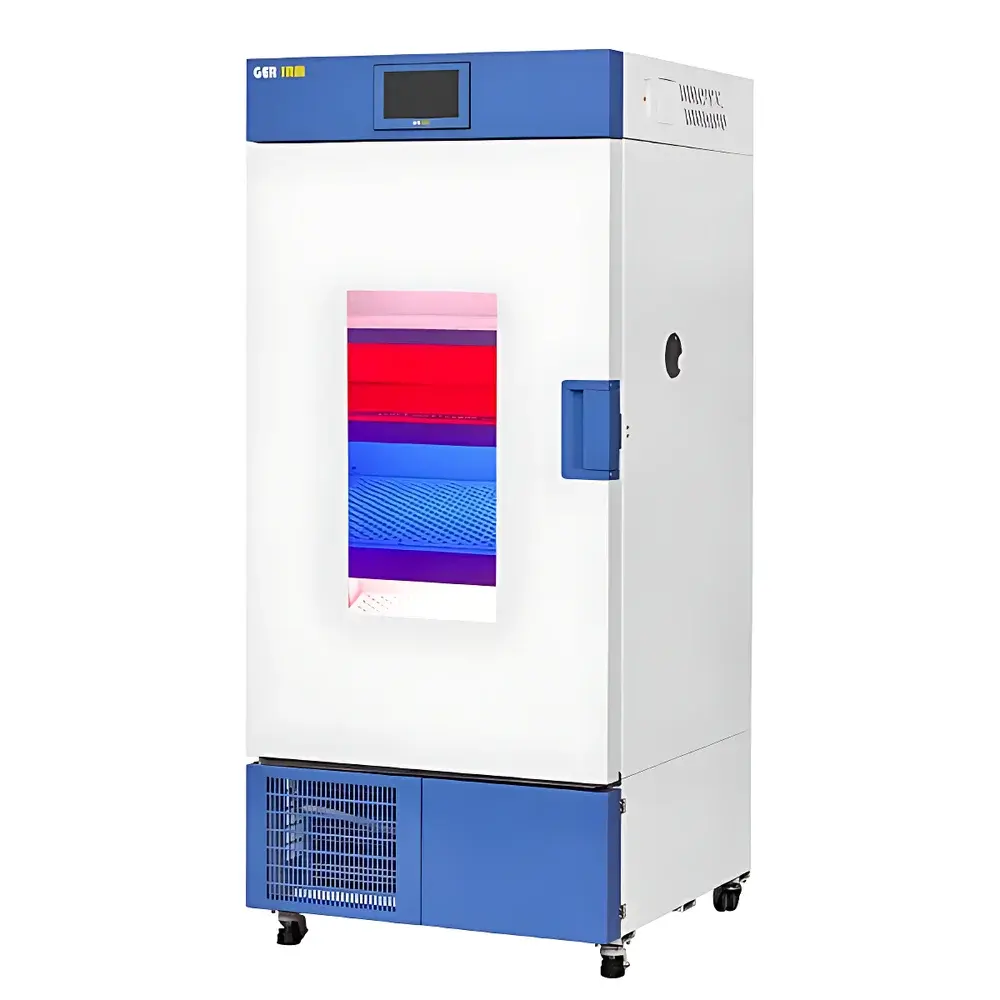
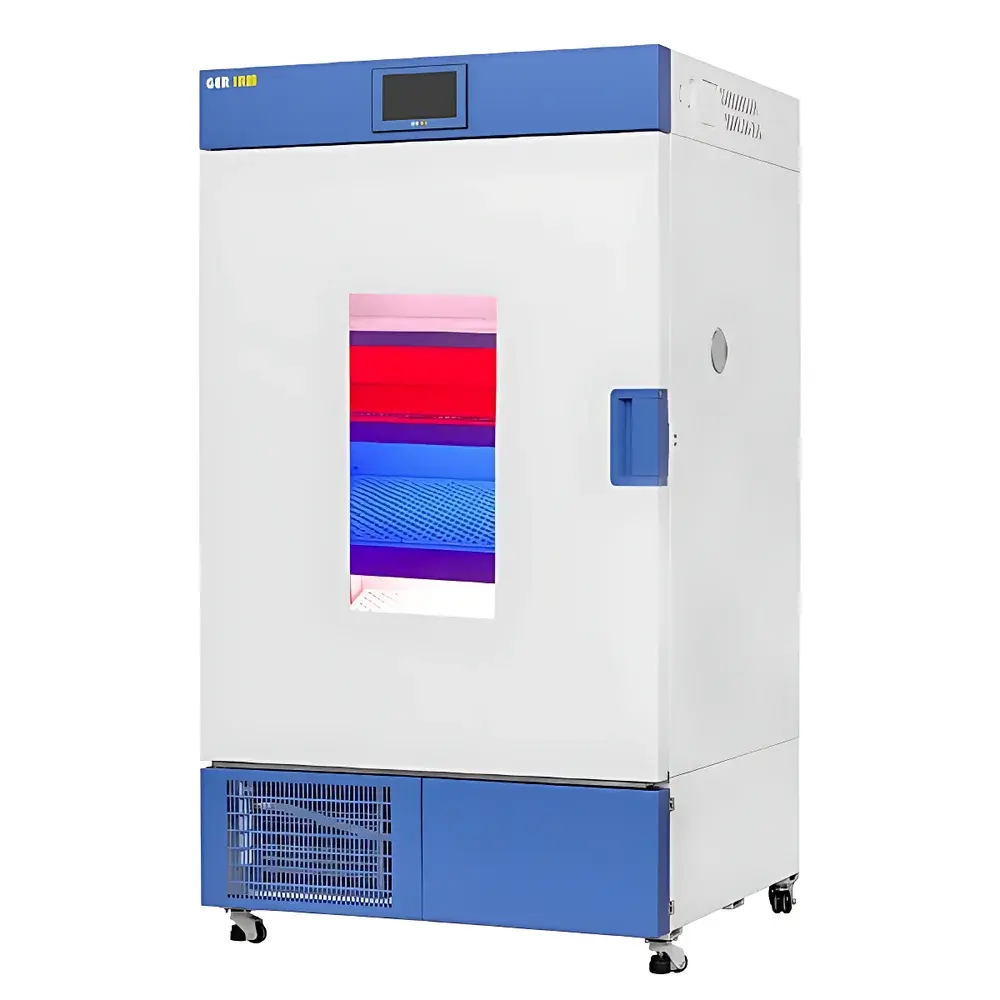
IRM IPA260 Advanced Plant Growth Chamber for Abiotic Stress Research
| Brand | IRM |
|---|---|
| Origin | Beijing, China |
| Manufacturer Type | Direct Manufacturer |
| Model | IPA260 |
| Illumination Method | Shelf-integrated LED lighting |
| Light Source | High-efficiency white LED array |
| Spectral Range | Visible spectrum (400–700 nm) |
| Temperature Range | 10–65°C (with illumination), 0–65°C (dark) |
| Temperature Fluctuation | ±0.3°C |
| Temperature Uniformity | ±1.0°C (within single shelf at 20°C) |
| Humidity Range | 30–95% RH |
| Photosynthetic Photon Flux Density (PPFD) | 0–500 µmol/m²/s |
| Chamber Capacity | 305 L |
| External Dimensions (W×D×H) | 780 × 790 × 1600 mm |
| Control System | 7-inch capacitive touchscreen with iHACC™ high-precision thermo-hygrometric control algorithm |
| Data Logging & Security | Audit-trail-enabled event logging, three-tier user permission management (Admin/Operator/Viewer), USB data export, power-failure auto-recovery |
| Optional Modules | CO₂ control (0–5000 ppm), 4G IoT remote monitoring & control (Android/Web), adjustable-speed centrifugal circulation fans, dual 50 mm access ports, integrated water reservoir with auto-refill and wastewater recirculation |
Overview
The IRM IPA260 Advanced Plant Growth Chamber is a purpose-engineered environmental simulation platform designed specifically for controlled abiotic stress studies in crop physiology, phenotyping, and functional genomics. It operates on a robust forced-air convection architecture with intelligent PID-based regulation of temperature, light intensity, and—when equipped—relative humidity and CO₂ concentration. The chamber implements IRM’s proprietary iHACC™ (intelligent Hybrid Adaptive Climate Control) algorithm, which dynamically coordinates refrigeration, heating, humidification, and ventilation subsystems to maintain high reproducibility under variable photoperiodic and thermal load conditions. Unlike generic incubators, the IPA260 is calibrated and validated for long-term stability at elevated temperatures (up to 65°C) and low-temperature operation (down to 0°C in dark mode), with frost-free performance verified at ≥20°C ambient across continuous 30-day runs. Its modular design supports ISO/IEC 17025-aligned validation protocols and complies with core requirements of GLP (Good Laboratory Practice) Annexes for environmental test equipment traceability.
Key Features
- High-precision climate control: ±0.3°C temperature fluctuation and ±1.0°C uniformity (at 20°C, single shelf), validated per ASTM E145-22 Annex A3 for environmental chambers
- Photosynthetically optimized LED lighting: Full-spectrum white LEDs delivering 0–500 µmol/m²/s PPFD (photosynthetic photon flux density) with spectral stability <±2% over 10,000 hours; optional monochromatic or multi-channel spectral tuning available
- Integrated hygrothermal management: Humidity range 30–95% RH with ±2% RH fluctuation (IPAH/IPAHC variants); built-in water reservoir with auto-refill, wastewater recirculation, and anti-overflow safeguards
- Intelligent thermal architecture: Inverter-driven hermetic compressor system minimizing surface temperature rise and eliminating thermal cutouts; optimized heat exchange geometry ensures stable operation during extended high-load cycles
- Secure operational governance: Three-level role-based access control (Administrator/Operator/Viewer), tamper-evident electronic logbook with timestamped events (including door openings, parameter changes, alarms), and full audit trail compliant with FDA 21 CFR Part 11 requirements for electronic records
- Resilient hardware interface: 7-inch industrial-grade capacitive touchscreen with glove-compatible responsiveness; support for scheduled programs (1–30 segments), timed start/stop, and blackout recovery with parameter retention
Sample Compatibility & Compliance
The IPA260 accommodates standard plant growth vessels—including Petri dishes, Magenta boxes, hydroponic trays, and potting systems—within its 305 L internal volume and 200–1000 mm adjustable vertical growth zone. Dual 50 mm diameter pass-through ports (left/right) enable non-invasive sensor cabling, gas sampling, or real-time physiological monitoring without compromising chamber integrity. All materials in contact with the growth environment meet USP Class VI biocompatibility standards and are free of volatile organic compounds (VOCs) that could interfere with phytohormone assays or transcriptomic profiling. The system satisfies essential clauses of ISO 17025:2017 (Section 6.4.3 on environmental condition monitoring), EN 61000-6-3 (EMC emissions), and IEC 61010-1 (safety for laboratory equipment). Optional CO₂ control module enables compliance with ASTM D5116-21 for carbon assimilation rate studies under defined atmospheric composition.
Software & Data Management
The embedded control firmware provides native support for CSV export via USB flash drive, including time-stamped temperature, humidity, light intensity, and alarm history. Event logs retain metadata such as operator ID, parameter setpoints, deviation thresholds, and system status flags—enabling full forensic reconstruction of experimental conditions. When configured with the optional 4G IoT module, the chamber connects securely to cloud-hosted dashboards compatible with Android mobile devices and desktop browsers, supporting TLS 1.2 encrypted remote viewing, parameter adjustment, and push notifications for critical alerts (e.g., door ajar, sensor failure, humidity deviation >±3% RH). All data transmissions adhere to GDPR-compliant anonymization protocols, and local storage retains ≥30 days of high-resolution (1-minute interval) environmental telemetry without external dependency.
Applications
- Drought, heat, cold, and salinity stress phenotyping across cereal, legume, and horticultural species
- Photomorphogenic response analysis under dynamic light spectra and diurnal cycles
- Pre-breeding evaluation of quantitative trait loci (QTL) associated with abiotic tolerance
- Controlled-environment calibration of hyperspectral imaging and chlorophyll fluorescence instrumentation
- Standardized seed germination testing per ISTA Rules (International Seed Testing Association)
- Long-term acclimation studies supporting IPCC AR6 vegetation modeling inputs
FAQ
What is the minimum operating temperature in dark mode?
The IPA260 achieves 0°C in dark mode (no illumination active), verified under ISO 17025-accredited calibration conditions.
Can the chamber maintain humidity stability during rapid temperature ramping?
Yes—the iHACC™ algorithm synchronizes humidifier output, condensate drainage, and fan speed modulation to limit RH deviation to ≤±2.5% during 5°C/h ramps between 20°C and 40°C.
Is CO₂ control available as a field-upgradeable option?
CO₂ sensing and dosing hardware must be factory-installed due to integration with the chamber’s sealed gas loop and pressure-compensated mass flow controller; retrofitting is not supported.
How is data integrity ensured during unexpected power loss?
Non-volatile memory preserves all active programs, setpoints, and logged events; upon restoration, the system resumes operation using the last valid configuration and timestamps all recovery actions.
Does the unit comply with electrical safety standards for academic laboratories?
Yes—it carries CE marking per EN 61010-1:2019 and includes redundant safety layers: independent overtemperature cutoff, ground-fault circuit interruption (GFCI), high-pressure refrigerant shutdown, and door-open interlock with audible/visual alert.
Related Products





