
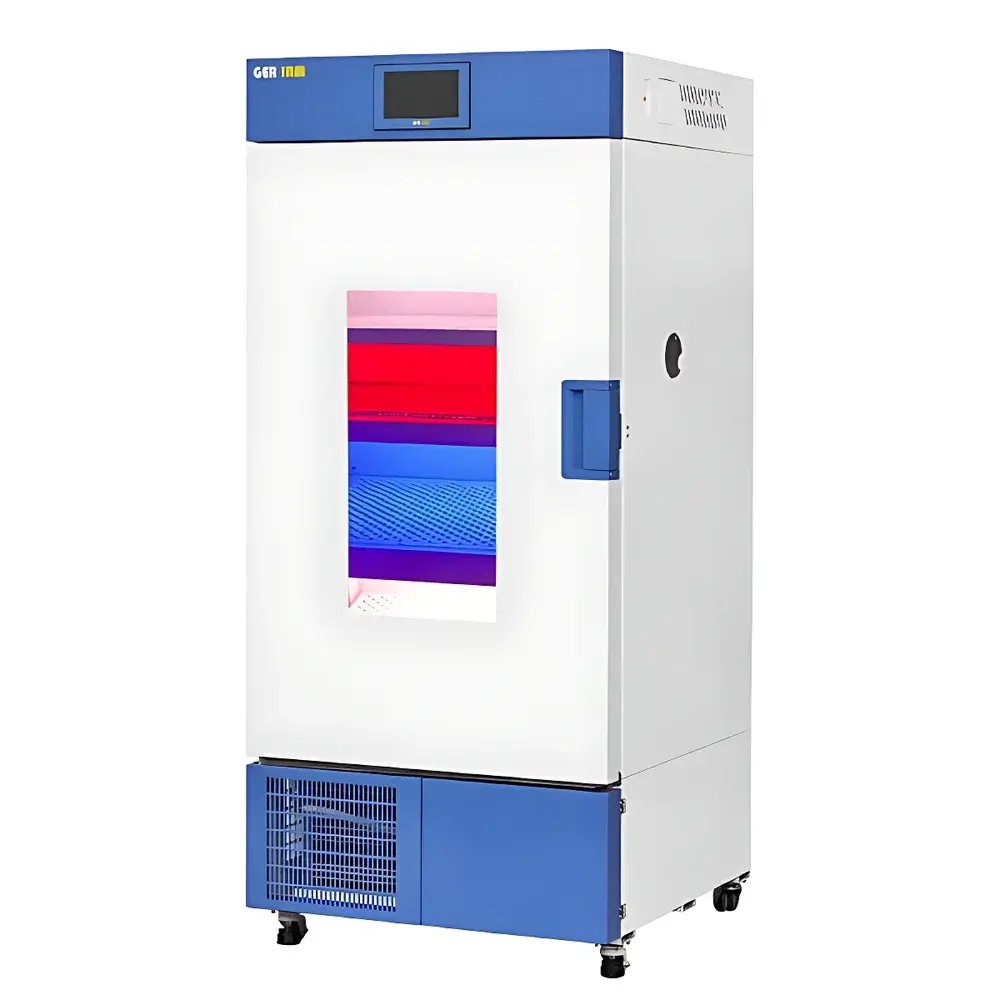
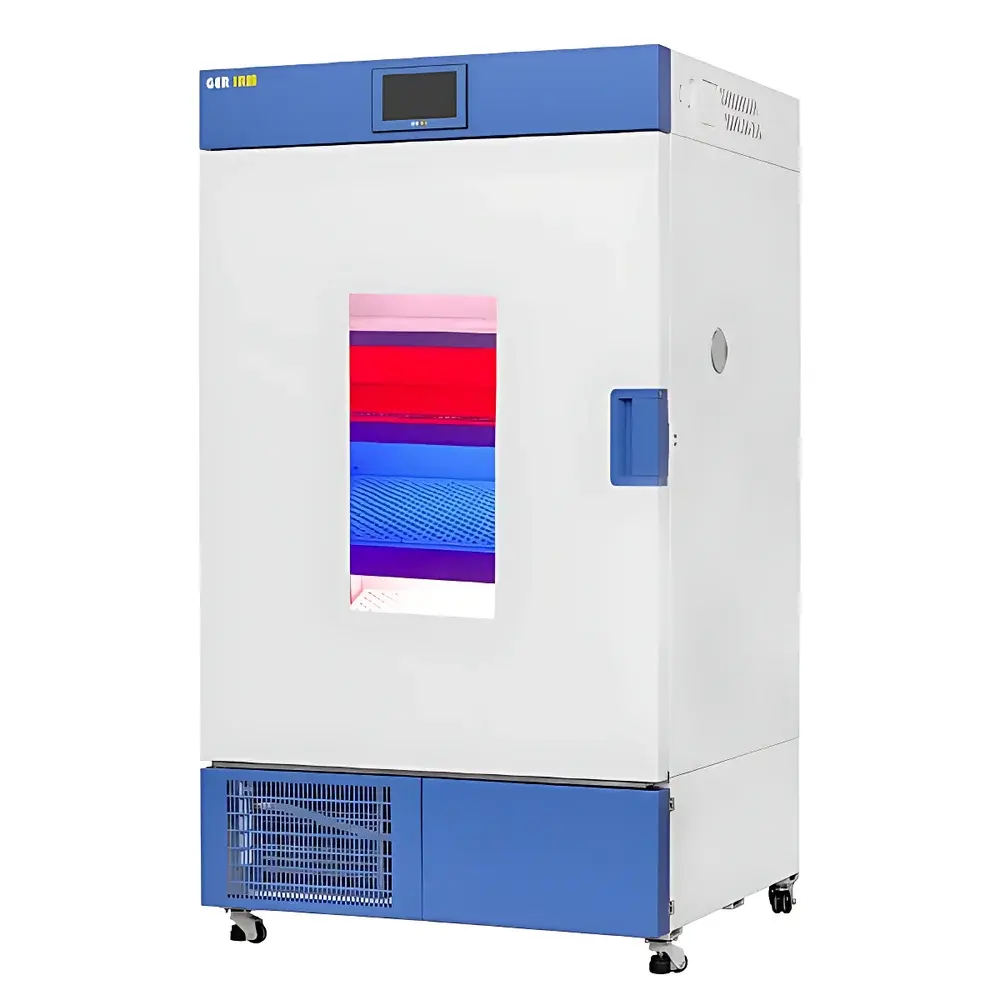
IRM IPF260 Quad-Color LED Plant Growth Chamber
| Brand | IRM |
|---|---|
| Origin | Beijing, China |
| Manufacturer Type | Direct Manufacturer |
| Model | IPF260 |
| Illumination Method | Shelf-Integrated LED Arrays |
| Light Source | High-Efficiency RGBW LEDs |
| Spectral Range | 400–700 nm (PAR) |
| Temperature Range | 10–65°C (with illumination), 0–65°C (dark) |
| Temperature Fluctuation | ±0.3°C |
| Temperature Uniformity | ±1.0°C (at 20°C, within single shelf) |
| Photosynthetic Photon Flux Density (PPFD) | 0–500 µmol/m²/s |
| Net Volume | 305 L |
| External Dimensions (W×D×H) | 780 × 790 × 1600 mm |
| Control System | 7-inch capacitive touchscreen with iHACC™ precision climate algorithm |
| Optional Modules | Humidity control (30–95% RH), CO₂ regulation (0–5000 ppm), 4G IoT connectivity, programmable multi-segment cycles (1–30 steps), event-logged audit trail, USB data export, and optional thermal printer |
Overview
The IRM IPF260 Quad-Color LED Plant Growth Chamber is an engineered environmental simulation platform designed for controlled-environment plant physiology research, seed germination studies, photobiology experiments, and pre-commercial crop phenotyping. It employs a balanced forced-air convection system coupled with intelligent PID-based temperature regulation and independently tunable spectral illumination—enabling precise replication of diurnal light–temperature regimes under laboratory conditions. Unlike conventional incubators, the IPF260 integrates four discrete LED channels (red, blue, green, white) within each shelf-mounted lighting module, allowing real-time spectral composition adjustment across the photosynthetically active radiation (PAR) band (400–700 nm). This architecture supports wavelength-specific investigations—including phytochrome and cryptochrome signaling, shade avoidance responses, and photomorphogenic development—without requiring external optical filters or lamp swaps. The chamber’s iHACC™ (intelligent Hybrid Air Conditioning & Climate Control) technology ensures stable thermal performance even during extended high-illumination protocols, eliminating frost accumulation above 20°C and maintaining ≤±0.3°C temperature fluctuation under steady-state operation.
Key Features
- Quad-channel RGBW LED illumination system with independent intensity control per spectrum, delivering uniform PPFD up to 500 µmol/m²/s across the full shelf surface
- Shelf-integrated lighting design eliminates shadowing and enables modular spectral reconfiguration without hardware modification
- High-efficiency inverter-driven hermetic compressor with low-surface-temperature operation, preventing thermal shutdown during continuous duty cycles
- 7-inch industrial-grade capacitive touchscreen interface supporting three-tier user permission levels (Operator, Supervisor, Administrator) with timestamped action logging compliant with GLP traceability requirements
- Programmable multi-step environmental profiles (1–30 segments) including ramp/soak sequences for temperature, light intensity, and optional humidity or CO₂ setpoints
- Comprehensive safety architecture: dual independent overtemperature cutoffs, leak-proof integrated water reservoir with auto-refill, overflow protection, door-open alarm, power-failure recovery with state retention, and real-time sensor health diagnostics
- Two 50-mm diameter pass-through ports (left/right) for external sensor cabling, gas lines, or pneumatic actuators
- Heavy-duty locking casters (100 kg load capacity per wheel) for stable relocation within shared core facilities
Sample Compatibility & Compliance
The IPF260 accommodates standard growth vessels—including petri dishes, Magenta boxes, hydroponic trays, and 10-cm pots—within its 305 L internal volume and 640 × 450 × 1060 mm usable chamber space. Its ±1.0°C temperature uniformity (measured at 20°C across a single shelf) meets ISO 17025 calibration validation criteria for environmental test chambers. The system supports compliance-ready workflows through built-in electronic audit trails, configurable alarm thresholds, and non-volatile memory retention of operational logs—even during unexpected power loss. Optional humidity (IPFH260 variant) and CO₂ (IPFHC260 variant) modules conform to ASTM E1823-22 guidelines for controlled-atmosphere plant growth equipment. All firmware operations are deterministic and repeatable, enabling alignment with FDA 21 CFR Part 11 requirements when paired with validated electronic signature protocols.
Software & Data Management
The embedded control firmware provides native support for time-series data acquisition at user-defined intervals (1 s to 60 min resolution), with on-device storage of up to 30 days of compressed sensor history. All operational parameters—including temperature setpoint, actual chamber temperature, PPFD readings per channel, fan speed, compressor status, and alarm events—are exportable via USB flash drive in CSV format for downstream statistical analysis in MATLAB, R, or Python. Optional 4G LTE module enables remote monitoring and intervention through a secure web dashboard compatible with Chrome, Edge, and Safari browsers on Windows, macOS, Android, and iOS platforms. Data exports include cryptographic hash signatures to verify integrity, satisfying ISO/IEC 17025 clause 7.7.2 for raw data authenticity. No cloud storage is performed by default; all telemetry remains on-premise unless explicitly enabled by the facility administrator.
Applications
- Photoperiodic response characterization in model species (Arabidopsis thaliana, Oryza sativa) and horticultural crops (tomato, lettuce, strawberry)
- Light quality–mediated secondary metabolite profiling (e.g., anthocyanin, flavonoid, glucosinolate induction)
- Stress physiology studies involving combined abiotic stressors (e.g., high-light + elevated temperature)
- Seed dormancy and germination kinetics under spectrally defined conditions
- Pre-acclimation trials for vertical farming infrastructure validation
- Regulatory-compliant stability testing of botanical extracts under ICH Q1B photostability conditions
- Teaching laboratories requiring reproducible, multi-parameter environmental control with intuitive operator interfaces
FAQ
What spectral combinations can be achieved with the quad-color LED system?
The IPF260 supports fully independent dimming of red (660 nm peak), blue (450 nm), green (525 nm), and warm-white (3000K CCT) channels, enabling custom spectra from monochromatic to broad-band white light—covering common photobiological benchmarks such as Cool White (CWF), Daylight (D65), and USDA-defined “Plant Growth” spectrum.
Is the chamber suitable for long-term unattended operation?
Yes. With its auto-refill water reservoir (for humidified variants), power-failure recovery logic, and redundant thermal protection circuits, the IPF260 is rated for continuous 24/7 operation up to 12 months between preventive maintenance cycles.
Can third-party sensors be integrated via the pass-through ports?
Absolutely. Each 50-mm port accepts standard NPT-threaded feedthroughs for thermocouples, CO₂ analyzers, PAR quantum sensors, or leaf temperature probes—with no internal modifications required.
Does the system support regulatory audit requirements for GxP environments?
When configured with the optional humidity and CO₂ modules and operated under documented SOPs, the IPF260 meets baseline technical prerequisites for GLP and GMP-aligned plant growth studies, including electronic record integrity, access control, and change management via its tiered permission architecture.
What is the maximum plant height accommodated at full illumination?
The vertical clearance between shelves allows for up to 200 mm of unobstructed growth height under full irradiance; total internal height (1060 mm) supports multi-tier cultivation setups with adjustable shelf spacing.





