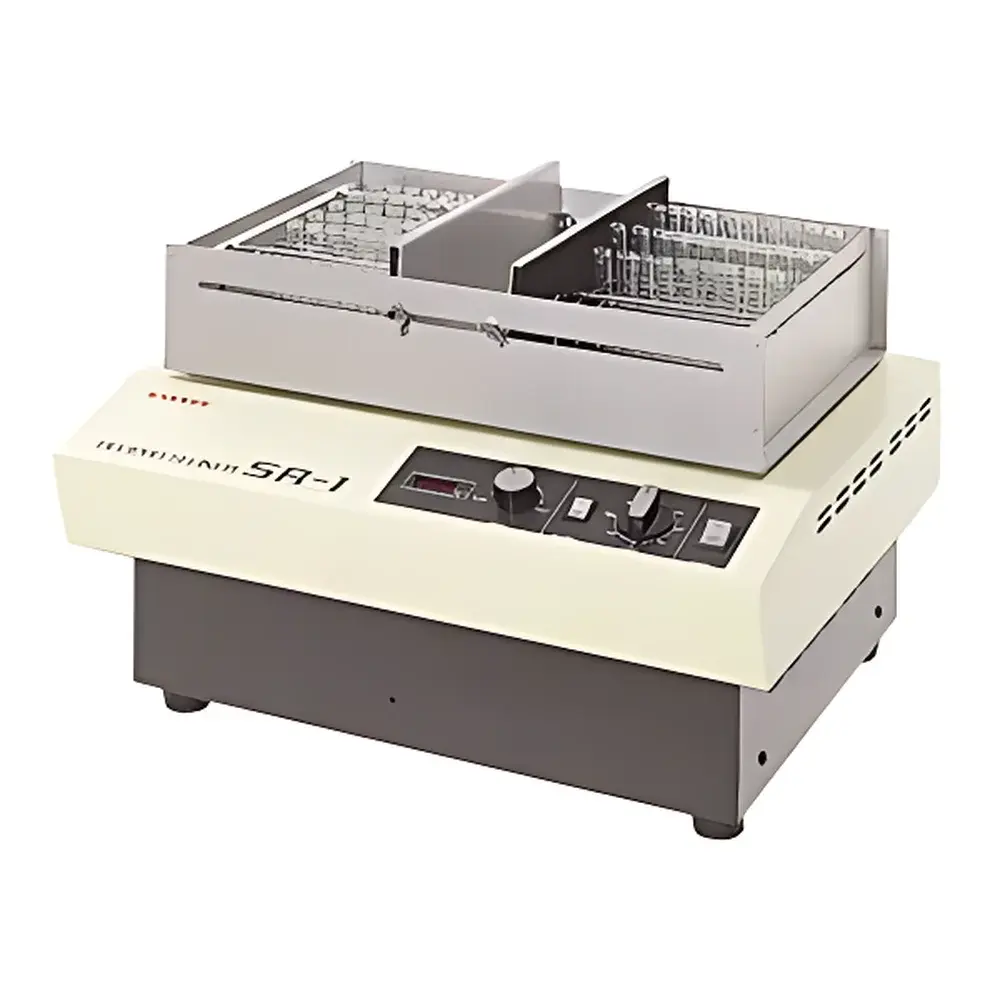
TAITEC SR-1 High-Capacity Reciprocating Shaker
| Brand | TAITEC |
|---|---|
| Origin | Japan |
| Model | SR-1 |
| Oscillation Mode | Reciprocating |
| Speed Range | 50–250 rpm |
| Amplitude | 50 mm (fixed, optional 35 mm) |
| Timer Range | 60 min |
| Platform Options | 4 interchangeable platforms (A, B, C, E) |
| Max Load Capacity | ~7 kg (including platform) |
| Display | Digital speed readout |
| Power Supply | AC 100 V, 1 A |
| Dimensions | 570 × 435 × 247 mm (W × D × H) |
| Weight | ~45 kg |
Overview
The TAITEC SR-1 High-Capacity Reciprocating Shaker is an industrial-grade laboratory shaker engineered for reproducible, high-force horizontal agitation of diverse sample containers—from microcentrifuge tubes to 1 L Erlenmeyer flasks. Unlike orbital or rotary shakers, the SR-1 employs a robust reciprocating (linear back-and-forth) motion mechanism, delivering consistent shear energy across large-volume or high-viscosity samples. Its fixed 50 mm amplitude—among the largest in its class—ensures vigorous mixing even under dense loading conditions, making it particularly suited for solid–liquid extraction, microbial suspension homogenization, and leaching protocols where particle resuspension and mass transfer efficiency are critical. Designed and manufactured in Japan to stringent JIS standards, the SR-1 integrates precision feedback-controlled motor regulation to maintain set speed within ±3 rpm across its full 50–250 rpm operating range, independent of load distribution or ambient temperature fluctuations.
Key Features
- Reciprocating motion with fixed 50 mm amplitude (custom 35 mm option available), optimized for high-energy horizontal agitation of viscous or particulate-laden samples
- Digital speed controller with real-time rpm readout and closed-loop feedback regulation for stable operation under variable load conditions
- 60-minute programmable mechanical timer with audible end-of-cycle alert—no software dependency or battery backup required
- Modular platform architecture supporting four standardized, application-specific accessories: A-platform (test tube rack), B-platform (Erlenmeyer flask holder with configurable support rods), C-platform (high-density centrifuge tube array), and E-platform (universal spring mesh for irregular or mixed-container setups)
- Structural load capacity of up to 7 kg—including platform weight—enabling simultaneous processing of multiple large-format vessels without performance degradation
- Robust cast-aluminum chassis and reinforced drive linkage ensure long-term mechanical stability and minimal vibration transmission to adjacent instrumentation
Sample Compatibility & Compliance
The SR-1 accommodates a broad spectrum of container types and volumes without modification: standard 1.5–50 mL centrifuge tubes, capped test tubes (φ18 mm × 150 mm), 50–1000 mL Erlenmeyer flasks, and custom vessels secured via the E-platform’s adjustable tension mesh. The B-platform supports up to six 1 L flasks or fifteen 300 mL flasks using factory-calibrated support rod configurations (long/short variants included). All platforms are fabricated from corrosion-resistant stainless steel or reinforced polymer compliant with ISO 15190:2020 (laboratory safety) and compatible with routine autoclaving (platforms only; main unit not sterilizable). While the SR-1 itself is non-temperature-controlled, it is routinely deployed inside environmental chambers (e.g., incubators, cold rooms) per ASTM D5252-19 for controlled-temperature extraction studies—provided chamber airflow and clearance requirements are observed.
Software & Data Management
The SR-1 operates as a standalone electromechanical instrument with no embedded firmware, network interface, or data logging capability. This design eliminates cybersecurity vulnerabilities, reduces calibration drift risk, and ensures uninterrupted operation in GxP environments where deterministic behavior is mandated. Speed and timer settings are retained mechanically and electrically—no volatile memory or configuration files exist. For laboratories requiring audit trails or electronic records, integration with external time-stamped video monitoring or PLC-based process control systems is supported via dry-contact relay outputs (optional accessory). The absence of proprietary software aligns with FDA 21 CFR Part 11 principles for instruments used in GLP/GMP workflows where validation burden must be minimized.
Applications
- Environmental analysis: Solid-phase extraction of heavy metals, PAHs, or microplastics from soil/sediment matrices per EPA Method 3550C
- Microbiology: Uniform suspension of biofilm fragments or fungal mycelia prior to CFU enumeration or DNA extraction
- Pharmaceutical QA/QC: Solubility testing of poorly water-soluble APIs in dissolution media under non-agitated vs. agitated comparators
- Food safety: Homogenization of heterogeneous food homogenates (e.g., meat composites, leafy greens) prior to pathogen enrichment per ISO 6579-1
- Bioprocess development: Pre-culture agitation of high-density bacterial inocula in baffled flasks to enhance oxygen transfer prior to bioreactor seeding
FAQ
Is the SR-1 suitable for use inside a CO₂ incubator?
Yes—provided the incubator maintains ≥10 cm clearance around the unit, allows unrestricted bottom airflow, and operates within ambient temperature limits (10–35°C). The SR-1 contains no temperature-sensitive electronics.
Can speed accuracy be verified independently?
Yes—using a calibrated handheld tachometer (e.g., Extech 461923) aligned with the platform edge during operation. TAITEC provides a traceable speed verification protocol in the user manual.
What maintenance is required?
Annual inspection of drive belt tension and platform mounting screws; lubrication-free operation otherwise. No scheduled motor servicing is specified per TAITEC’s 10-year mechanical life expectancy.
Are platform accessories CE-marked?
Yes—each platform carries CE marking under Machinery Directive 2006/42/EC as interchangeable components of the SR-1 system.
Does TAITEC provide IQ/OQ documentation?
Yes—factory-issued Installation Qualification (IQ) templates and Operational Qualification (OQ) test scripts are available upon request for regulated laboratories.