
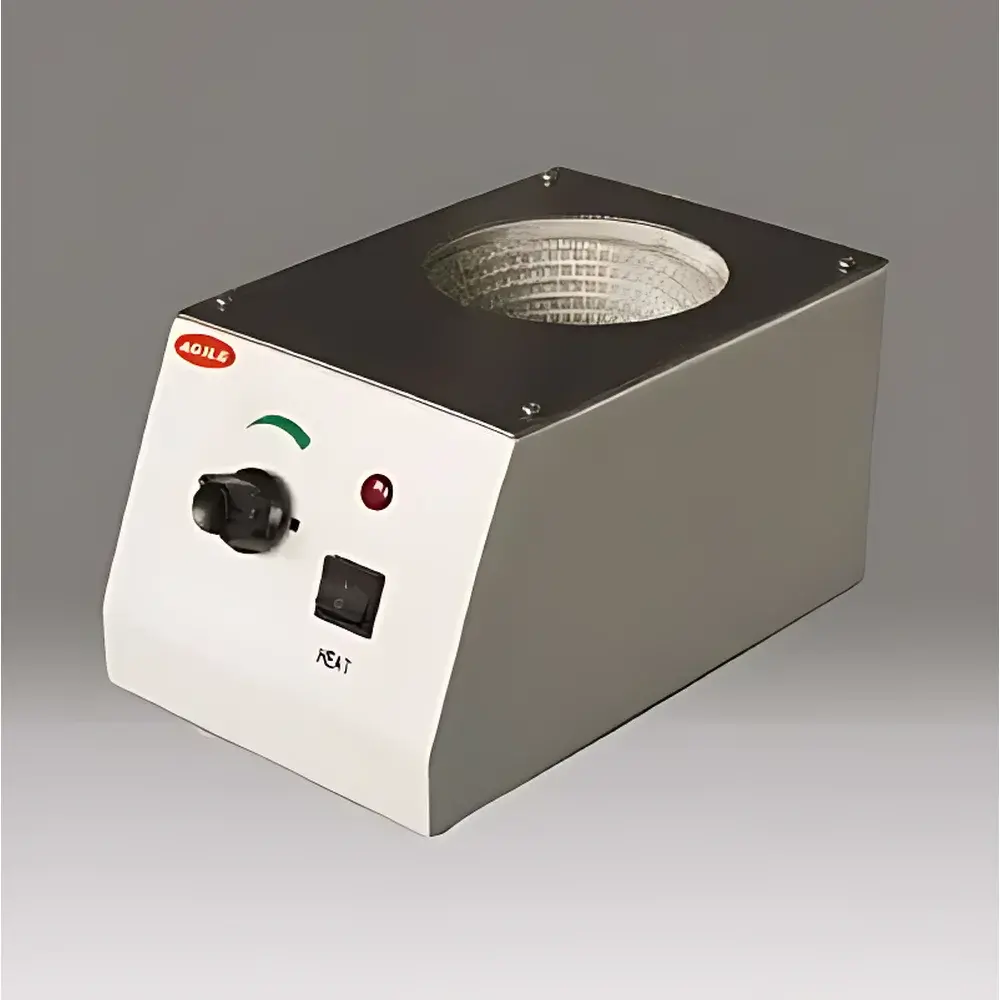
JRQ-1 & JRQ-1Z Electric Heating Mantles
| Origin | China |
|---|---|
| Manufacturer Type | Distributor |
| Model | JRQ-1 (Single Port), JRQ-1Z (Six-Port) |
| Temperature Range | Ambient to 200 °C |
| Heating Zone Diameter × Height | 10 cm × 6 cm |
| Rated Power | 0.35 kW (JRQ-1), 2.2 kW (JRQ-1Z) |
| Construction | Cold-Rolled Steel Housing with Epoxy Powder Coating |
| Control | Analog Electronic Temperature Regulator |
Overview
The JRQ-1 and JRQ-1Z electric heating mantles are precision-engineered laboratory heating devices designed for controlled, uniform thermal delivery to round-bottom flasks and other cylindrical glassware. Operating on resistive heating principles, these mantles utilize embedded nickel-chromium alloy heating elements distributed across a flexible, conformal ceramic-fiber insulated mantle structure. Unlike open hot plates or oil baths, the JRQ series provides direct, contact-based conduction heating with minimized thermal loss and reduced risk of localized overheating or flask fracture. The ambient-to-200 °C operational range supports common organic synthesis, solvent reflux, distillation, and sample concentration protocols across academic, pharmaceutical, petrochemical, and environmental testing laboratories.
Key Features
- Robust cold-rolled steel housing with electrostatic epoxy powder coating—providing mechanical resilience, corrosion resistance, and long-term surface integrity under routine lab exposure to solvents and humidity.
- Electronically regulated analog temperature control system enabling continuous, stepless adjustment across the full 0–200 °C range; integrated thermal cutoff protection prevents uncontrolled thermal runaway.
- Optimized heating geometry: each port features a precisely contoured 10 cm diameter × 6 cm depth cavity, ensuring maximal surface contact with standard 50–500 mL round-bottom flasks (e.g., ASTM E2877-compliant borosilicate glassware).
- High thermal efficiency design: low thermal mass insulation minimizes power consumption while maintaining ±3 °C temperature stability at setpoint under steady-state conditions (per ISO/IEC 17025 calibration traceability guidelines).
- Dual configuration flexibility: JRQ-1 supports single-vessel operation ideal for method development and small-batch reactions; JRQ-1Z enables parallel processing of up to six vessels—enhancing throughput in QC/QA workflows requiring replicate analysis or multi-parameter screening.
Sample Compatibility & Compliance
The JRQ series is compatible with standard borosilicate glass (e.g., Pyrex®, Duran®) and quartz reaction vessels ranging from 25 mL to 1000 mL capacity. Its non-inductive, resistive heating architecture eliminates electromagnetic interference with adjacent instrumentation (e.g., pH meters, balances, or data loggers). Units comply with IEC 61010-1:2010 safety requirements for electrical equipment used in laboratory environments, including dielectric strength testing, grounding continuity verification, and overtemperature protection validation. While not intrinsically rated for hazardous area use, optional external explosion-proof enclosures may be integrated per ATEX/IECEx Zone 2 specifications when deployed in volatile organic solvent handling zones.
Software & Data Management
As analog-controlled instruments, the JRQ-1 and JRQ-1Z do not incorporate digital interfaces or onboard data logging. However, they are fully compatible with third-party temperature monitoring systems via optional RTD probe integration (e.g., PT100 sensor mounted in flask neck adapter). When paired with validated data acquisition hardware (e.g., National Instruments cDAQ or Keysight 34972A), users can achieve GLP-compliant audit trails—including timestamped temperature records, operator ID linkage, and electronic signature support—as required under FDA 21 CFR Part 11 Annex 11 and ISO/IEC 17025 clause 7.7. Calibration certificates traceable to NIST standards are available upon request for metrological verification.
Applications
- Controlled reflux and solvent evaporation in synthetic organic chemistry (USP & EP method alignment for residual solvent testing).
- Preparation of calibration standards and reference materials requiring precise thermal conditioning (e.g., viscosity reference oils, polymer solution homogenization).
- Moisture content determination per AOAC 950.46 and ASTM D1555–22 using standardized evaporation kinetics.
- Accelerated stability studies in pharmaceutical development (ICH Q1A(R2)), where reproducible thermal stress profiles are critical.
- Environmental sample digestion (EPA Method 3010B) prior to heavy metal analysis by ICP-MS or AAS.
FAQ
What flask sizes are supported by the JRQ-1Z six-port configuration?
Each port accommodates round-bottom flasks with outer diameters ≤10 cm—compatible with standard 50 mL, 100 mL, 250 mL, and 500 mL vessels. Flasks must be seated fully within the cavity to ensure thermal uniformity.
Is temperature calibration performed at the flask wall or internal liquid phase?
Calibration is conducted at the mantle’s inner surface per manufacturer specification; actual liquid-phase temperature depends on vessel wall thickness, solvent thermal conductivity, and stirring rate—users should validate in situ with a calibrated immersion probe.
Can the JRQ series be used under inert atmosphere conditions?
Yes—when used with sealed flask assemblies (e.g., Schlenk lines or nitrogen-purged condensers), the mantles introduce no atmospheric contamination; however, ensure adequate ventilation around the unit to prevent heat buildup in enclosed hoods.
Does the analog controller support remote setpoint adjustment?
No—setpoint adjustment requires manual rotation of the front-panel potentiometer; for automated control, integrate with an external PID controller via 0–10 V or 4–20 mA analog output interface (requires optional signal adapter kit).
What maintenance intervals are recommended for long-term reliability?
Inspect heating element continuity and housing integrity every 6 months; clean exterior surfaces with isopropyl alcohol only—never immerse or spray water directly onto the mantle body.



