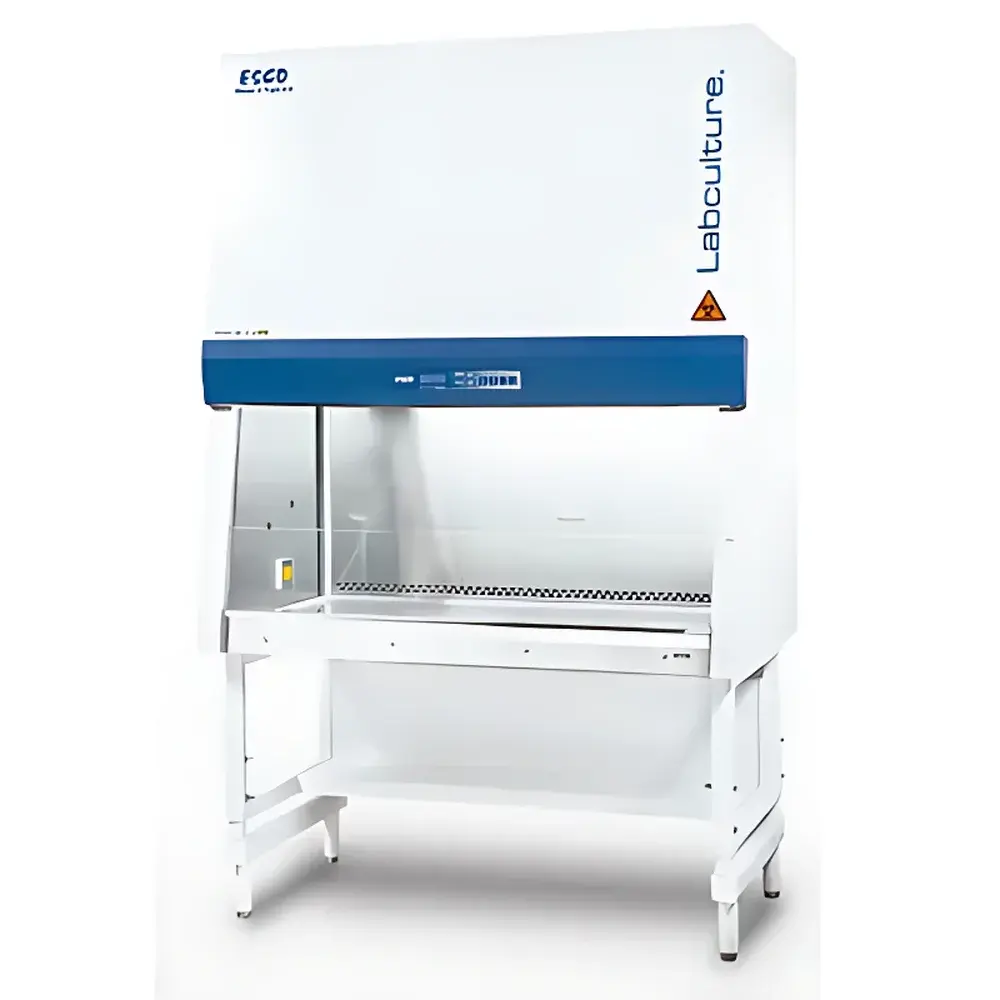
Esco Labculture A2 Class II Biological Safety Cabinet (LA2-A Series)
| Brand | Esco |
|---|---|
| Origin | Singapore |
| Manufacturer Type | Original Equipment Manufacturer (OEM) |
| Origin Category | Imported |
| Model | LA2-A |
| Instrument Type | Class II Biological Safety Cabinet |
| External Dimensions (L×W×H) | Model-dependent (e.g., LA2-3A: 1115 × 852 × 1540 mm) |
| Internal Dimensions (L×W×H) | Model-dependent (e.g., LA2-3A: 970 × 623 × 670 mm) |
| Inflow Velocity | 0.53 m/s (105 fpm) |
| Downflow Velocity | 0.35 m/s (70 fpm) |
| ULPA Filter Efficiency | ≥99.999% @ 0.1–0.3 µm |
| Power Supply | 220 VAC, 50 Hz |
| Compliance | NSF/ANSI 49, EN 12469, YY 0569, JIS K 3800 |
| Control System | Sentinel Gold microprocessor-based digital display with real-time monitoring |
| Optional Features | RS232 data port, night/standby mode, ISOCIDE antimicrobial coating, seamless stainless steel work surface, ergonomic tilt-angle front window (10°), ADA-compliant control panel |
Overview
The Esco Labculture A2 Class II Biological Safety Cabinet (LA2-A Series) is an engineered solution for containment of low-to-moderate risk biological agents (BSL-1 to BSL-2), designed in strict accordance with the operational and safety requirements defined in NSF/ANSI 49, EN 12469, YY 0569, and JIS K 3800. It operates on the principle of inward airflow (inflow) to protect personnel, downward laminar airflow (downflow) to protect samples, and exhaust air filtration to protect the environment—characteristic of Class II, Type A2 cabinets. Air is drawn through the front grille at a minimum inflow velocity of 0.53 m/s (105 fpm), passes over the work area, and is recirculated (70% by volume) after passing through dual Minipleat ULPA filters with ≥99.999% efficiency for particles between 0.1 and 0.3 µm. The remaining 30% is exhausted via a dedicated ducted or thimble-connected system. This balanced airflow architecture ensures simultaneous protection of operator, product, and environment without compromising sterility or containment integrity.
Key Features
- High-efficiency DC motor-driven blower system—reducing energy consumption by up to 40% compared to conventional AC motors while maintaining stable, low-noise airflow performance.
- Dual Minipleat ULPA filters (not HEPA) certified to IEST-RP-CC001.3, delivering ≥99.999% particle retention at the most penetrating particle size (MPPS) of 0.1–0.3 µm—exceeding standard HEPA (99.97% @ 0.3 µm) specifications.
- Monolithic 304 stainless steel work surface with zero seams, screws, or fasteners—enabling rapid decontamination and autoclave-compatible cleaning protocols.
- Sentinel Gold microprocessor control system featuring a large-format LCD interface displaying real-time inflow/downflow velocities, filter life status, UV lamp hours, alarm logs, and system diagnostics.
- Ergonomic 10° forward-sloped sash and angled control/display pad compliant with ADA accessibility guidelines—minimizing operator fatigue during extended procedures.
- ISOCIDE antimicrobial powder coating applied to all external painted surfaces—validated per ISO 22196 to inhibit microbial colonization on cabinet exteriors.
- Optimized side-wall baffle design with enhanced airfoil geometry—improving containment efficiency at the work surface perimeter and reducing turbulence-induced aerosol escape.
- Integrated quick-start mode: sash position detection automatically activates lighting and exhaust fan when the sash is raised to the operational height (typically 200 mm).
- RS232 serial port for remote parameter logging, audit trail export, and integration with laboratory information management systems (LIMS) under GLP/GMP environments.
Sample Compatibility & Compliance
The LA2-A series accommodates a broad range of biosafety applications including cell culture, microbiological assay preparation, recombinant DNA handling, and pharmaceutical aseptic processing. Its Class II, Type A2 configuration permits use with minute quantities of volatile toxic chemicals (e.g., ≤5% v/v ethanol or formaldehyde), provided exhaust ducting is properly configured. All models are certified to NSF/ANSI 49 (2022 edition), EN 12469:2000+A1:2009, China’s YY 0569-2011, and Japan’s JIS K 3800:2010. Certification includes full third-party validation of airflow uniformity, containment integrity (via potassium iodide and microbial challenge testing), and structural stability under dynamic load conditions. Units support 21 CFR Part 11-compliant electronic records when paired with validated LIMS interfaces and audit-trail-enabled software configurations.
Software & Data Management
The Sentinel Gold control platform provides embedded firmware with non-volatile memory for storing >10,000 event logs—including sash position changes, UV activation cycles, alarm triggers (e.g., airflow deviation >±10%, filter saturation), and maintenance reminders. Data export via RS232 supports CSV-formatted timestamps for regulatory documentation. Optional firmware upgrades enable password-protected user roles (Operator, Technician, Administrator), configurable alarm thresholds, and automated calibration verification prompts aligned with ISO/IEC 17025 internal quality assurance protocols. No cloud connectivity is included by default; all data remains on-device unless explicitly interfaced via secure, audited serial transmission.
Applications
- Aseptic handling of mammalian and insect cell lines in academic and industrial bioprocessing labs.
- Preparation of diagnostic reagents and clinical specimens under CLIA- and CAP-accredited workflows.
- Handling of genetically modified organisms (GMOs) requiring BSL-2 containment per NIH Guidelines.
- Pharmaceutical QC/QA activities involving sterility testing and media fill simulations.
- Vaccine development workflows where simultaneous personnel and product protection is mandated.
- Teaching laboratories requiring robust, low-maintenance containment for undergraduate microbiology instruction.
FAQ
What certifications does the LA2-A series hold?
NSF/ANSI 49, EN 12469, YY 0569, and JIS K 3800—verified by independent accredited test laboratories.
Can the cabinet be used with volatile organic solvents?
Yes—only with trace amounts (≤5% v/v) and mandatory ducted exhaust; consult local EHS for solvent compatibility and explosion-proof requirements.
Is the ULPA filter service life documented?
Filter lifetime is monitored in real time based on cumulative runtime and pressure differential; typical service interval is 5–7 years under normal BSL-2 usage.
Does the system support FDA 21 CFR Part 11 compliance?
When integrated with validated external LIMS and configured with role-based access control and electronic signature modules, yes—subject to site-specific validation.
What maintenance is required beyond filter replacement?
Annual certification per NSF/ANSI 49 is recommended; includes airflow mapping, containment testing, UV intensity verification, and electrical safety inspection.
Related Products