
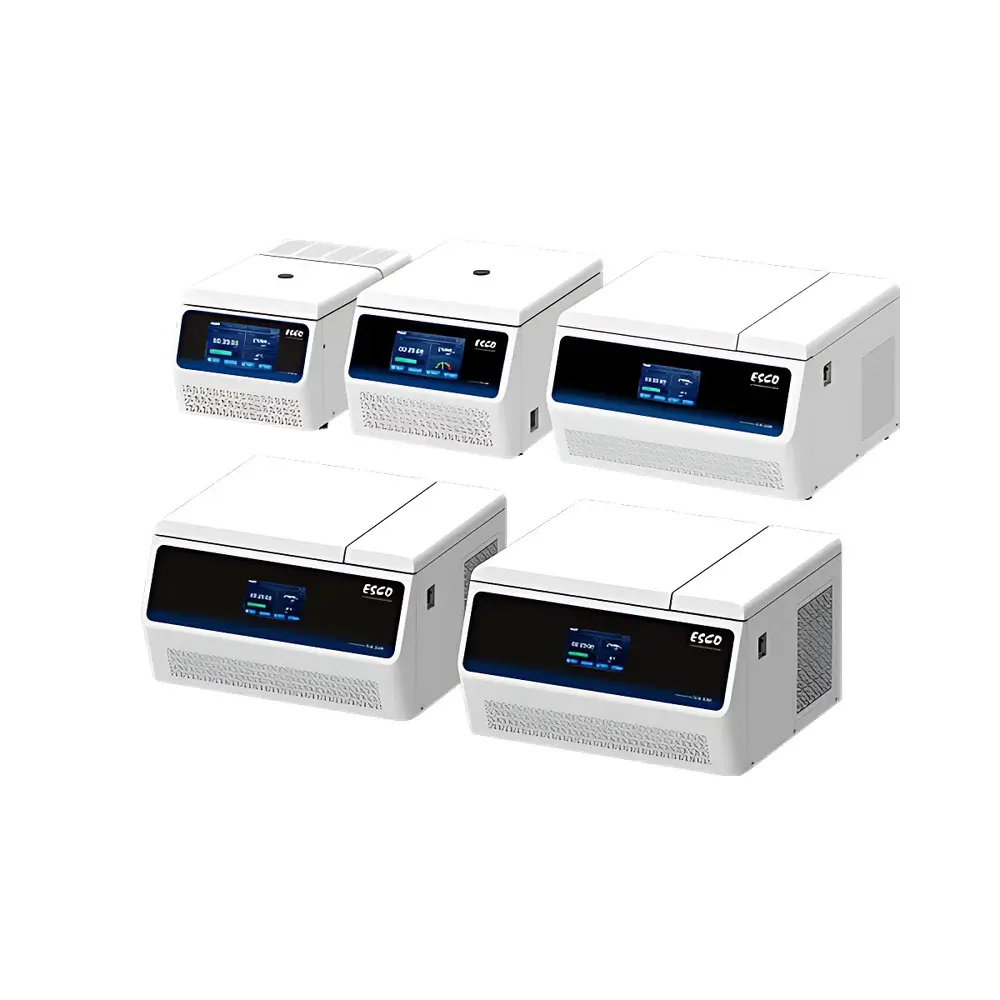
Esco Versati-TS Intelligent High-Speed Benchtop Centrifuge
| Brand | Esco |
|---|---|
| Origin | Shanghai, China |
| Manufacturer Type | Original Equipment Manufacturer (OEM) |
| Product Category | Domestic |
| Model | Esco Versati-TS |
| Instrument Type | Benchtop Centrifuge |
| Speed Range | 10,000–30,000 rpm |
| Temperature Control Accuracy | ±2 °C |
| Speed Control Precision | ±10 rpm |
| Vibration Amplitude | ≤0.01 mm |
| Noise Level | ≤60 dB(A) |
| Rotor Autoidentification Time | ~1 s |
| Data Logging Capacity | ≥100,000 entries |
| Sterilization Compatibility | 121 °C, 15–20 min autoclave cycle |
| Display | 7-inch LCD touchscreen with bilingual UI (English/Chinese) |
| Safety Certifications | IEC 61010-1, IEC 61010-2-020, ISO 13485 (manufacturer), compliant with GLP/GMP documentation requirements |
Overview
The Esco Versati-TS Intelligent High-Speed Benchtop Centrifuge is an engineered solution for precision separation in demanding life science and industrial laboratories. Operating on the principle of sedimentation under controlled centrifugal force (RCF), it delivers reproducible particle separation across diverse sample matrices—including nucleic acids, subcellular organelles, viruses, and therapeutic proteins—by leveraging rotational speeds up to 30,000 rpm and programmable temperature regulation. Designed for benchtop integration without compromising performance or safety, the Versati-TS series bridges the functional gap between compact footprint and high-throughput capability. Its architecture adheres to international electrical safety and laboratory equipment standards (IEC 61010-1 and IEC 61010-2-020), supporting regulated environments where traceability, audit readiness, and operational integrity are mandatory.
Key Features
- Precision temperature control within ±2 °C across the full speed range, maintaining sample integrity during prolonged high-speed runs—critical for enzymatic assays, RNA isolation, and cold-sensitive biologics.
- Real-time RCF/RPM synchronization with ±10 rpm speed accuracy ensures consistent g-force application, minimizing inter-run variability in quantitative separations.
- Ultra-low vibration design (≤0.01 mm amplitude) achieved through dynamic balancing of rotor assemblies and reinforced stainless-steel housing, enabling stable operation at maximum rated speed without microplate or tube displacement.
- Soft ramp deceleration technology (1000–0 rpm) with 12 programmable acceleration/deceleration profiles prevents resuspension and pellet disruption in density-gradient or delicate cell preparations.
- 7-inch capacitive touchscreen interface supports bilingual operation (English/Chinese), intuitive workflow navigation, and real-time graphical display of run progress—including live RCF, temperature, and time curves.
- Auto-rotor recognition system identifies installed rotors in ~1 second via embedded RFID tags, retrieving validated maximum speed limits, rotor-specific calibration data, and historical usage logs to prevent over-speeding or mismatched configurations.
- Multi-tier user access control (Administrator / Operator / Guest) enforces role-based permissions, password protection, and immutable audit trails—fully compatible with GLP and GMP documentation workflows requiring electronic record integrity per FDA 21 CFR Part 11 principles.
Sample Compatibility & Compliance
The Versati-TS accommodates a broad spectrum of sample containers—from 0.2 mL PCR tubes to 50 mL conical tubes—and supports fixed-angle, swing-bucket, and vertical rotors certified for biosafety containment (BSL-2/BSL-3 applications). All rotors feature BioSeal™ four-point sealing to suppress aerosol generation during high-speed pelleting of pathogenic or genetically modified materials. The entire rotor set and adapter components are autoclavable at 121 °C for 15–20 minutes, ensuring compliance with ISO 13485-mandated sterilization protocols for clinical and diagnostic use. The chamber interior is constructed from electropolished 316L stainless steel with PTFE coating, resisting corrosion from common buffers (e.g., Tris-HCl, EDTA, guanidine salts) and facilitating residue-free cleaning between runs.
Software & Data Management
Data integrity is maintained through on-device logging of ≥100,000 operational events—including start/stop timestamps, rotor ID, speed/temperature setpoints, error codes, and user login activity. All logs are exportable via USB port in PDF format with embedded digital signatures, satisfying regulatory requirements for raw data retention and retrospective analysis. The system supports two timing modes: “Start Timer” (initiates countdown upon lid closure) and “At-Speed Timer” (begins only after reaching target RPM), eliminating timing artifacts in kinetic studies. Up to 1,000 user-defined programs—including multi-step gradient centrifugation sequences with up to seven discrete segments—can be stored and recalled with one-touch activation.
Applications
The Versati-TS is routinely deployed in molecular biology labs for plasmid purification, viral vector concentration, and exosome isolation; in biopharmaceutical QC for residual host-cell protein removal and aggregate analysis; in academic research for mitochondrial fractionation and synaptic vesicle enrichment; and in industrial settings for catalyst recovery and polymer nanoparticle sizing. Its thermal stability and low-noise operation (<60 dB[A]) make it suitable for shared core facilities and open-lab environments where continuous, unattended operation is required.
FAQ
What regulatory standards does the Versati-TS comply with?
It meets IEC 61010-1 (safety of electrical equipment) and IEC 61010-2-020 (particular requirements for centrifuges), and its manufacturer holds ISO 13485 certification. Electronic log functionality aligns with FDA 21 CFR Part 11 for audit-trail integrity.
Can the centrifuge operate without active cooling?
Yes—the refrigeration system is independently controllable; ambient-temperature runs are fully supported without compressor engagement.
Is rotor calibration traceable to national standards?
Each rotor carries a unique ID linked to factory-calibrated speed/RCF coefficients, with optional NIST-traceable calibration certificates available upon request.
How is emergency access managed during power failure?
A mechanical emergency lid release mechanism allows manual opening without tools or external power, ensuring rapid sample retrieval during unexpected shutdowns.
Does the system support remote monitoring or network integration?
Local USB data export is standard; Ethernet or Wi-Fi connectivity is not natively supported but may be implemented via third-party middleware in validated IT environments.



