
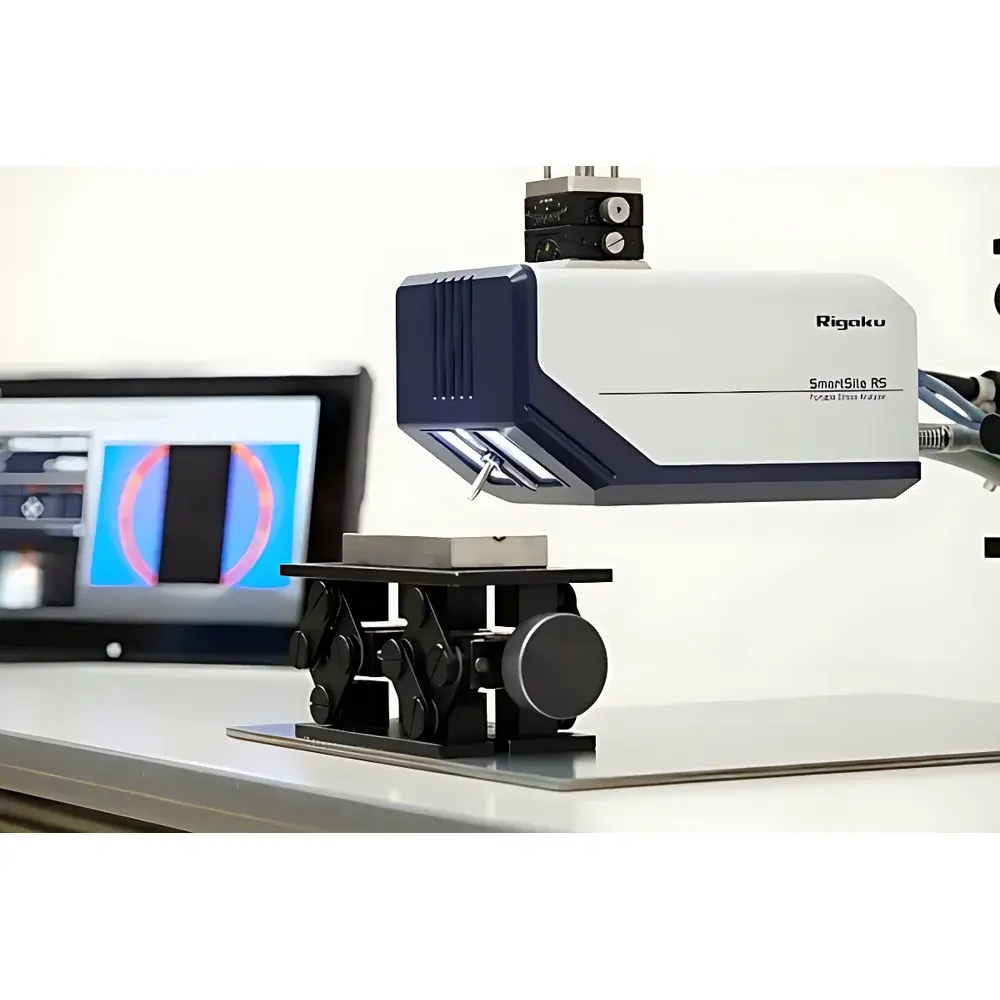
Rigaku SmartSite RS Portable X-Ray Stress Analyzer
| Brand | Rigaku |
|---|---|
| Origin | Japan |
| Model | SmartSite RS |
| Weight | 3 kg |
| Dimensions (Test Head) | 114 mm (W) × 248 mm (D) × 111 mm (H) |
| Detector Type | Dual semiconductor-based 2D area detectors |
| X-ray Source | Microfocus sealed-tube anode (Cr, Fe, Co, Cu selectable) |
| ψ-angle range | −60° to +60° |
| 2θ-angle range | 70° to 160° (adjustable per material and reflection) |
| Safety | Integrated laser alignment, 3-axis accelerometer for tilt monitoring, optional lead-lined shielding enclosure for lab use |
| Control Interface | Android-based touchscreen tablet with LAN/Wi-Fi connectivity |
| Compliance | IEC 61000-6-3, IEC 61000-6-4, JIS Z 4901:2020 (X-ray equipment safety), ISO 21940-11 (residual stress measurement — XRD method) |
Overview
The Rigaku SmartSite RS Portable X-Ray Stress Analyzer is an engineered solution for non-destructive, in-situ residual stress evaluation using the sin²ψ X-ray diffraction (XRD) method. Unlike conventional benchtop or floor-standing XRD systems, the SmartSite RS integrates a microfocus X-ray source, dual semiconductor 2D area detectors, and real-time geometric compensation algorithms into a single handheld test head weighing only 3 kg. Its core measurement principle relies on lattice strain determination via Bragg angle shifts across multiple ψ-tilt orientations, enabling quantitative calculation of biaxial stress components (σ₁₁, σ₂₂, τ₁₂) in polycrystalline metallic materials. Designed for field deployment and constrained-access environments—including internal surfaces of cylindrical components with inner diameters ≥200 mm—the instrument meets the technical requirements of ASTM E915-22 (Standard Test Method for Verifying the Alignment of X-Ray Diffraction Instrumentation for Residual Stress Measurement) and ISO 21940-11 (Mechanical vibration — Balance quality requirements of rotors — Part 11: Procedures and verification of balancing machines). The system operates at nominal tube voltages up to 30 kV and currents up to 1 mA, with selectable anode targets (Cr, Fe, Co, Cu) optimized for common engineering alloys such as stainless steel, titanium, aluminum, and nickel-based superalloys.
Key Features
- Ultra-compact test head (114 × 248 × 111 mm) enables access to confined geometries including boreholes, weld seams, turbine blades, and gear teeth.
- Dual semiconductor 2D area detectors acquire full Debye–Scherrer diffraction rings simultaneously—eliminating mechanical scanning and reducing measurement time per orientation to under 30 seconds.
- Real-time 3-axis accelerometer feedback dynamically corrects for test head tilt during data acquisition, ensuring angular fidelity without manual re-leveling.
- Laser alignment system projects collimated crosshairs onto the sample surface, verifying beam incidence point and incident angle prior to exposure.
- Android-based tablet interface supports offline operation, step-by-step guided workflows, and on-device stress tensor calculation using standard sin²ψ regression algorithms.
- Networked control via wired Ethernet or IEEE 802.11n Wi-Fi allows remote supervision, firmware updates, and centralized data export compliant with ASTM E1361 (Standard Guide for Data Exchange in Residual Stress Testing).
Sample Compatibility & Compliance
The SmartSite RS is validated for use on ferrous and non-ferrous metals exhibiting measurable diffraction peaks in the selected 2θ range (70°–160°). It accommodates curved, rough, or coated surfaces through adaptive focus correction and automatic background subtraction. Surface preparation requirements align with ISO 2639 (Metallic materials — Determination of residual stresses by X-ray diffraction) — typically electropolishing or fine grinding to ≤0.5 µm Ra. All radiation safety features comply with Japanese Industrial Standard JIS Z 4901:2020 and EU Directive 2013/59/Euratom. Optional lead-acrylic shielding enclosures meet laboratory-grade Class II X-ray device classification per IEC 61000-6-3/6-4 for electromagnetic compatibility and emission control.
Software & Data Management
The embedded software suite provides full traceability per GLP/GMP requirements: each measurement log records operator ID, timestamp, GPS coordinates (when enabled), detector calibration status, exposure parameters, and raw 2D frame metadata. Stress results are exported in CSV and XML formats compatible with third-party statistical process control (SPC) platforms. Audit trail functionality satisfies FDA 21 CFR Part 11 requirements when deployed with network authentication and digital signature modules. Data encryption (AES-256) and role-based access control (RBAC) are enforced during LAN/Wi-Fi transmission.
Applications
- Residual stress mapping pre- and post-shot peening, laser shock peening, or low-plasticity burnishing in aerospace landing gear and compressor disks.
- In-process verification of heat treatment uniformity in automotive crankshafts and camshafts.
- Weld integrity assessment across pipeline girth welds, pressure vessel nozzles, and nuclear component repairs.
- Tooling fatigue life prediction through subsurface stress gradient profiling near machined edges.
- Quality assurance of additive-manufactured Ti-6Al-4V parts where thermal history induces anisotropic stress fields.
FAQ
What X-ray tube anodes are supported?
Cr, Fe, Co, and Cu anodes are factory-configurable; selection depends on the target material’s diffraction characteristics and required penetration depth.
Is calibration traceable to national standards?
Yes — angular calibration uses NIST-traceable silicon reference powder (SRM 640e); intensity response is verified against certified stress-free steel standards per ISO 21940-11 Annex B.
Can the system perform texture analysis?
No — the SmartSite RS is purpose-built for residual stress quantification using the sin²ψ method; it does not support pole figure acquisition or ODF reconstruction.
What is the minimum measurable stress uncertainty?
Typical combined standard uncertainty (k=2) is ±15 MPa for ferritic steels under optimal surface and geometry conditions, as verified per ISO/IEC 17025 accredited interlaboratory studies.
Is training and application support available internationally?
Rigaku-certified application engineers provide remote and on-site training, method development assistance, and ISO 17025-compliant validation documentation upon request.



