
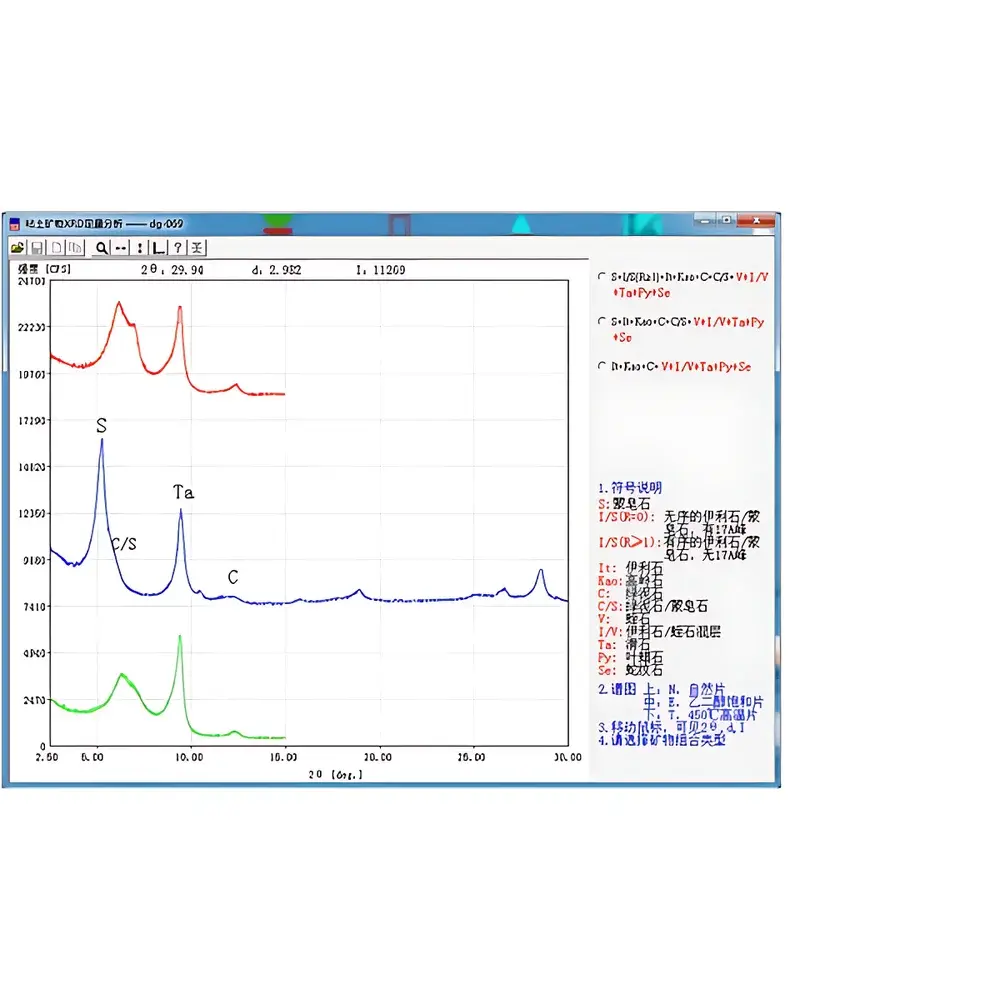
Rigaku Clayquan II XRD Quantitative Analysis Software for Clay Minerals
| Brand | Rigaku |
|---|---|
| Origin | Beijing, China |
| Model | Clayquan II |
| Compatibility | Windows XP/Vista/2003/7 (Chinese), Microsoft Office 2003/2007 |
| Output Format | .xls |
| Standards Compliance | SY/T 5160–2010, SY/T 5477–2003, SY/T 5163–2010 |
| Mineral Coverage | Smectite (S), Illite/Smectite mixed-layer (I/S), Illite (It), Kaolinite (Kao), Chlorite (C), Chlorite/Smectite mixed-layer (C/S), Palygorskite (Pa), Vermiculite (V), Illite/Vermiculite mixed-layer (I/V), Pyrophyllite (Py), Talc (Ta), Serpentine (Se) |
| Mixed-layer ratio calculation | Supported for I/S, I/V, C/S |
| Quantitative method | Reference Intensity Ratio (RIR) with internal standard correction and peak deconvolution |
Overview
Rigaku Clayquan II is a specialized X-ray diffraction (XRD) quantitative analysis software engineered for the precise identification and quantification of clay and associated sheet-silicate minerals in sedimentary, soil, hydrothermal, and low-grade metamorphic samples. Unlike generic Rietveld or full-pattern refinement tools, Clayquan II implements a validated, industry-tuned methodology rooted in the Reference Intensity Ratio (RIR) approach—optimized for the complex peak overlaps, preferred orientation effects, and baseline distortions characteristic of fine-grained clay assemblages. The software operates on raw or processed XRD intensity-vs-2θ data files (typically from Rigaku SmartLab, Ultima IV, or other Bragg-Brentano geometry diffractometers), applying sequential corrections including background subtraction, peak smoothing, 2θ calibration, integrated intensity extraction, and constrained peak deconvolution. Its core strength lies in its ability to resolve mixed-layer phases—particularly illite/smectite (I/S), chlorite/smectite (C/S), and illite/vermiculite (I/V)—and compute their layer proportions using empirically calibrated intensity ratios derived from certified reference materials and interlaboratory round-robin studies conducted under petroleum industry protocols.
Key Features
- Three configurable mineral assemblage modes (II-1, II-2, II-3) enabling context-aware quantification based on geological origin and expected phase inventory
- Integrated mixed-layer ratio calculation for I/S, C/S, and I/V systems using standardized intensity-based algorithms compliant with SY/T 5160–2010
- Extended mineral library covering 12 phases: smectite (S), illite (It), kaolinite (Kao), chlorite (C), palygorskite (Pa), vermiculite (V), pyrophyllite (Py), talc (Ta), serpentine (Se), and their binary mixed-layer variants
- Robust baseline modeling with adaptive polynomial fitting and user-adjustable smoothing windows
- Peak position correction via internal standard (e.g., corundum or fluorite) or fixed-angle alignment against NIST SRM 676a
- Batch processing support for multi-sample workflows with consistent parameter propagation
- Export of all quantitative results—including individual phase wt%, mixed-layer ratios, and integration statistics—to editable Microsoft Excel (.xls) format
Sample Compatibility & Compliance
Clayquan II is validated for use with oriented clay mounts prepared by centrifugation or sedimentation on glass slides, as well as random powder mounts for non-swelling phases (e.g., talc, pyrophyllite, serpentine). It supports data acquired under Cu-Kα radiation (λ = 1.5418 Å) with conventional scintillation or silicon strip detectors. The software adheres strictly to Chinese petroleum industry standards SY/T 5160–2010 (for vermiculite-containing systems) and SY/T 5477–2003 (for general clay quantification), ensuring traceability in reservoir characterization, source rock evaluation, and caprock integrity assessment. While not certified to ISO/IEC 17025 or ASTM D7539, its algorithmic framework aligns with the procedural rigor required for GLP-compliant reporting in exploration geochemistry laboratories. All calculations are fully auditable: intermediate spectra, baseline functions, peak fit residuals, and RIR coefficient tables are retained within the project file structure.
Software & Data Management
Clayquan II runs natively on localized Chinese-language editions of Windows XP through Windows 7 (32-bit), requiring no additional runtime libraries beyond Microsoft Visual C++ 2008 Redistributable. It interfaces directly with common XRD vendor data formats (e.g., Rigaku’s *.ras, PANalytical’s *.raw, Bruker’s *.raw) via built-in import filters. No cloud dependency or online activation is required; licensing is node-locked to the host machine. Audit trails are maintained through timestamped project logs that record operator ID (manual entry), analysis date, input file path, selected mineral mode, applied corrections, and final output checksum. Though not FDA 21 CFR Part 11–compliant out-of-the-box, the software supports manual documentation of electronic records in accordance with laboratory SOPs for regulated environments. Data export is restricted to .xls to ensure compatibility with legacy QA/QC pipelines in national oil companies and geological survey institutions.
Applications
- Petroleum system analysis: quantifying smectite-to-illite transformation kinetics for thermal maturity modeling and basin burial history reconstruction
- Caprock and seal evaluation: assessing swelling potential and permeability anisotropy via I/S and smectite content
- Soil science and regolith studies: differentiating weathering-derived vermiculite and illite/vermiculite in tropical and subtropical profiles
- Hydrothermal alteration mapping: identifying pyrophyllite–kaolinite–serpentine assemblages in epithermal and porphyry systems
- Geotechnical engineering: correlating clay mineralogy with plasticity index, shrink-swell behavior, and shear strength parameters
- Academic research: supporting method validation studies comparing RIR-based quantification against electron microprobe or TEM-based modal analysis
FAQ
Is Clayquan II compatible with modern Windows 10/11 operating systems?
Clayquan II was developed for Windows XP–7 (32-bit) and lacks native support for Windows 10/11. Virtualization (e.g., Windows 7 VM under VMware Workstation) or hardware legacy mode is required for deployment on current platforms.
Does the software support external calibration standards beyond corundum?
Yes—users may define custom RIR values for any internal standard (e.g., NaCl, Si, ZnO) provided certified intensity ratios are available from ICDD PDF-4+ or NIST publications.
Can Clayquan II process data from synchrotron or neutron diffraction sources?
No. The software assumes Cu-Kα wavelength and Bragg-Brentano geometry. It does not accommodate variable λ, time-of-flight, or energy-dispersive configurations.
How are mixed-layer ratios calculated for I/S and I/V systems?
Ratios are derived from the relative intensities of diagnostic peaks (e.g., I/S 001 vs. 002, I/V 002 vs. 003) using empirical calibration curves established from natural and synthetic mixed-layer reference samples characterized by TEM and chemical analysis.
Is technical support available outside China?
Direct vendor support is coordinated through Rigaku’s Beijing office and authorized distributors in APAC; English-language documentation and remote diagnostics are available upon request.
Related Products



