
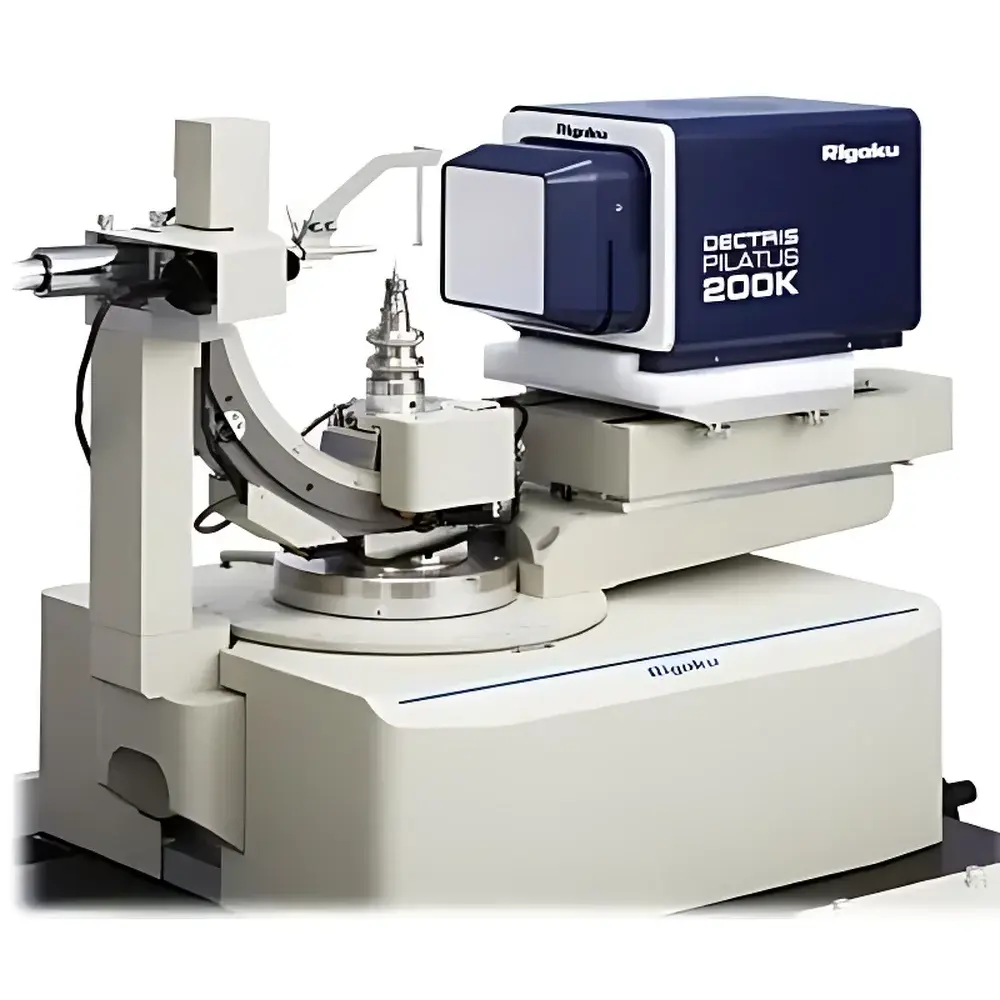
Rigaku XtaLAB P200 Single-Crystal X-ray Diffractometer
| Brand | Rigaku |
|---|---|
| Origin | Japan |
| Instrument Type | Single-Crystal X-ray Diffractometer |
| Configuration | Floor-Standing |
| Detector | PILATUS200K Hybrid Pixel Array Detector |
| Detector Pixel Size | 172 µm |
| Dynamic Range | 1 × 10⁶ photons/pixel |
| Operating Temperature | Ambient (No Cryogenic Cooling Required) |
| X-ray Source Options | MicroMax003 (Cu or Mo), DualSource (Cu + Mo), MicroMax007HF, MicroMax007HF-DW, MultiMax9 |
| Goniometer Types | Partial χ, Fixed χ, Three-Axis AFC-Kappa, Four-Axis Kappa |
| Optional Accessories | Low-Temperature Device (e.g., Oxford Cryostream) |
Overview
The Rigaku XtaLAB P200 is a high-performance single-crystal X-ray diffractometer engineered for precise three-dimensional structural determination of small-molecule crystalline compounds. It operates on the fundamental principle of Bragg diffraction, where monochromatic X-rays interact with a periodically ordered crystal lattice to produce a characteristic diffraction pattern. This pattern is recorded by a hybrid pixel array detector and processed via direct-space and reciprocal-space algorithms to yield atomic coordinates, bond lengths, bond angles, torsion angles, and displacement parameters with high fidelity. Designed specifically for academic laboratories, pharmaceutical R&D groups, and contract analytical service providers, the XtaLAB P200 delivers rapid, reliable, and reproducible structural solutions — particularly for challenging samples including microcrystals (<10 µm), weakly diffracting species, and air-sensitive compounds.
Key Features
- Integrated PILATUS200K hybrid pixel array detector: Enables shutterless continuous data collection, eliminating mechanical shutter delays and associated radiation damage risks.
- No dark current or readout noise: Ensures quantitative intensity measurement across all exposure times — critical for accurate absorption correction and refinement of low-symmetry or twinned structures.
- High dynamic range (1 × 10⁶ photons/pixel): Facilitates simultaneous capture of strong and weak reflections without saturation or truncation, improving completeness and precision in final structural models.
- Microfocus sealed-tube X-ray source architecture: Delivers high-brightness beam profiles optimized for small crystals; compatible with Cu Kα (λ = 1.5418 Å) and Mo Kα (λ = 0.7107 Å) radiation depending on sample absorption and resolution requirements.
- Modular goniometer system: Supports multiple configurations including Partial χ, Fixed χ, three-axis AFC-Kappa, and four-axis Kappa geometries — enabling optimal orientation control for complex space groups and multi-domain crystals.
- Ambient-temperature semiconductor detection: Eliminates liquid nitrogen dependency and associated maintenance overhead, reducing total cost of ownership while maintaining detector stability over extended acquisition periods.
Sample Compatibility & Compliance
The XtaLAB P200 accommodates standard capillary-mounted, loop-mounted, or cryoloop-mounted single crystals ranging from ~5–500 µm in linear dimension. Its optical path and collimation design support both room-temperature and low-temperature data collection (when paired with optional Oxford Cryostream or equivalent cryogenic device). The system complies with international standards relevant to structural characterization workflows, including IUCr CIF reporting guidelines, ISO/IEC 17025 requirements for testing laboratories, and supports audit-ready documentation for GLP-compliant environments. Data integrity is reinforced through timestamped metadata embedding, hardware-level detector calibration traceability, and full integration with Rigaku’s CrysAlisPro software suite — which includes built-in validation against IUCr-recommended R-factor thresholds and geometry outlier checks per CIF deposition standards.
Software & Data Management
Data acquisition, processing, and structure solution are fully integrated within Rigaku’s CrysAlisPro platform — a Windows-based application supporting automated unit cell determination, integration, scaling, absorption correction, and space group assignment. The software implements robust algorithms for handling twinning, pseudo-symmetry, and disorder modeling. All raw frames and processed reflection files (.hkl) are stored with embedded experimental metadata (wavelength, temperature, scan parameters, detector geometry), ensuring full FAIR (Findable, Accessible, Interoperable, Reusable) compliance. Export formats include CIF, SHELX .ins/.res, and Mercury-compatible .mol files. For regulated environments, CrysAlisPro supports user access control, electronic signatures, and audit trail generation aligned with FDA 21 CFR Part 11 requirements when deployed on validated IT infrastructure.
Applications
- Determination of absolute stereochemistry in chiral pharmaceutical intermediates and active pharmaceutical ingredients (APIs).
- Validation of synthetic reaction outcomes, including regioisomerism, tautomerism, and coordination geometry in metal–organic frameworks (MOFs) and catalyst precursors.
- Polymorph screening and solid-form characterization for patent support and regulatory filings (e.g., ICH Q5A, Q5B).
- Co-crystal and salt formation analysis to guide solubility, stability, and bioavailability optimization.
- Teaching and method development in undergraduate and graduate crystallography laboratories requiring turnkey operation and pedagogical visualization tools.
FAQ
What crystal size is suitable for data collection on the XtaLAB P200?
Crystals between 10–100 µm are routinely analyzed; sub-10 µm crystals may be measured using microfocus optics and optimized beam alignment.
Does the system require liquid nitrogen for detector operation?
No — the PILATUS200K detector operates at ambient temperature and requires no cryogenic cooling.
Can the instrument collect data at low temperatures?
Yes, when equipped with an optional cryogenic device such as the Oxford Cryostream 800+, data can be collected from 80 K to 500 K.
Is remote operation supported?
CrysAlisPro enables secure remote monitoring and control via institutional VPN; full unattended operation is possible with scheduled runs and email notifications.
How does the PILATUS detector improve data quality compared to legacy CCD systems?
It eliminates point-spread function degradation, provides instantaneous readout without shutter latency, and offers superior signal-to-noise ratio due to zero readout noise and absence of dark current.
Related Products




