
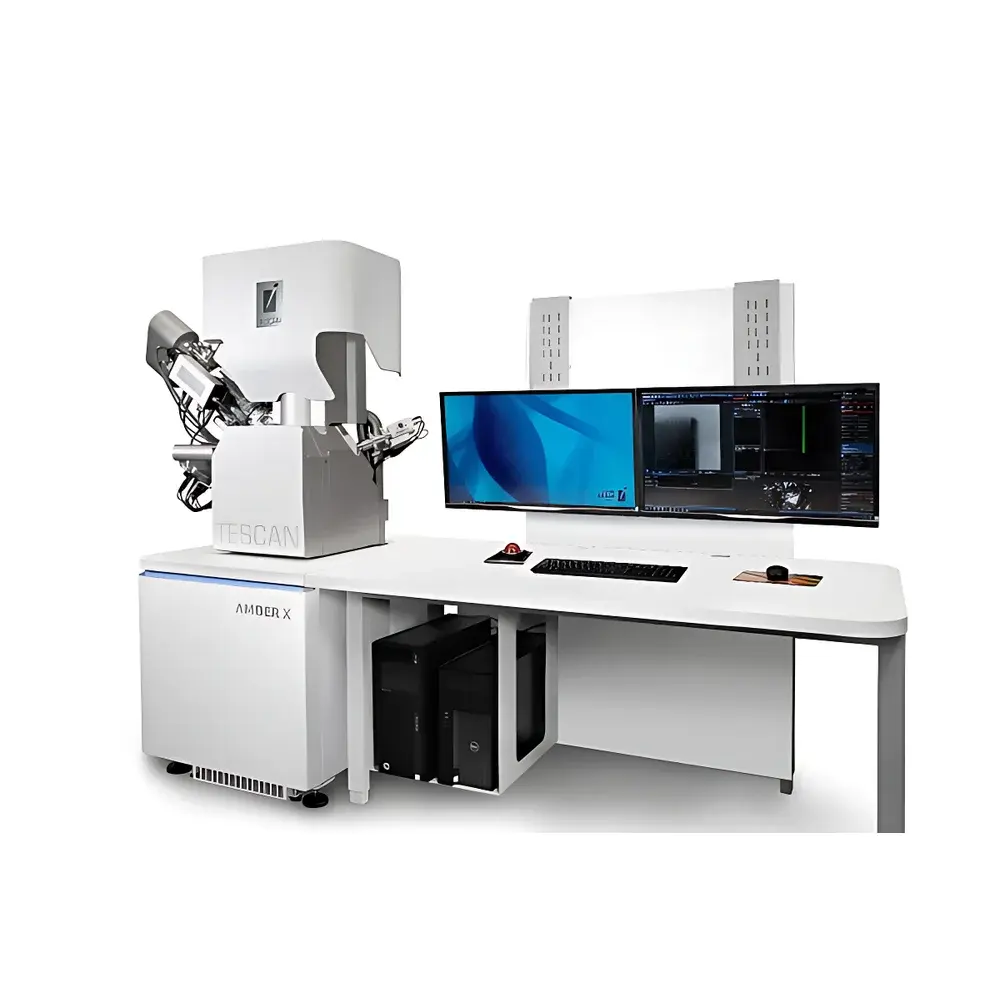
TESCAN AMBER X Xenon Plasma FIB-SEM DualBeam Microscope
| Brand | TESCAN |
|---|---|
| Origin | Czech Republic |
| Manufacturer Type | Original Equipment Manufacturer (OEM) |
| Origin Category | Imported Instrument |
| Model | TESCAN AMBER X |
| Price Range | USD 1.3–2.0 million |
Overview
The TESCAN AMBER X is a high-performance dual-beam platform integrating a xenon (Xe) plasma focused ion beam (FIB) column with a BrightBeam™ ultra-high-resolution (UHR) field-emission scanning electron microscope (FE-SEM). Unlike conventional gallium (Ga)-based FIB-SEM systems, the AMBER X leverages the physical properties of xenon — a chemically inert, heavy noble gas — to deliver high-current, large-area ion milling with minimal subsurface damage, no ion implantation, and negligible contamination. This enables artifact-free cross-sectioning, TEM lamella preparation, and 3D structural reconstruction of sensitive or reactive materials — including aluminum alloys, battery cathodes, soft polymers, and heterostructured devices — where Ga-induced amorphization or elemental redistribution would compromise analytical validity. The system operates on a coaxial FIB-SEM geometry with precisely aligned ion and electron optical axes, ensuring sub-micrometer registration accuracy between milling and imaging positions. Its non-magnetic electron column design eliminates magnetic field interference, preserving electron beam coherence for stable, high signal-to-noise imaging at sub-nanometer resolution under standard operating conditions.
Key Features
- Xenon plasma ion source delivering >100 nA total current at ≤50 nm probe size, enabling rapid, wide-field milling (up to 1 mm wide cross-sections) with low sputter yield variability.
- BrightBeam™ FE-SEM column featuring a fully demagnetized objective lens, optimized for zero-field imaging of magnetic and beam-sensitive specimens without image distortion.
- In-column secondary electron (SE) and backscattered electron (BSE) detectors positioned at the final lens aperture, providing simultaneous topographic and compositional contrast with high collection efficiency at the FIB-SEM coincident point.
- Optimized beam overlap calibration routine with real-time drift compensation, supporting quantitative multi-modal tomography (FIB-SEM serial sectioning + EDS/EBSD correlation).
- Large-stage navigation capability with 150 mm × 150 mm travel range and integrated optical camera for macro-to-micro sample coordination.
- Modular hardware architecture accommodating in-chamber EDS, EBSD, CL, and time-of-flight SIMS detectors without compromising FIB access or vacuum integrity.
Sample Compatibility & Compliance
The AMBER X is engineered for broad material compatibility — from conductive metals and ceramics to insulating oxides, organic thin films, and cryo-preserved biological composites. Its low-energy Xe⁺ ion interaction minimizes knock-on damage and eliminates Ga incorporation, making it compliant with ASTM E2967 (Standard Guide for FIB Sample Preparation) and ISO/IEC 17025 requirements for traceable microstructural analysis. The system supports full GLP/GMP workflow integration via audit-trail-enabled software logging and meets essential requirements for FDA 21 CFR Part 11 compliance when deployed with validated Essence™ configuration protocols. Vacuum architecture maintains base pressure 48 h continuous operation).
Software & Data Management
TESCAN Essence™ is a modular, role-based control platform built on a deterministic real-time kernel. Its GUI allows users to define custom workflows — from automated cross-sectioning scripts to batch-mode 3D reconstruction pipelines — with parameter inheritance, version-controlled protocol libraries, and metadata-rich HDF5 output. All imaging, milling, and detector data are timestamped and linked to instrument configuration logs, enabling full traceability for regulatory submissions. Raw data export supports open formats (TIFF, MRC, EMDB-compatible stacks) and integrates with third-party reconstruction tools (Avizo, Dragonfly, TomoJ). Remote monitoring and collaborative annotation are supported via secure TLS-encrypted web interface with multi-user permission tiers.
Applications
- High-fidelity 3D microstructure quantification in additively manufactured alloys and porous battery electrodes.
- Contamination-free cross-sectioning of Al-based interconnects and Cu/low-k dielectrics for semiconductor failure analysis.
- Serial sectioning of heterogeneous catalysts and MOFs without beam-induced phase segregation.
- Correlative FIB-SEM/EDS/EBSD mapping of grain boundary networks in polycrystalline photovoltaic absorbers.
- Preparation of damage-free lamellae from cryo-FIB milled biological tissues for cryo-TEM validation.
- Large-area site-specific trenching for MEMS packaging inspection and wafer-level metrology.
FAQ
What distinguishes xenon plasma FIB from gallium liquid metal ion sources?
Xenon plasma FIB provides higher total ion current, larger probe sizes, and significantly reduced ion implantation depth compared to Ga⁺ sources — eliminating chemical contamination and lattice disorder in beam-sensitive materials.
Can the AMBER X perform automated 3D tomography?
Yes — its synchronized beam control, drift-compensated stage, and Essence™ scripting engine support unattended serial sectioning with sub-50 nm slice thickness repeatability and automated alignment correction.
Is the system compatible with in-situ heating or cooling stages?
The AMBER X chamber accommodates commercially available heating, cooling, and mechanical testing stages with full FIB-SEM access and electrical feedthroughs up to 12 channels.
How is data integrity ensured during long-duration experiments?
All acquisition parameters, vacuum logs, and beam alignments are embedded in raw data files; optional hardware watchdog timers trigger emergency shutdown if environmental thresholds are exceeded.
Does TESCAN provide application support for method development?
Yes — TESCAN’s Application Scientists offer remote and on-site workflow optimization, including SOP generation, metrology validation, and regulatory documentation support tailored to ISO 17025 or ICH Q5E frameworks.





