
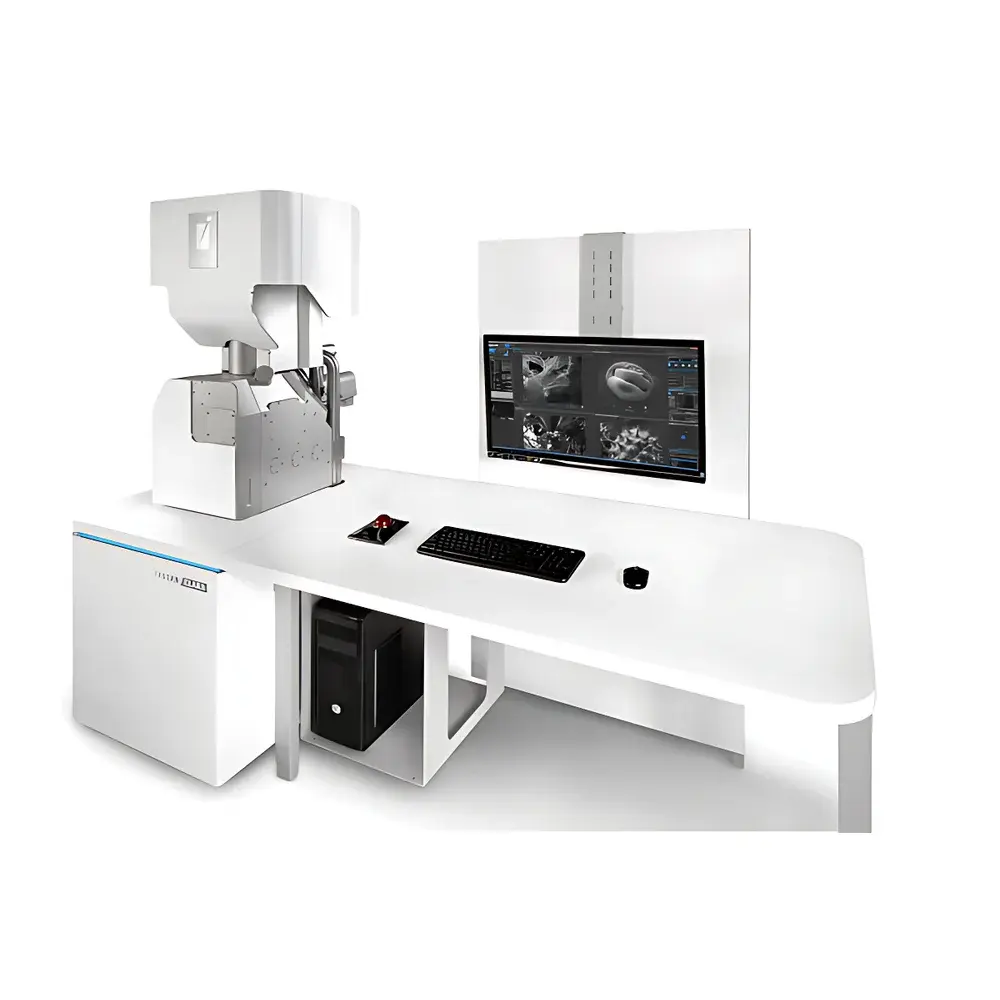
TESCAN CLARA Ultra-High-Resolution Field-Emission Scanning Electron Microscope
| Brand | TESCAN |
|---|---|
| Origin | Czech Republic |
| Manufacturer Type | Original Equipment Manufacturer (OEM) |
| Instrument Type | Floor-Standing SEM |
| Electron Source | Thermal Field-Emission Gun (TFEG) |
| Secondary Electron Resolution | 0.9 nm @ 15 kV |
| Magnification Range | 2× to 2,000,000× |
| Accelerating Voltage | 200 V – 30 kV (with deceleration mode down to 50 V) |
| Backscattered Electron Resolution | 2.0 nm @ 30 kV (in low-vacuum mode) |
Overview
The TESCAN CLARA is an ultra-high-resolution field-emission scanning electron microscope engineered for precision nanoscale imaging and multi-modal analytical characterization across materials science, semiconductor metrology, life sciences, and advanced manufacturing. Based on TESCAN’s proprietary BrightBeam™ SEM column architecture, the CLARA integrates a variable-ratio electrostatic–electromagnetic hybrid objective lens — a breakthrough design eliminating external magnetic stray fields while enabling sub-nanometer resolution at low landing voltages (down to 50 V in deceleration mode). This architecture ensures high-fidelity imaging of beam-sensitive, non-conductive, and ferromagnetic specimens without charge compensation or conductive coating. The instrument operates under high-vacuum, low-vacuum, and variable-pressure conditions, supporting diverse sample environments without compromising signal fidelity or spatial resolution.
Key Features
- BrightBeam™ column with electrostatic–electromagnetic hybrid objective lens: zero magnetic leakage, enabling high-resolution imaging of magnetic materials and beam-sensitive biological specimens.
- In-Column Detector System: Four next-generation detectors — including energy-filtered Multidetector™ (SE/BSE separation via energy gating), axial detector (high-efficiency SE/BSE collection across full voltage range), and two dedicated BSE channels — deliver nine distinct imaging modes from a single acquisition.
- In-Flight Beam Tracing™ technology: real-time electron beam path monitoring and dynamic correction for optimal focus, astigmatism compensation, and drift stability during long-duration acquisitions.
- Intermediate Lens™ system: enhances depth of field and signal-to-noise ratio at high magnifications while maintaining beam coherence and probe current stability up to 400 nA.
- Large-volume specimen chamber (Ø 220 mm × H 270 mm) with >20 standardized expansion ports for in situ stages, cryo-transfer systems, micro-manipulators, and multi-technique integration (e.g., Raman, EDS, EBSD, CL, EBL).
- Modular hardware platform compatible with TESCAN-native and third-party analytical modules — including energy-dispersive X-ray spectroscopy (EDS), electron backscatter diffraction (EBSD), cathodoluminescence (CL), electron beam lithography (EBL), and correlative light-electron microscopy (CLEM) via CORAL™.
Sample Compatibility & Compliance
The CLARA supports broad sample compatibility — from insulating polymers and hydrated biological tissues to high-aspect-ratio nanostructures and bulk ferromagnetic alloys. Its low-voltage imaging capability (50–500 V landing energy) minimizes surface charging and radiation damage, making it suitable for routine GLP/GMP-compliant quality control workflows in pharmaceutical, medical device, and semiconductor industries. The system complies with IEC 61000-6-3 (EMC emissions), ISO 14644-1 Class 5 cleanroom recommendations for installation, and supports audit-ready operation per FDA 21 CFR Part 11 when configured with TESCAN Flow™ and SharkSEM™ with electronic signature and full audit trail functionality.
Software & Data Management
The CLARA is controlled by Essence™ — a modular, role-based software platform designed for intuitive operation across user expertise levels. Core capabilities include: automated image stitching (Mosaic), 3D collision modeling for stage navigation, LUT/histogram-based contrast optimization, calibrated dimensional metrology (including GD&T-compliant tolerance measurement), and offline processing via TESCAN Flow™. Optional modules extend functionality to correlative microscopy (CORAL™), remote operation (SharkSEM™), time-lapse in situ analysis, and AI-assisted feature recognition (via third-party integration). All software components log metadata, parameter history, and operator actions in accordance with ALCOA+ principles for traceability and regulatory review.
Applications
- Nanomaterial characterization: graphene flake thickness mapping, quantum dot dispersion analysis, nanoparticle size distribution quantification.
- Semiconductor failure analysis: gate oxide defect inspection, trench profile metrology, BEOL interconnect void detection at <1 nm scale.
- Life sciences: uncoated freeze-fractured tissue sections, immunogold-labeled cellular ultrastructure, correlative CLEM workflows.
- Geosciences & metallurgy: phase identification via integrated EBSD/EDS, grain boundary mapping, inclusion analysis in high-strength alloys.
- Additive manufacturing: powder morphology screening, build-layer porosity assessment, post-processing crack propagation tracking.
FAQ
What vacuum modes does the TESCAN CLARA support?
The CLARA operates in high-vacuum (10⁻⁷–10⁻⁸ mbar), low-vacuum (10–133 Pa), and variable-pressure modes — enabling direct imaging of non-conductive and hydrated samples without sputter coating.
Can the CLARA be upgraded with EDS and EBSD simultaneously?
Yes — the large chamber and standardized port layout allow concurrent installation of multiple analytical detectors, including silicon drift detector (SDD)-based EDS and high-sensitivity EBSD cameras with pattern indexing speeds exceeding 1,000 fps.
Is the system compliant with FDA 21 CFR Part 11 requirements?
When equipped with TESCAN Flow™, SharkSEM™ with electronic signatures, and audit-trail-enabled Essence™ modules, the CLARA meets electronic record and signature requirements for regulated laboratories.
What is the maximum beam current available at high resolution?
The CLARA delivers up to 400 nA probe current while maintaining sub-nanometer resolution — critical for high-speed elemental mapping and low-noise EBSD pattern acquisition.
Does the CLARA support automated stage navigation for large-area surveys?
Yes — the motorized 5-axis stage (X/Y/Z/T/R) integrates with Mosaic™ software for fully automated tile-based imaging, coordinate referencing, and ROI-based re-acquisition across mm-scale samples.





