
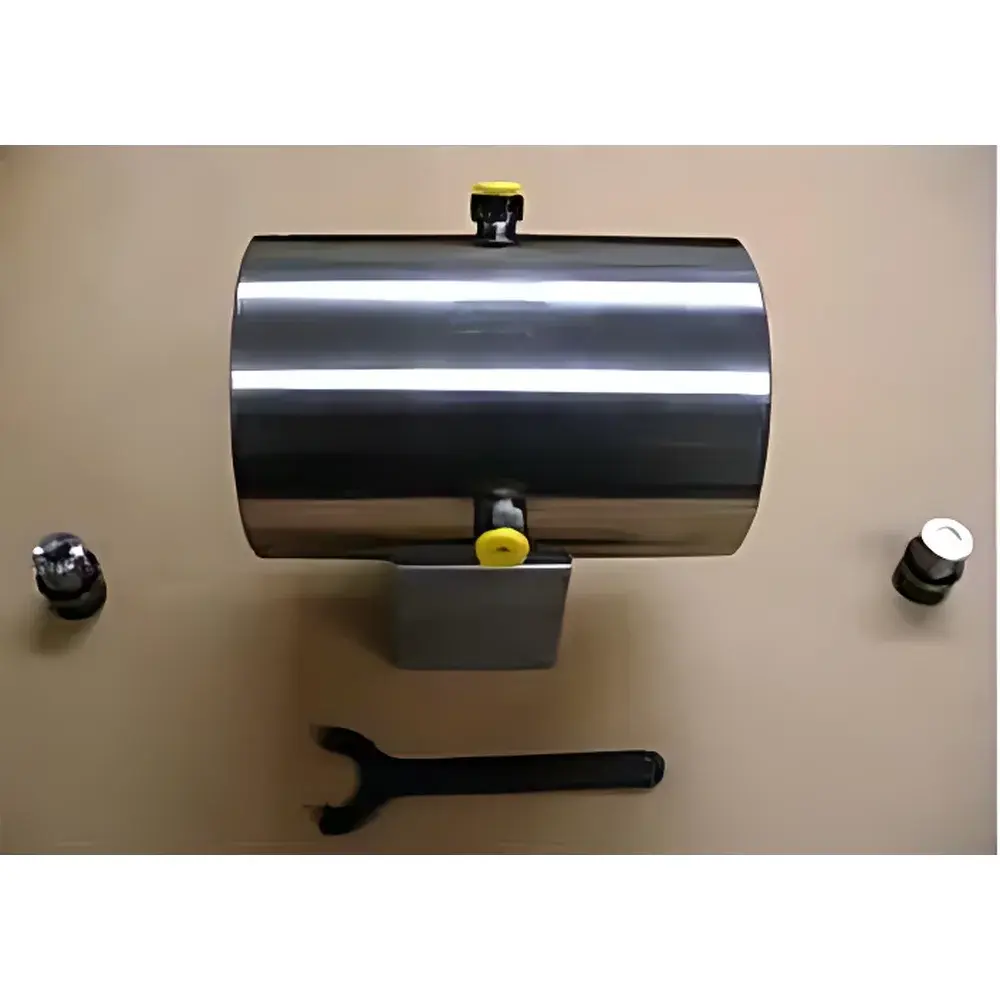
Newport 4-1-1552 High-Pressure Optical Absorption Cell
| Brand | Newport |
|---|---|
| Origin | USA |
| Body Material | 316 Stainless Steel |
| Optical Path Length | 1 cm |
| Clear Aperture | 11/16 in (≈17.5 mm) |
| Pressure Rating | 100,000 psi (689 MPa) |
| Port Configuration | Two 1/4-in SUPERPRESSURE fittings, orthogonal (90° apart) |
| Application | In-situ UV-Vis-NIR spectroscopy under extreme pressure conditions |
| Compliance | Designed for integration with ASTM E275, ISO 1042, and USP <857> spectrophotometric validation protocols |
Overview
The Newport 4-1-1552 High-Pressure Optical Absorption Cell is an engineered optical flow-through cell designed for quantitative absorbance measurements of liquids, gases, and supercritical fluids under static pressures up to 100,000 psi (689 MPa). Based on the principle of Beer–Lambert law spectroscopy, this cell enables real-time, in situ transmission measurements in high-pressure reaction monitoring, geochemical simulation, catalytic process development, and materials phase-transition studies. Its monolithic 316 stainless steel construction ensures mechanical integrity, corrosion resistance, and thermal stability across extended temperature ranges (–20 °C to +150 °C with appropriate seals), while maintaining optical path length fidelity at full rated pressure. Unlike standard quartz cuvettes, the 4-1-1552 integrates precision-machined SUPERPRESSURE ports—compatible with Swagelok®-style 1/4-in tube fittings—enabling direct coupling to high-pressure fluid delivery systems, autoclaves, or diamond anvil cell auxiliary manifolds.
Key Features
- Robust 316 stainless steel body with electropolished internal surfaces to minimize scattering and adsorption artifacts
- Precisely controlled 1.0 cm optical path length, certified via interferometric verification per ISO 10110-5
- 11/16-inch (17.5 mm) clear aperture accommodates standard collimated beams from benchtop UV-Vis-NIR spectrophotometers (e.g., Agilent Cary, Shimadzu UV-2700, PerkinElmer Lambda 950)
- Orthogonal 1/4-in SUPERPRESSURE ports enable bidirectional flow configuration or sealed static measurement; port geometry complies with ASME B16.11 forged fitting standards
- Pressure-rated O-ring grooves accommodate Viton®, Kalrez®, or metal C-rings depending on chemical compatibility and temperature requirements
- No internal windows or bonded interfaces—optical windows are mounted externally using kinematic, strain-free compression fixtures to preserve wavefront flatness (λ/10 @ 633 nm)
Sample Compatibility & Compliance
The 4-1-1552 supports a broad range of sample chemistries including aqueous electrolytes, organic solvents (e.g., methanol, THF, supercritical CO₂), hydrogen sulfide-containing brines, and reactive halogenated media—provided seal material and window substrate (fused silica, sapphire, or CaF₂) are selected accordingly. It meets mechanical design criteria outlined in ASME BPVC Section VIII, Division 2, and is routinely deployed in laboratories adhering to GLP and GMP frameworks. When operated with traceable pressure transducers and NIST-traceable spectrophotometer calibration standards, the system satisfies data integrity requirements of FDA 21 CFR Part 11 for regulated absorbance quantification. Documentation packages include as-built dimensional reports, hydrostatic test certificates (150% of rated pressure), and material mill test reports (MTRs) per ASTM A240.
Software & Data Management
While the cell itself is hardware-only, its integration into automated workflows is supported via third-party instrument control platforms including LabVIEW™ (NI), MATLAB Instrument Control Toolbox, and Python-based libraries (e.g., PyVISA, SpectraPy). When paired with spectrometers offering analog voltage output or Ethernet-enabled spectral streaming, time-resolved absorbance kinetics (A vs. t) can be synchronized with pressure ramp profiles using timestamped acquisition. Audit trails—including pressure setpoint, actual reading, wavelength, integration time, and detector gain—are exportable in CSV or HDF5 format for long-term archival and 21 CFR Part 11-compliant review.
Applications
- In situ monitoring of high-pressure polymerization kinetics in ethylene/propylene systems
- Quantitative speciation analysis of Fe²⁺/Fe³⁺ redox couples in hydrothermal vent simulants
- Bandgap determination of semiconductor nanocrystals under isochoric compression
- Validation of thermodynamic models for CO₂–H₂O–NaCl phase equilibria via dissolved species absorbance
- Calibration transfer between high-pressure reference cells and process spectrometers in petrochemical online analyzers
FAQ
What optical window materials are compatible with the 4-1-1552 cell?
Fused silica (190–2500 nm), sapphire (150–5500 nm), and calcium fluoride (120–8000 nm) are standard options; custom AR-coated variants available upon request.
Can the cell be used for dynamic pressure cycling?
Yes—rated for ≥10,000 full-pressure cycles when operated within recommended temperature and chemical compatibility limits; fatigue life validated per ASTM E606.
Is the 1 cm path length maintained under 100,000 psi loading?
Yes—finite element analysis (FEA) and experimental metrology confirm axial deformation < ±0.3 µm at full rating, preserving Beer–Lambert linearity to ±0.2% absorbance error.
Does Newport provide calibration services for this cell?
Newport offers optional factory verification of optical path length and pressure rating; NIST-traceable absorbance calibration requires separate spectrophotometer qualification per ISO/IEC 17025-accredited labs.
How is leak integrity verified prior to operation?
Hydrostatic testing at 150% of maximum working pressure (150,000 psi) is performed pre-shipment; end users must conduct helium mass spectrometer leak checks (<1×10⁻⁹ std cm³/s) after window installation and port tightening.



