
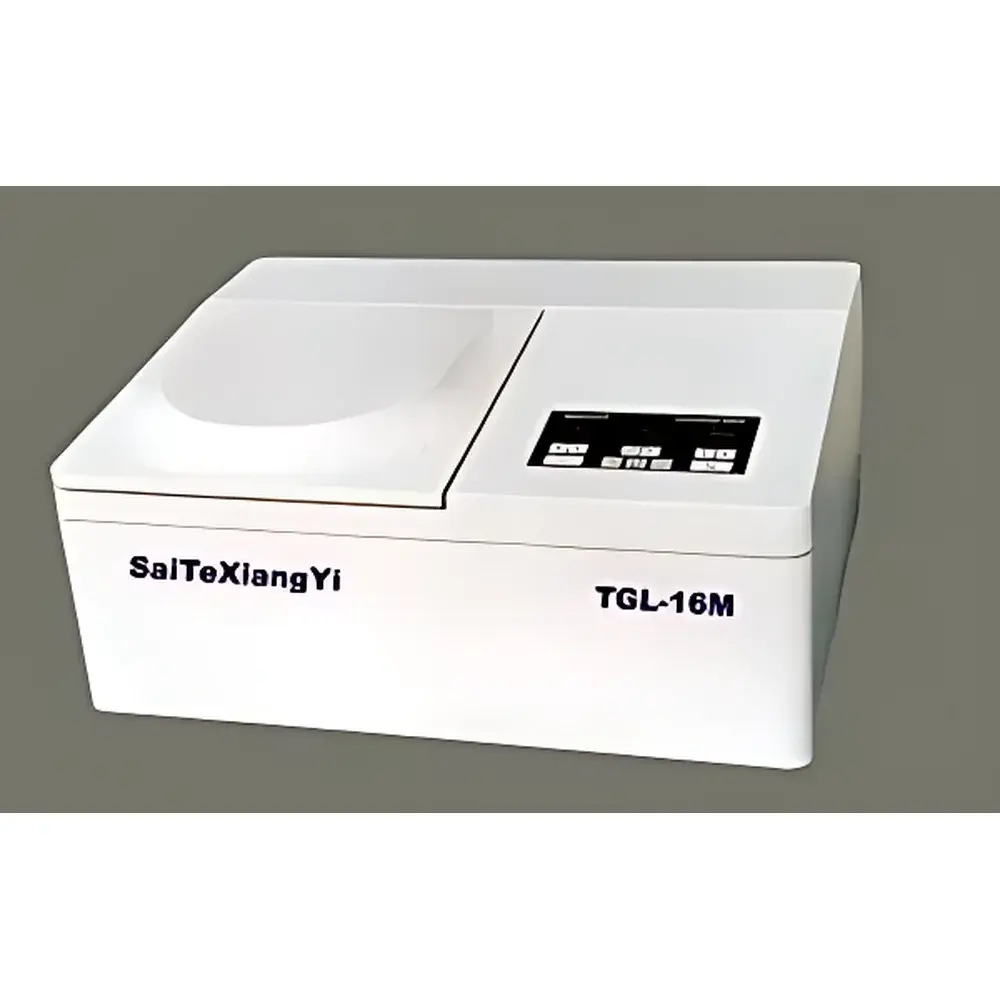
TGL-16M Desktop High-Speed Refrigerated Centrifuge
| Origin | Shanghai, China |
|---|---|
| Manufacturer Type | Authorized Distributor |
| Origin Category | Domestic (China) |
| Model | TGL-16M |
| Pricing | Available Upon Request |
| Speed Range | 10,000–30,000 rpm (rated max: 16,000 rpm) |
| Max RCF | 19,800 × g |
| Temperature Control | −20 °C to +40 °C |
| Timer Range | 0–99 min |
| Power Supply | AC 220 V, 50 Hz, 15 A |
| Dimensions (L×W×H) | 600 × 470 × 330 mm |
| Weight | 70 kg |
| Rotor Configurations | No.1 Angle Rotor (1.5 mL × 12, 16,000 rpm, 17,800 × g) |
Overview
The TGL-16M Desktop High-Speed Refrigerated Centrifuge is an engineered solution for precise, reproducible separation of biological and chemical samples under controlled thermal conditions. Designed for routine and advanced laboratory workflows—including nucleic acid purification, protein pelleting, cell fractionation, and microvolume sample concentration—the instrument operates on the principle of sedimentation force generation via high-speed rotational acceleration. Its refrigerated architecture maintains sample integrity during extended runs by actively regulating chamber temperature between −20 °C and +40 °C, minimizing thermal degradation of thermolabile analytes such as enzymes, antibodies, and RNA. The centrifuge employs a brushless DC motor for low-vibration, maintenance-free operation and integrates real-time RCF (Relative Centrifugal Force) calculation based on rotor geometry and rotational speed—ensuring method transferability across laboratories and compliance with standardized protocols.
Key Features
- Microprocessor-based control system with digital LED display for simultaneous monitoring of speed (rpm), RCF, time, and temperature
- Capacitive touch panel interface supporting programmable multi-step protocols with up to 99-minute timer resolution
- Integrated electronic door lock with interlock verification—prevents lid opening during operation and halts rotation immediately upon detection of unauthorized access
- Comprehensive safety architecture: automatic rotor imbalance detection, overspeed cutoff, overtemperature shutdown, and lid-open emergency stop
- Five interchangeable rotor options optimized for diverse sample formats—from 1.5 mL microtubes to 48-well ELISA plates—enabling method flexibility without hardware reconfiguration
- Compact desktop footprint (600 × 470 × 330 mm) with robust steel chassis and vibration-damping feet for stable performance in shared lab environments
Sample Compatibility & Compliance
The TGL-16M supports a broad range of primary sample containers, including polypropylene and polycarbonate microcentrifuge tubes (0.2–10 mL), PCR strips, and standard 96-well and 48-well microplates. All rotors are certified for autoclaving (121 °C, 20 min) and comply with ISO 13485–aligned manufacturing practices. While not pre-certified for FDA 21 CFR Part 11, the device’s audit-ready operational logs—including start/stop timestamps, set parameters, and fault events—support GLP/GMP-aligned documentation requirements when integrated into validated laboratory information management systems (LIMS). It meets IEC 61010-1:2010 safety standards for electrical equipment used in laboratory settings.
Software & Data Management
The centrifuge operates independently without external software dependency; however, its parameter logging capability enables manual traceability for quality records. All run data—including target speed, actual RCF, elapsed time, final temperature, and error codes—are retained in non-volatile memory for at least 100 cycles. For laboratories requiring electronic record retention, optional RS-232 or USB interfaces (available upon request) permit export of session logs to CSV-compatible spreadsheets. No proprietary drivers or cloud services are required—ensuring compatibility with air-gapped or regulated IT infrastructures.
Applications
- Isolation of plasmid DNA and genomic DNA from bacterial lysates using high-RCF pelleting (≥17,800 × g)
- Clarification of mammalian cell culture supernatants prior to downstream chromatography or ELISA analysis
- Preparative separation of subcellular organelles (e.g., mitochondria, nuclei) via differential centrifugation protocols
- Routine quality control of vaccine formulations, where temperature-controlled pelleting preserves antigen conformation
- High-throughput sample preparation for mass spectrometry workflows requiring low-volume, high-purity precipitates
- Stabilization of nanomaterial suspensions through controlled aggregation kinetics studies
FAQ
What is the maximum RCF achievable with the TGL-16M, and which rotor delivers it?
The highest certified RCF is 23,755 × g, achieved using Rotor No.2 (1.5 mL × 24) at 16,000 rpm.
Can the TGL-16M maintain −20 °C during continuous operation at maximum speed?
Yes—the refrigeration system is rated for full-load thermal stability across the entire speed and temperature range, verified per ISO 13732-1 thermal mapping guidelines.
Are rotor calibration certificates provided with each unit?
Each rotor is supplied with a factory-verified balance report and geometric specification sheet; NIST-traceable calibration services are available through authorized service partners.
Does the instrument support user-defined rotor identification to prevent mismatch errors?
No—rotor recognition is manual; users must select the correct rotor profile from the menu prior to run initiation to ensure accurate RCF calculation and safety limits.
What maintenance intervals are recommended for long-term reliability?
Brushless motor requires no scheduled servicing; annual inspection of refrigerant integrity, door seal compression, and rotor threads is advised per manufacturer’s technical bulletin TB-TGL-16M-Rev.3.



